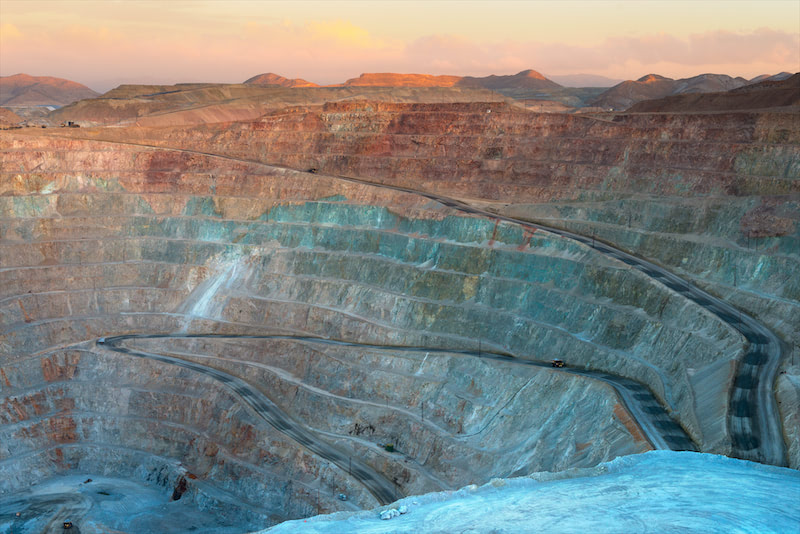
While the second phase of Chinese company's Mirador copper mine in Ecuador remains mired in a 'completed but awaiting approval' deadlock, 10,000 kilometers away in Washington, the President, alongside the Export-Import Bank of the United States, is announcing a historic supply chain security initiative named 'Project Vault.' Between this halt in one place and the start in another, a covert global resource war centered on critical minerals like copper, lithium, cobalt, and gallium is moving from the shadows to the forefront.
Why the 'Final Sprint' Turned into an Endless Wait?
According to public information, the Mirador Phase II project was largely completed as early as May 2025. Light-load testing in July and full-load trial runs in December comprehensively met all standards – all technical and environmental prerequisites were fulfilled. The sole bottleneck remains the administrative step of signing the Mining Contract.
The stated reason is the persistent political volatility in Ecuador: snap elections in 2023, another general election in 2025, a cabinet reshuffle following the president's re-election, and frequent turnovers among senior officials at the Ministry of Energy and Mines. As the company noted, "Personnel changes have significantly impacted policy continuity and administrative efficiency," stalling the already-negotiated contract during the approval process.
America's 'Project Vault': Reshaping Supply Chains with State Power
Just as Mirador Phase II became stuck in 'completed but awaiting approval,' the U.S. executed a strategic pivot with unprecedented force. On February 2, 2026, the Export-Import Bank of the United States, jointly with the White House, launched 'Project Vault' with great fanfare, announcing the creation of a U.S. Strategic Critical Minerals Reserve. This public-private partnership, backed by tens of billions of dollars in direct loans, incorporates rare earth elements, lithium, cobalt, gallium, and even copper into the reserve, explicitly aiming to "reduce dependence on foreign-controlled supply chains."
This is not a simple emergency stockpiling effort but a systemic project covering the entire 'financing-procurement-reserve-supply' chain. Original equipment manufacturers like Boeing and GE Vernova, along with suppliers such as Hartree Partners, Mercuria Americas, and Traxys, quickly mobilized. More symbolically, Ivanhoe Mines is directing germanium and gallium from its Kipushi mine in the DRC straight into the U.S. strategic stockpile; Glencore is in negotiations regarding the sale of a 40% stake in its two key DRC copper-cobalt mines, Mutanda and Kamoto, with the buyer being a critical minerals alliance backed by U.S. capital.
From Resource to Sovereignty: A Battle for 'Anchoring'
While seemingly isolated, these two events converge on a core proposition: critical minerals are being elevated from commodities to strategic assets, and their flow and ownership are being repoliticized.
In the past, resource competition primarily manifested as commercial price wars or battles for market share. Today, from Ecuador to the DRC, from South America to Africa, the 'right to anchor' critical minerals is becoming a focal point of great power competition. Through 'Project Vault,' the U.S. is leveraging its national credit, using capital as a link and its alliance network as support, to rapidly secure upstream resources globally. Meanwhile, Chinese companies, having invested heavily and completed construction in projects like Mirador, now face 'stranded asset' risks due to political shifts in the host country, making it difficult to realize returns.
This isn't simply about being 'targeted' or 'obstructed'; it reflects a profound shift in the logic of international resource governance. When minerals are integrated into national security strategies, and when supply chain resilience is prioritized over cost efficiency, traditional market-oriented investment models inevitably encounter unprecedented institutional friction.
From Stockpile Mentality to Systemic Competition
Duan Shaofu, Deputy Secretary-General and Director of the Heavy Metals Department and Mineral Resources Office of the China Nonferrous Metals Industry Association, recently suggested "expanding China's national copper strategic reserve and exploring commercial reserve mechanisms." This is a sober response to this new reality. However, it must be recognized that the resource competition is no longer a simple 'stockpiling race' but a comprehensive contest of systemic capabilities.
The underlying logic of America's 'Project Vault' is not total state control, but leveraging policy-based finance to mobilize private capital, integrating allied resources through diplomatic and security tools, and driving upstream extraction through end-user demand. It's a comprehensive toolkit combining finance, diplomacy, industry, and security.
For China, while enhancing strategic reserves is necessary, a more urgent task is to build a globally resilient resource acquisition system. This requires not only a dual-track approach of national and commercial reserves but also exploring how, within a complex geopolitical environment, to hedge against systemic risks from political shifts in individual countries through more flexible entities, diversified capital structures, and deeper local integration.
As critical minerals become the 'critical anchor' in great power rivalry, companies going global are no longer just investors; they are the forward-deployed sensors for national strategic resource security. Safeguarding these sensors requires far more than a simple contract – it demands a complete system of institutional design and global coordination capabilities deeply interwoven with national strategy.
The vault has been opened; the game is afoot. Whoever gains the upper hand in this battle for 'anchoring' will grasp the key to the future of key industries and unlock the door to pioneering industrial upgrading and transformation.