A Panoramic View of Solid-State Battery Anodes: The Triple Game of Technology, Capacity, and Market

Published: Feb 9, 2026 22:06
The industrialization of solid-state battery anodes follows a clear technological progression, closely linked to the maturity of the electrolyte system: first, compatibility and improvement—silicon-based/composite anodes; second, upgrading and breakthroughs—pre-lithiation/composite lithium metal anodes; and third, the ultimate goal—pure lithium metal anode capacity deployment.
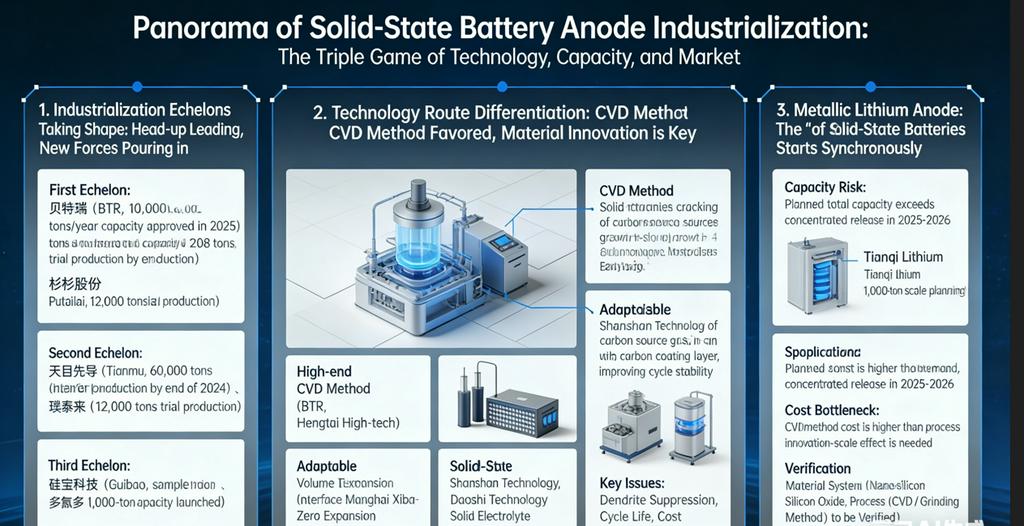
The industrialization of solid-state battery anodes follows a clear technological progression, closely linked to the maturity of the electrolyte system: first, compatibility and improvement—silicon-based/composite anodes; second, upgrading and breakthroughs—pre-lithiation/composite lithium metal anodes; and third, the ultimate goal—pure lithium metal anode capacity deployment.


According to SMM forecasts, all-solid-state battery shipments will reach 13.5 GWh by 2028, while semi-solid-state battery shipments will reach 160 GWh. Global lithium-ion battery demand is projected to reach approximately 2,800 GWh by 2030, with the EV sector's lithium-ion battery demand showing a CAGR of around 11% from 2024 to 2030, ESS lithium-ion battery demand at a CAGR of about 27%, and consumer electronics lithium battery demand at a CAGR of roughly 10%. Global solid-state battery penetration is estimated at about 0.1% in 2025, with all-solid-state battery penetration expected to reach around 4% by 2030, and global solid-state battery penetration potentially approaching 10% by 2035.

**Note:** For further details or inquiries regarding solid-state battery development, please contact:
Phone: 021-20707860 (or WeChat: 13585549799)
Contact: Chaoxing Yang. Thank you!

Data Source Statement: Except for publicly available information, all other data are processed by SMM based on publicly available information, market communication, and relying on SMM‘s internal database model. They are for reference only and do not constitute decision-making recommendations.

For any inquiries or to learn more information, please contact: lemonzhao@smm.cn
For more information on how to access our research reports, please contact:service.en@smm.cn
Related News
[SMM Analysis] Ternary Cathode Material Prices Pull Back, but Producers Show Limited Willingness to Restock
1 min ago
[SMM Analysis] Ternary Cathode Material Prices Pull Back, but Producers Show Limited Willingness to Restock
Read More
[SMM Analysis] Ternary Cathode Material Prices Pull Back, but Producers Show Limited Willingness to Restock
[SMM Analysis] Ternary Cathode Material Prices Pull Back, but Producers Show Limited Willingness to Restock
1 min ago
[SMM Analysis] Downstream Acceptance of Raw Materials Relatively Weak, and Ternary Cathode Precursor Prices Edged Down
16 mins ago
[SMM Analysis] Downstream Acceptance of Raw Materials Relatively Weak, and Ternary Cathode Precursor Prices Edged Down
Read More
[SMM Analysis] Downstream Acceptance of Raw Materials Relatively Weak, and Ternary Cathode Precursor Prices Edged Down
[SMM Analysis] Downstream Acceptance of Raw Materials Relatively Weak, and Ternary Cathode Precursor Prices Edged Down
This week, ternary cathode precursor prices declined slightly. Raw materials, nickel sulphate prices edged up today, cobalt sulphate prices declined again, and manganese sulphate prices held steady.
16 mins ago
Premier Li Stresses Green, Low-Carbon Economy Push with Hydrogen Energy Focus
38 mins ago
Premier Li Stresses Green, Low-Carbon Economy Push with Hydrogen Energy Focus
Read More
Premier Li Stresses Green, Low-Carbon Economy Push with Hydrogen Energy Focus
[SMM Hydrogen Energy Express] On March 5, Premier Li Qiang delivered the government work report at the Fourth Session of the 14th National People’s Congress, emphasizing that every effort must be made to advance the development of a green, low-carbon economy. Specific measures include: improving relevant policies to promote green, low-carbon development; carrying out actions to improve quality, reduce costs, and cut carbon emissions in key industries, and further advancing the development of zero-carbon industrial parks and factories; establishing a national low-carbon transition fund to actively foster emerging growth drivers such as hydrogen energy and green fuels; implementing strong and effective controls over high energy-consuming and high-emission projects, accelerating the phase-out of outdated capacity, while supporting innovation and application of green, low-carbon technology and equipment; improving the mechanism for managing total resource volumes and the comprehensive conservation system, and strengthening the recycling and utilization of renewable resources.
38 mins ago