A Panoramic View of Solid-State Battery Anodes: The Triple Game of Technology, Capacity, and Market

Published: Feb 9, 2026 22:06
The industrialization of solid-state battery anodes follows a clear technological progression, closely linked to the maturity of the electrolyte system: first, compatibility and improvement—silicon-based/composite anodes; second, upgrading and breakthroughs—pre-lithiation/composite lithium metal anodes; and third, the ultimate goal—pure lithium metal anode capacity deployment.
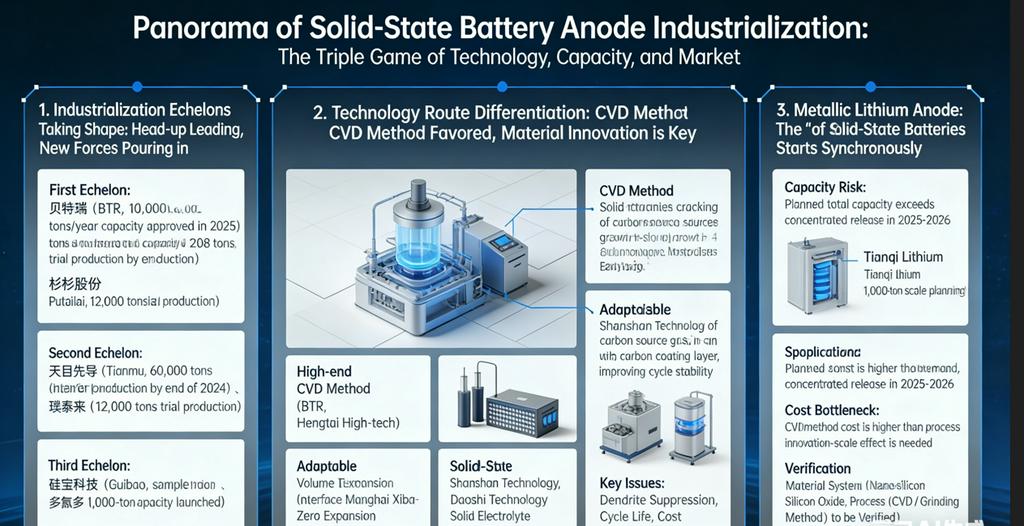
The industrialization of solid-state battery anodes follows a clear technological progression, closely linked to the maturity of the electrolyte system: first, compatibility and improvement—silicon-based/composite anodes; second, upgrading and breakthroughs—pre-lithiation/composite lithium metal anodes; and third, the ultimate goal—pure lithium metal anode capacity deployment.


According to SMM forecasts, all-solid-state battery shipments will reach 13.5 GWh by 2028, while semi-solid-state battery shipments will reach 160 GWh. Global lithium-ion battery demand is projected to reach approximately 2,800 GWh by 2030, with the EV sector's lithium-ion battery demand showing a CAGR of around 11% from 2024 to 2030, ESS lithium-ion battery demand at a CAGR of about 27%, and consumer electronics lithium battery demand at a CAGR of roughly 10%. Global solid-state battery penetration is estimated at about 0.1% in 2025, with all-solid-state battery penetration expected to reach around 4% by 2030, and global solid-state battery penetration potentially approaching 10% by 2035.

**Note:** For further details or inquiries regarding solid-state battery development, please contact:
Phone: 021-20707860 (or WeChat: 13585549799)
Contact: Chaoxing Yang. Thank you!

Data Source Statement: Except for publicly available information, all other data are processed by SMM based on publicly available information, market communication, and relying on SMM‘s internal database model. They are for reference only and do not constitute decision-making recommendations.

For any inquiries or to learn more information, please contact: lemonzhao@smm.cn
For more information on how to access our research reports, please contact:service.en@smm.cn
Related News
Peak Energy Challenges Battery Industry with Salt-Based Technology
6 hours ago
Peak Energy Challenges Battery Industry with Salt-Based Technology
Read More
Peak Energy Challenges Battery Industry with Salt-Based Technology
U.S. startup Peak Energy has pledged to supply up to 4.75GWh of sodium-ion battery energy storage systems to Jupiter Power by 2030, leveraging sodium derived from common table salt as a core material. Last week, the company also reached an agreement to provide 1.5GWh of battery storage capacity to Energy Vault, an AI-focused power infrastructure provider.
6 hours ago
Ford to Adopt 48-Volt Electrical Architecture for Pickups, Following Tesla Cybertruck
6 hours ago
Ford to Adopt 48-Volt Electrical Architecture for Pickups, Following Tesla Cybertruck
Read More
Ford to Adopt 48-Volt Electrical Architecture for Pickups, Following Tesla Cybertruck
Ford Motor said on Feb. 17 (local time) that it will introduce a 48-volt electrical architecture for its pickup trucks, a technology commercialized by Tesla in its Cybertruck. The move is part of Ford’s broader plan to invest $5 billion in next-generation battery electric vehicles, as the automaker seeks to improve efficiency, reduce wiring complexity, and enhance overall vehicle performance through updated electrical systems.
6 hours ago
Samsung C&T to Invest Up to KRW 9.4 Trillion Over Three Years in Energy and Bio
6 hours ago
Samsung C&T to Invest Up to KRW 9.4 Trillion Over Three Years in Energy and Bio
Read More
Samsung C&T to Invest Up to KRW 9.4 Trillion Over Three Years in Energy and Bio
Samsung C&T announced it will invest up to KRW 9.4 trillion over the next three years in future growth sectors, including energy and biotechnology. The company plans to allocate approximately KRW 6.5 trillion to KRW 7.5 trillion to energy and bio-related businesses during the period. In the energy segment, Samsung C&T will focus investments on overseas solar power projects and battery energy storage systems (BESS), as well as renewable energy, hydrogen, and small modular reactors (SMRs) with a power generation capacity of around 300MW.
6 hours ago