Former US Fed Governor Kevin Warsh was nominated by Trump as the next Chair of the US Fed, sparking market speculation that the subsequent monetary policy path may turn marginally hawkish. Recent turmoil in global financial markets, particularly the excessive accumulated profits in the precious metals sector leading to a price collapse among bulls, resulted in a significant correction in nonferrous metals amid selling sentiment. However, with the recovery in risk appetite, copper prices quickly returned to near the January trading range. How has the macro sentiment changed recently? What supports are there for copper prices?
US Dollar Index Stops Falling and Stabilizes, US Fed Policy Path Awaits Clarity
In late January, the US dollar index weakened rapidly, hitting a low of 95.36 on January 27, the lowest since February 2022. Dollar-denominated commodities generally gained momentum, and copper prices were also boosted. The earlier sustained weakness in the US dollar was driven by multiple factors: inflation pressure was relatively small, and the previously released nonfarm unemployment rate had risen, leading markets to bet on two possible interest rate cuts by the US Fed within the year, with the federal funds rate still expected to be lowered. On the other hand, to stimulate economic growth and address midterm election pressures, Trump continuously pressured the US Fed in hopes of further rate cuts. Additionally, due to concerns about the sustainability of US fiscal and debt conditions, coupled with Trump's recent trade measures, European institutions, as the largest creditors, are reassessing the safe-haven attributes of US Treasury assets, with some selling actions observed, continuing to release signals of de-dollarization.
However, the appointment of the new US Fed Chair has cast uncertainty over the future trajectory of the US dollar, serving as a trigger for recent sharp fluctuations in financial markets. Earlier favored candidates held relatively dovish policy stances, advocating more aggressive interest rate cuts to align with Trump's political demands. But the nominee, Warsh, has opposed excessive quantitative easing and long advocated reducing the US Fed's large balance sheet. This has sparked market concerns that subsequent monetary policy expectations may turn marginally hawkish. The US dollar index rebounded from lows, causing turmoil in global financial markets, and commodities faced a sell-off. Warsh's core proposal has been to implement a policy package of "interest rate cuts and balance sheet reduction." Expectations for further US Fed rate cuts this year still exist, but market analysis suggests that, against the backdrop of already fragile overseas demand for US Treasuries, this policy package could trigger market volatility. Hence, investors currently harbor many doubts, and Warsh's related policy proposals after the US Fed leadership change will be the focus of market attention.
Tight Ore Supply Situation Hard to Change, Intensified Resource Competition Among Major Countries
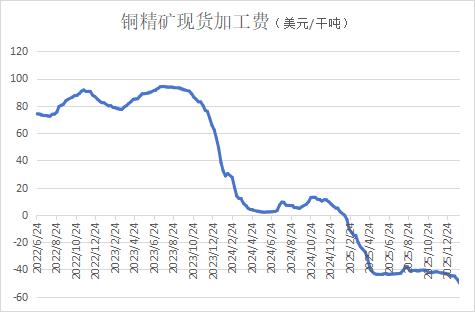
Since the closure of First Quantum's Cobre Panama copper mine, spot TC for domestic copper concentrates has continued to weaken. With production disruptions at world-class copper mines such as Ivanhoe Mines' Kakula, Codelco's El Teniente, and Freeport Indonesia's Grasberg last year, the vulnerability of global copper mine supply has been repeatedly exposed. Global copper mine production growth has struggled to gain momentum, leading to increased bargaining power for overseas miners. The mid-year long-term contracts and 2026 annual long-term contract TCs agreed with domestic smelters have all fallen to zero, undoubtedly worsening the operational conditions for domestic smelters. Since the beginning of the year, disruptions in overseas copper mines have persisted. Although the impact has been limited in scale, spot TC for copper concentrates in China has resumed its decline, now breaking below the $50/dmt threshold. Minor developments on the supply side can easily trigger market fluctuations. Previously, annual production figures and future output forecasts for major global copper mines were successively released. Among these, Southern Copper's production fell short of expectations, and the company plans to shift its production focus toward silver. This news, combined with gains in precious metals and related nonferrous metals, drove SHFE copper to break through previous highs on January 29, further highlighting the market's sensitivity to supply-side disruptions.
Earlier, key resource-rich countries introduced a series of resource protection policies. Coupled with the US's significant tariff hikes on imports last year and recent changes in Venezuela and Greenland this year, the market has become increasingly aware of intensifying competition among major economies for control over strategic resources. Although the results of the US Section 232 investigation previously led to a temporary suspension of tariffs on critical minerals, the US recently unveiled a $12 billion strategic metals acquisition and storage plan. This initiative is intended to procure and stockpile mineral resources for automakers, technology companies, manufacturers, and others, with the reserve scope expected to include rare earths, copper, lithium, and other critical minerals, as well as strategic elements with high price volatility. At the same time, the China Nonferrous Metals Industry Association (CNIA) recently stated at a press conference that it will cooperate with relevant authorities to strictly control new copper smelting projects and expand the scale of national copper strategic reserves. It will also explore the establishment of a commercial reserve mechanism, selecting state-owned key enterprises through fiscal interest subsidies to pilot commercial reserves, and consider including copper concentrates—which have large trade volumes and are easily liquidated—into the reserve scope. These developments reflect the strategic importance that major global economies attach to critical mineral resources, including copper. Reserve-building activities will directly increase physical demand for copper, and as competition for resources among major powers deepens, copper's value as an asset will continue to be highlighted.
Overall, recent speculation about the future policy direction of the US Fed has triggered significant turbulence in financial markets, with copper prices also experiencing volatility. However, due to the accelerated rise in precious metals earlier, which drove other metals to repeatedly reach new periodic or even historical highs, copper prices have been restrained by the rebound in global visible inventory, leading to cautious price movements. Futures prices hovered near the 100,000 yuan mark for over half a month, with downstream acceptance of this price level gradually improving. It was not until the end of last month that copper prices managed to break through. As a result, during this period, copper futures were relatively less influenced by sentiment compared to other varieties. In the absence of additional negative factors, there is limited room for a downward correction. After the release of pessimistic sentiment, copper prices quickly returned to the previous high fluctuation range, supported by strategic reserve competition among major economies. Currently, with the Chinese New Year approaching domestically, the accumulation of inventory is expected to continue. Against the backdrop of weak fundamentals, without additional support, futures prices may continue to fluctuate at highs. In the future, investors will keep their focus on the control of critical mineral resources by major global economies and changes in the policy stance of the new US Fed chair.
(Wenhua Composite)