[SMM Analysis] Tungsten Inventory Depletion in Europe Triggers Panic Buying, Accelerating Global Price Uptrend

Published: Feb 2, 2026 16:35
Last week, surging European tungsten prices, driven by low inventories and panic buying, highlighted a severe supply-demand imbalance. While the scrap market sees a global shift due to high Asian premiums, EQR’s progress in Spain and Australia is strategically reshaping the non-Chinese supply landscape. Despite post-Lunar New Year caution, the upward price trend remains firm.

Smelting Side: European Tungsten Spot Transactions Surged, Offer Center Rapidly Shifted Upwards
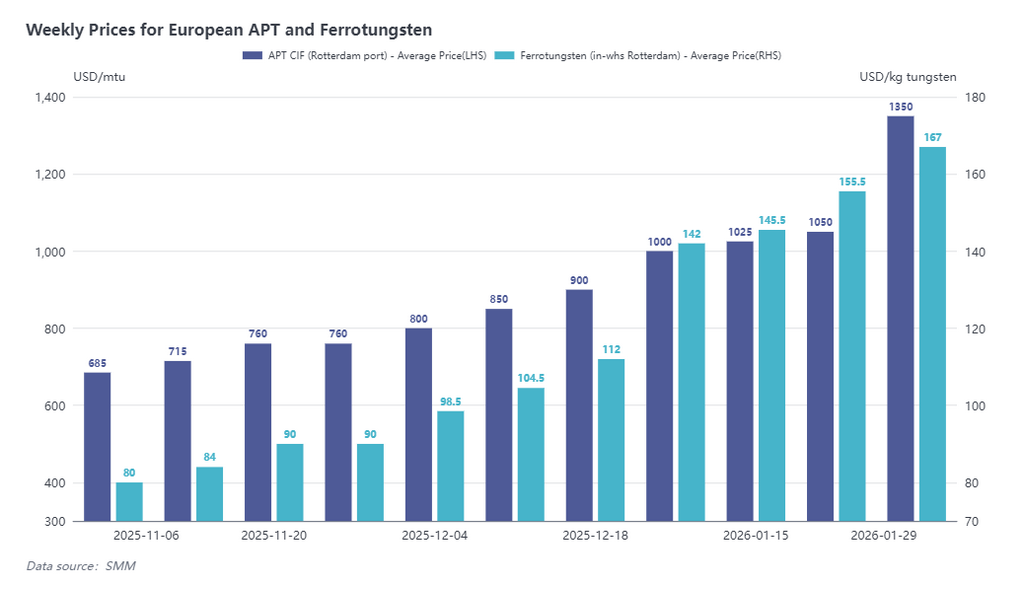
As of last Friday, SMM data showed that the price of APT CIF Rotterdam port was $1,300-1,400/mtu, with an average price of $1,350/mtu, up by $300/mtu compared to January 23; the price of Ferrotungsten (Rotterdam warehouse) was $162-172/kg W, with an average price of $167/kg W, up by $11.5/kg W compared to January 23.

Last week, European tungsten prices entered a phase of rapid increase, primarily driven by critically low downstream inventories, with some buyers making concentrated procurement of spot cargo at high prices. According to an SMM survey, approximately 20 mt of European APT was traded at $1,350/mtu last week, with a small additional volume traded at $1,320/mtu. Although the actual trading volume was very limited, these high-priced transactions significantly boosted the offer sentiment among traders in the European local market and other non-Chinese markets. By the end of last week, APT offers at Rotterdam and Baltimore ports had quickly risen to $1,400/mtu, a price level that has currently deterred most end-users.

A European trader stated, "I have to say, more and more hard metal producers are seeing their inventories bottom out. The issue of raw material shortage is becoming increasingly evident. But currently, no one knows how to solve this problem." The contradiction between tight supply and rigid demand is difficult to alleviate in the short term, and global tungsten prices are expected to continue climbing to new highs.


End-Use and Scrap: European Tungsten Scrap Prices Under Pressure, Asian Market Premiums Significant

For the end-use market and the scrap market, the price increases for products from major European hard metal manufacturers are quite limited, which contrasts sharply with Chinese producers.

According to an SMM survey, the current transaction price for scrap (covering hard metal end mills, drills, inserts, etc., with a tungsten carbide content above 90%) acquired by local European traders from factories is about €75/kg and above. These traders tend to resell the scrap to intermediaries, who then channel it to other higher-priced markets.

Currently, tungsten scrap prices in Asia are already at high levels. In the Indian market, the price for hard metal scrap (WC content 90-92%) is at ₹9,100-9,300/kg (approximately $100/kg), a level close to that in the Chinese market, and it shows a continuous upward trend. Within the Chinese market, the price for scrap tungsten drills has reached $112/kg, while the price for scrap tungsten rods has reached $117/kg. The significant price spreads existing in the global scrap market are highly likely to continue driving a new round of adjustments in global trade flows.


Ore Side: Reshaping the Supply Landscape Outside China, EQR's Multinational Tungsten Mine Project Accelerates

In 2026, global tungsten mine development officially entered an acceleration phase. According to information disclosed by EQ Resources (EQR) in its Q4 2025 earnings briefing, the company's multinational resource footprint has achieved milestone progress. At the Barruecopardo mine in Spain, through continuous optimization of production processes, the resource recovery rate has steadily increased from the initial 40% upon acquisition to nearly 70%, solidifying its strategic position as a core supplier within Europe. Meanwhile, the Mt Carbine mine in Australia successfully overcame challenges in stripping engineering and fully commenced mining operations on the Iilanthi high-grade ore vein, with production expected to achieve leapfrog growth in 2026. Against the backdrop of major global powers intensifying efforts to reshape critical mineral supply chains, the strategic reserve value of tungsten is becoming increasingly prominent, and EQR's accelerated development is becoming a crucial cornerstone for supply diversification in Western markets.

Currently, Chinese tungsten prices continued their strong upward trend in January, with the price of standard-grade wolframite concentrate increasing by 32.4% for the entire month. Constrained by the current supply-demand imbalance, the continued rise in global tungsten prices appears unstoppable. The market is currently in a wait-and-see mode, anticipating the further driving impact of the Chinese New Year holiday in February on price trends.


Data Source Statement: Except for publicly available information, all other data are processed by SMM based on publicly available information, market communication, and relying on SMM‘s internal database model. They are for reference only and do not constitute decision-making recommendations.

For any inquiries or to learn more information, please contact: lemonzhao@smm.cn
For more information on how to access our research reports, please contact:service.en@smm.cn
Related News
[SMM Analysis]  Tungsten Market Shifts to High-Level Shock; Sentiment Turns Cautious Amid Intensified Supply-Demand Game
Mar 14, 2026 17:27
[SMM Analysis] Tungsten Market Shifts to High-Level Shock; Sentiment Turns Cautious Amid Intensified Supply-Demand Game
Read More
[SMM Analysis]  Tungsten Market Shifts to High-Level Shock; Sentiment Turns Cautious Amid Intensified Supply-Demand Game
[SMM Analysis] Tungsten Market Shifts to High-Level Shock; Sentiment Turns Cautious Amid Intensified Supply-Demand Game
SMM March 13: This week, China’s domestic tungsten market exhibited high-level oscillations with intensified supply-demand competition. Multiple mines put products up for auction during the week, but transactions were bleak.As of March 13, tungsten prices remained largely stable, yet market sentiment became extremely divided.
Mar 14, 2026 17:27
Titanium Market Structure Becomes Clearer: Upstream Consolidates at Weak Levels, Midstream and Downstream Strength Expected [SMM Titanium Weekly Review]
Mar 13, 2026 17:49
Titanium Market Structure Becomes Clearer: Upstream Consolidates at Weak Levels, Midstream and Downstream Strength Expected [SMM Titanium Weekly Review]
Read More
Titanium Market Structure Becomes Clearer: Upstream Consolidates at Weak Levels, Midstream and Downstream Strength Expected [SMM Titanium Weekly Review]
[SMM Titanium Weekly Review: Titanium Dioxide Showed Signs of Recovery; Diverging Strength Across the Titanium Industry Chain Market This Week] This week, the titanium industry chain in China showed pronounced structural divergence, with the tug-of-war between sellers and buyers across upstream and downstream segments intensifying and cost pass-through facing obstacles. Overall, the sector was characterized by a combination of weak recovery and localized strong support. Trading in upstream titanium ore and titanium slag was sluggish. Downstream processing enterprises tightly controlled costs, with procurement consistently maintained at a pace driven by rigid demand. Coupled with inventory at high levels across the industry, the raw material end remained under pressure, enterprises’ willingness to operate stayed weak, capacity release was constrained, and the supply-demand imbalance continued to stand out. In the midstream titanium dioxide segment, pressure from elevated costs of raw materials and energy sharply increased production-side strain. Enterprises held prices firm and showed a strong willingness to sell, and while domestic trade demand did not see a noticeable increase in volume—relying only on rigid-demand support—overseas markets still demonstrated a certain degree of resilience, leaving the overall market running relatively strong. The downstream sponge titanium and titanium products segments performed impressively: sponge titanium inventories remained low, and, together with robust downstream restocking demand, top-tier enterprises proactively adjusted prices, with enterprises showing strong confidence in holding prices firm. The titanium products market saw stable supply and demand: the supply-side operating rate was steady, while demand-side differentiation was evident. Civilian applications were mainly driven by rigid-demand restocking, while orders in high-end fields such as aerospace and military industries were steady. The market recovered steadily, and differences in the pace across segments of the industry chain also set the tone for subsequent market dynamics.
Mar 13, 2026 17:49
Manganese-based Battery Materials: Differentiated Trends, Cost-Supported Stability
Mar 13, 2026 13:52
Manganese-based Battery Materials: Differentiated Trends, Cost-Supported Stability
Read More
Manganese-based Battery Materials: Differentiated Trends, Cost-Supported Stability
This week, China’s domestic manganese-based battery materials market has shown a differentiated operation trend. The price of battery-grade manganese tetroxide has slightly declined, the price of electrolytic manganese dioxide has slightly increased, and lithium manganate has maintained a weak balance of supply and demand.
Mar 13, 2026 13:52