[Topik Khusus Impor dan Ekspor Baja SMM] Lompatan Ke Luar di Bawah Restrukturisasi Permintaan Domestik: Analisis Panoramik Logika Mendalam di Balik Lonjakan Ekspor Baja China pada 2025 (Bagian 2)
- Limpahan Kapasitas Sepanjang Jalur Sutra Mengubah Lanskap Ekspor
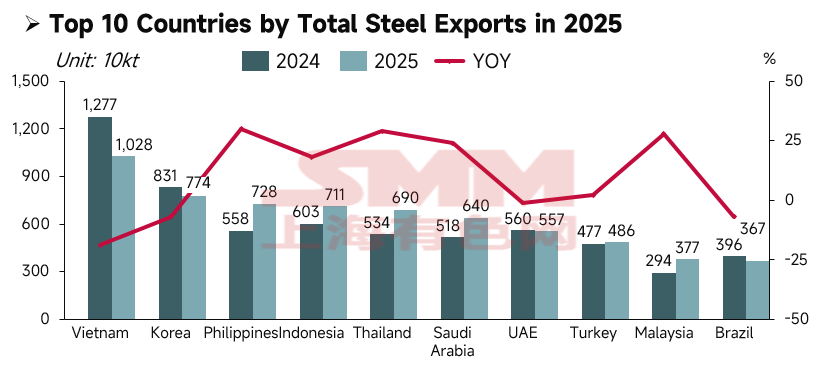
Di antara 10 negara teratas berdasarkan total ekspor baja dari China pada tahun 2025, meskipun ekspor ke Vietnam menurun, volumenya masih dengan kuat menduduki peringkat teratas di antara tujuan ekspor. Alasan penurunannya sudah familiar—tindakan anti-dumping yang diterapkan Vietnam terhadap HRC China pada 2025. Patut dicatat, menurut survei SMM, temuan anti-penyelundupan Vietnam terhadap baja gulungan lebar dari China juga diperkirakan akan difinalisasi pada Februari–Maret 2026, dan pasar saat ini memandang kemungkinan implementasi anti-penyelundupan cukup tinggi, dengan para eksportir sudah mengalami penurunan pesanan yang signifikan. Oleh karena itu, dapat diprediksi dengan masuk akal bahwa ekspor HRC China ke Vietnam selanjutnya akan menurun drastis. Namun, mengingat proyek infrastruktur skala besar di dalam negeri Vietnam, seperti kanal, hotel, dan zona ekonomi khusus, yang masih menciptakan permintaan kaku untuk rebar konstruksi dan kawat baja, Vietnam diperkirakan akan tetap menjadi salah satu tujuan ekspor utama China dalam 3–5 tahun ke depan. Demikian pula, negara-negara ASEAN lainnya seperti Filipina (7,28 juta ton), Indonesia (7,11 juta ton), dan Thailand (6,9 juta ton) juga berada dalam fase urbanisasi yang cepat. Karena biaya produksi baja melalui tungku listrik di pasar lokal mereka relatif tinggi, negara-negara ini masih bergantung pada baja biasa yang hemat biaya dari China. Terutama di Filipina, di mana hambatan perdagangan saat ini relatif rendah, negara tersebut tetap menjadi pasar utama untuk ekspor baja dingin dan baja galvanis China dalam jangka pendek, dengan total volume diperkirakan masih memiliki potensi kenaikan lebih lanjut.
Sumber Data: Administrasi Umum Bea Cukai, SMM
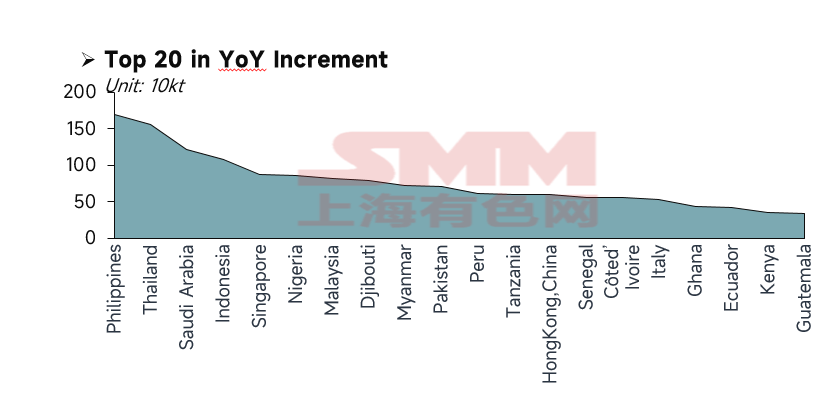
Melihat kembali negara-negara dengan pertumbuhan nominal dan persentase tertinggi dalam ekspor China dari 2024 hingga 2025, titik terang baru di Timur Tengah, seperti Arab Saudi, menonjol. Pada tiga kuartal pertama 2025, nilai ekspor baja China ke Arab Saudi melonjak 41% year-on-year, tingkat pertumbuhan paling signifikan di antara pasar tujuan ekspor utama China. Hal ini didorong oleh pembangunan kota baru dan proyek transisi energi di bawah "Visi 2030" Arab Saudi, yang memicu konsumsi besar-baik pipa baja dan produk panjang untuk infrastruktur. Sementara itu, Afrika dan Amerika Latin telah menjadi lautan biru baru. Selain alasan konstruksi lokal yang disebutkan sebelumnya, "pengalihan balik" akibat gesekan perdagangan juga berperan. Misalnya, dampak dari Mekanisme Penyesuaian Batas Karbon (CBAM) Uni Eropa dan tarif tinggi AS memaksa baja China menarik diri dari pasar berpenghalang tinggi seperti Amerika Utara dan mengalir ke wilayah-wilayah dengan resistensi perdagangan yang relatif lebih rendah.
Sumber Data: Administrasi Umum Bea Cukai, SMM
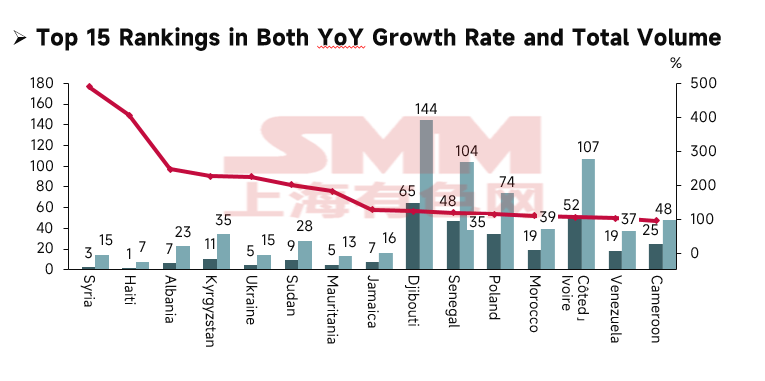
Analisis latar belakang Djibouti dan Senegal, yang mencapai pertumbuhan tinggi dalam tingkat pertumbuhan tahun-ke-tahun dan volume total, mengungkapkan bahwa Djibouti berfungsi sebagai "pusat transit" untuk perdagangan global dan gerbang bagi infrastruktur. Pertumbuhannya terutama berasal dari lokasi geografisnya yang unik dan transformasi strategis sebagai "Gerbang ke Afrika Timur." Dengan perubahan terkini dalam situasi Laut Merah, Djibouti, sebagai simpul penting yang menghubungkan Asia dengan Eropa dan Afrika, mengalami lonjakan permintaan untuk konstruksi fasilitas penyimpanan pelabuhan dan pemindahan muatan. Senegal, di sisi lain, mengalami percepatan industrialisasi yang didorong oleh penemuan energi. Pertumbuhan pesatnya erat kaitannya dengan pengembangan minyak dan gas skala besar serta infrastruktur transportasi. Tahun 2024 merupakan tahun pivotal bagi Senegal untuk bergabung dalam jajaran "produsen minyak dan gas." Proyek-proyek seperti ladang gas Greater Tortue Ahmeyim membutuhkan sejumlah besar pipa baja berkualitas tinggi, baja untuk platform pengeboran, dan fasilitas penyimpanan. Melalui proyek ini, Senegal bergerak menuju tahap baru kemandirian energi, mengonsolidasikan peran kuncinya dalam transisi energi global.
Sumber Data: Administrasi Umum Bea Cukai, SMM
- Kemajuan Dual-Track "Peningkatan Kualitas" Produk Jadi dan "Ekspansi Volume" Produk Setengah Jadi
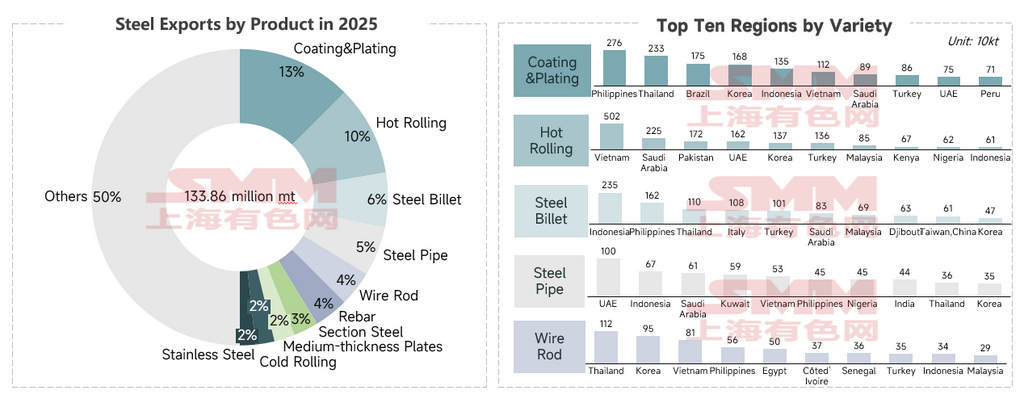
Sumber Data: Administrasi Umum Bea Cukai, SMM
Rincian ekspor baja China pada tahun 2025 mengungkapkan karakteristik inti: polarisasi ekstrem di antara kategori produk, mencerminkan dampak ganda dari pergeseran pusat manufaktur global dan hambatan proteksionisme perdagangan. ① Total volume ekspor lembaran berlapis dan galvanis melebihi 31,09 juta ton, menjadikannya kategori tunggal terbesar dalam ekspor baja China dan "batu pemberat" yang tak terbantahkan dalam lanskap produk ekspor. Lembaran berlapis dan galvanis (seperti lembaran galvanis, lembaran berlapis warna, dll.) banyak digunakan dalam peralatan rumah tangga, braket pemasangan panel surya, dan infrastruktur struktur baja ringan. China telah mengembangkan kelengkapan rantai industri yang kuat dan keunggulan biaya terkait skala di bidang ini. Negara-negara Asia Tenggara, yang diwakili oleh Filipina, sangat bergantung pada gulungan berlapis dan galvanis untuk kebutuhan lembaran atap dan rangka baja ringan selama urbanisasi. Selain itu, karena lokasi geografis dan iklimnya, bangunan setempat membutuhkan penggunaan luas lembaran berlapis warna dan lembaran galvanis dengan ketahanan korosi yang kuat dan sifat kedap udara yang baik untuk bahan atap dan dinding guna menahan angin kencang dan erosi hujan. Terlebih lagi, bahan-bahan ini cepat aus, yang tidak hanya menimbulkan permintaan konstruksi baru tetapi juga kebutuhan perawatan dan penggantian yang signifikan untuk stok yang ada.② Ekspor HRC menurun dari 29,88 juta ton pada 2024 menjadi 24,44 juta ton pada 2025. Tahun 2025 juga menandai periode terberat bagi HRC China dalam menghadapi hambatan perdagangan. Sebagai "target utama" investigasi anti-dumping global, pengencangan kebijakan di tujuan utama seperti Vietnam dan Turki memaksa eksportir secara sukarela mengurangi volume atau terlibat dalam ekspor ulang. Pada 2025 saja, HRC menghadapi hingga enam investigasi anti-dumping, dan tujuan ekspor utama seperti Vietnam, Thailand, Korea Selatan, dan Brasil menerapkan langkah-langkah terkait. Lebih lanjut, praktik sebelumnya mengekspor sebagai baja paduan dengan "menambahkan boron/kromium" secara bertahap diblokir oleh beberapa negara melalui "investasi anti-pengelakan." SMM secara wajar memperkirakan bahwa jika volume ekspor HRC ingin dipertahankan pada 2026, hal itu akan lebih bergantung pada pasar seperti Arab Saudi, yang tidak mengajukan kasus anti-dumping besar-besaran dan memiliki permintaan infrastruktur yang kuat, daripada lautan merah ASEAN tradisional. ③ Pipa baja mempertahankan pertumbuhan stabil, mencapai 13,36 juta ton, didorong oleh proyek pipa minyak dan gas di Timur Tengah, seperti Arab Saudi dan UAE, serta proyek pengaliran air di Afrika Utara, yang memberikan pesanan kontrak jangka panjang yang stabil untuk pipa tanpa kelim dan pipa las China. Mengenai baja billet, penjelasan terkait telah diberikan sebelumnya, dan analisis mendalam mengenai pendorong utamanya akan dilanjutkan dalam fitur mendatang. Pantau terus SMM Steel Industry Research...
Bonus di akhir: Industri baja memiliki pasang surutnya sendiri. SMM dengan hormat mengundang Anda untuk berpartisipasi dalam "Survei Prospek Varietas dan Pasar Ekspor Baja 2026". Masukan Anda akan menjadi sumber data inti untuk laporan mendalam kami berikutnya. Klik tautan di bawah, dan mari bersama identifikasi titik pertumbuhan paling pasti di "era 100 juta ton" ini!
https://v.wjx.cn/vm/wEwxM3V.aspx
Pernyataan Hak Cipta dan Kekayaan Intelektual:
Laporan ini dibuat atau disusun secara independen oleh SMM Information & Technology Co., Ltd. (selanjutnya disebut "SMM"), dan SMM secara hukum menikmati hak cipta lengkap dan hak kekayaan intelektual terkait.
Hak cipta, hak merek dagang, hak nama domain, hak properti informasi data komersial, dan hak kekayaan intelektual terkait lainnya dari semua konten yang terkandung dalam laporan ini (termasuk namun tidak terbatas pada informasi, artikel, data, bagan, gambar, audio, video, logo, iklan, merek dagang, nama dagang, nama domain, desain tata letak, dll.) dimiliki atau dipegang oleh SMM atau pemegang hak terkaitnya.
Hak-hak di atas dilindungi secara ketat oleh hukum dan peraturan terkait Republik Rakyat Tiongkok, seperti Undang-Undang Hak Cipta Republik Rakyat Tiongkok, Undang-Undang Merek Dagang Republik Rakyat Tiongkok, dan Undang-Undang Anti-Persaingan Tidak Sehat Republik Rakyat Tiongkok, serta perjanjian internasional yang berlaku.
Tanpa otorisasi tertulis sebelumnya dari SMM, tidak ada lembaga atau individu yang boleh:
1. Menggunakan seluruh atau sebagian laporan ini dalam bentuk apa pun (termasuk namun tidak terbatas pada menerbitkan ulang, memodifikasi, menjual, mentransfer, menampilkan, menerjemahkan, mengompilasi, menyebarluaskan);
2. Mengungkapkan isi laporan ini kepada pihak ketiga mana pun;
3. Melisensikan atau mengizinkan pihak ketiga mana pun untuk menggunakan konten laporan ini;
4. Untuk penggunaan tanpa izin apa pun, SMM akan secara hukum menuntut tanggung jawab hukum pelanggar, menuntut mereka untuk menanggung tanggung jawab hukum termasuk namun tidak terbatas pada liabilitas breach of contract, mengembalikan keuntungan tidak sah, dan mengganti kerugian ekonomi langsung dan tidak langsung.
Pernyataan Sumber Data:
(Selain informasi yang tersedia secara publik, data lain dalam laporan ini berasal dari informasi yang tersedia secara publik (termasuk tetapi tidak terbatas pada berita industri, seminar, pameran, laporan keuangan perusahaan, laporan broker, data dari Biro Statistik Nasional, data impor ekspor bea cukai, berbagai data yang diterbitkan oleh asosiasi dan lembaga utama, dll.), pertukaran pasar, dan analisis komprehensif serta inferensi yang wajar yang dibuat oleh tim peneliti berdasarkan model basis data internal SMM. Informasi ini hanya untuk referensi dan tidak merupakan saran pengambilan keputusan.
SMM menyimpan hak interpretasi final atas istilah dalam pernyataan ini dan hak untuk menyesuaikan dan memodifikasi isi pernyataan sesuai dengan keadaan aktual.

![[SMM Steel] Harga Baja Vietnam Stabil karena Permintaan Lemah Membatasi Pemulihan](https://imgqn.smm.cn/usercenter/ENDOs20251217171718.jpg)