SMM December 31: In late November 2025, according to the official website of the Gulf Cooperation Council (hereinafter referred to as "GCC") Technical Secretariat for Anti Injurious Practices in International Trade and Official Gazette Issue No. 53, the GCC Ministerial Committee composed of industry ministers formally approved the Standing Committee's recommendation to impose definitive anti-dumping duties on electric accumulators used for starting piston engines (HS code 85071000) originating in or exported from China and Malaysia.
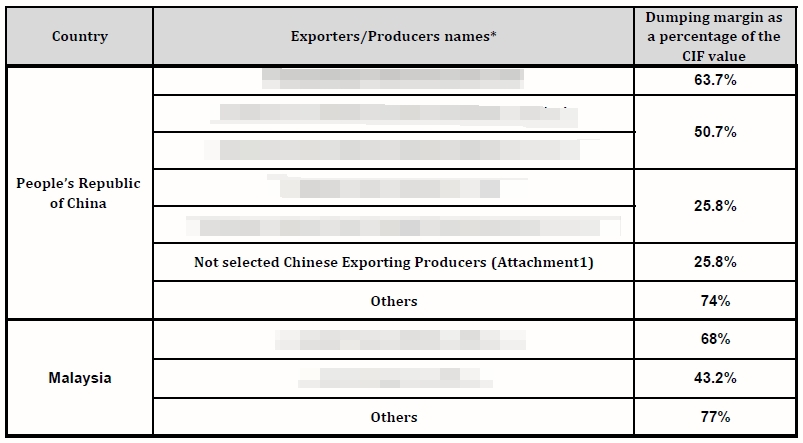
The investigation results showed that three Chinese enterprises (five entities) would be subject to duties of 25.8%, 50.7%, and 63.7%, respectively, while non-selected Chinese export producers would face a 25.8% duty, and other enterprises would be subject to a 74% duty. For Malaysia, two enterprises would be levied duties of 43.2% and 68%, respectively, with other enterprises facing a 77% duty. The definitive anti-dumping duties will be imposed as ad valorem duties based on a percentage of the product's CIF value and will take effect from January 13, 2026, for a validity period not exceeding five years. The enterprises affected by these anti-dumping duties are mainly concentrated in regions such as Guangdong, Zhejiang, Hubei, and Jiangxi, as well as some Chinese-invested enterprises in Malaysia.
It is understood that the Gulf Cooperation Council is the most important political and economic organization in the Gulf region, with formal members including Saudi Arabia, the UAE, Qatar, Kuwait, Oman, and Bahrain. Reportedly, since August 2024, the GCC Bureau of Technical Secretariat for Anti Injurious Practices in International Trade announced that, in response to applications submitted by three enterprises (Oman's Reem Batteries and Power Appliances Company, Qatar's Al Shabib Battery Factory (Q Power), and Saudi Arabia's Middle East Battery Company), it had initiated an anti-dumping investigation into electric accumulators used for starting piston engines originating in or imported from China or Malaysia.
According to the latest customs data, China's cumulative exports of starter lead-acid batteries from January to November 2025 reached 64.9848 million units, a YoY decline of 1.11%. By weight, the cumulative volume was 461,600 mt, down 5.18% YoY. Exports to GCC countries accounted for 5.9% by unit and 12.7% by weight, down 0.87% and 1.43%, respectively, compared with their shares in 2024.
This year, China's lead-acid battery exports faced multiple constraints, including the US reciprocal tariffs, anti-dumping investigations in the Middle East, and higher production costs due to the domestic lead market outperforming the overseas market. By November 2025, the total export volume of lead-acid batteries from China had fallen by more than 10% YoY. In H1 2025, as tariff policy risks increased, Chinese export enterprises rushed to export, with some lead-acid battery manufacturers shipping products early to export destination ports, leading to a slight increase in battery exports during the first half of the year. In July 2025, the GCC announced the results of its anti-dumping investigation and planned to impose punitive tariffs in September 2025. However, after continued negotiations by enterprises from China and Malaysia with the GCC, the implementation of the punitive tariffs was eventually postponed to January 2026. The expected tariff enforcement in the Middle East market next year is likely to further drag down China's lead-acid battery exports. Notably, Chinese companies are now concentrating on building factories in Southeast Asian countries and even considering direct investment in the Middle East, which may shift some of the decline in China's battery exports to overseas markets.