[SMM Imports Analysis] Iron ore imports did not increase but decreased in May, and are expected to increase slightly in June

Published: Jun 9, 2025 14:03

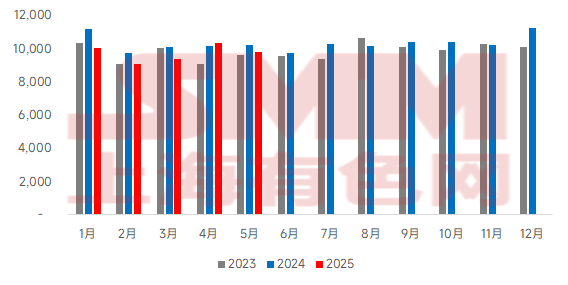
SMM, June 9, 2025: According to statistics from the General Administration of Customs of China, China imported 98.131 million mt of iron ore fines and its concentrates in May, a decrease of 5.007 million mt MoM, down 4.9% MoM, and a decrease of 3.8% YoY. The cumulative imports of iron ore fines and its concentrates from January to May reached 486.409 million mt, down 5.2% YoY.

From the perspective of SMM's port arrival data, the import volumes by country in May exhibited structural differentiation characteristics: arrivals from Australia continued to increase; however, there were significant reductions from sources such as Brazil, India, South Africa, and Ukraine. Demand side, domestic steel mills' pig iron production peaked and then pulled back, coupled with the advancement of crude steel output reduction policies, prompting some steel mills to initiate annual maintenance ahead of schedule, leading to an overall weakening of import demand. Supply side, affected by the diversion of demand to Europe and India, the proportion of Brazilian ore flowing to Europe increased, and the growth in India's domestic consumption constrained its export scale. Meanwhile, the decline in ore prices suppressed the shipping enthusiasm of non-mainstream mines such as those in South Africa, while the continuous accumulation of Ukrainian concentrate inventory at domestic ports led traders to prioritize the digestion of spot cargo, further reducing immediate purchases. Under the combined influence of multiple factors, the total iron ore imports in May showed a downward trend.

Looking ahead to June, iron ore imports are expected to increase. Despite market expectations that domestic demand will continue to decline, the decline is anticipated to be limited. Due to the continuous decline in iron ore prices, the cost-effectiveness of imported iron ore is currently higher, and steel mills have increased their usage ratio, becoming the core driving force supporting the overall high demand for imported iron ore. The supply side presents a complex situation. On the one hand, the collapse of port equipment in Peru in May will lead to a significant decline in its shipping volume. On the other hand, as the closing month of Q2, most mines will actively increase their shipping volumes to meet their mid-year production targets, a factor that will strongly drive an increase in iron ore port arrivals.

Chart-: China's Iron Ore Imports
Source: General Administration of Customs of China

》View SMM steel product quotes, data, and market analysis

》Subscribe to view SMM metal spot historical prices

Data Source Statement: Except for publicly available information, all other data are processed by SMM based on publicly available information, market communication, and relying on SMM‘s internal database model. They are for reference only and do not constitute decision-making recommendations.

For any inquiries or to learn more information, please contact: lemonzhao@smm.cn
For more information on how to access our research reports, please contact:service.en@smm.cn
Related News
Ferrous Metals May Continue Trading at Elevated Levels in the Short Term [SMM Steel Industry Chain Weekly Report]
Mar 27, 2026 18:45
Ferrous Metals May Continue Trading at Elevated Levels in the Short Term [SMM Steel Industry Chain Weekly Report]
Read More
Ferrous Metals May Continue Trading at Elevated Levels in the Short Term [SMM Steel Industry Chain Weekly Report]
This week, ferrous metals retreated after a rapid rise. At the beginning of the week, the market said that Asia had shifted to coal-fired power generation due to a natural gas supply deficit, while Indonesia would increase coal production and impose export taxes. The rise in international coal prices was transmitted to China, and coking coal and coke led the gains in ferrous metals; mid-week, the Middle East situation remained volatile, and the U.S. and Iran held differing attitudes toward war, with ferrous metals consolidating at high levels; the pullback in the second half of the week was also mainly due to the weakening of the cost-side logic, as market rumors said long-term iron ore contract negotiations had been completed, expectations for tightening iron ore supply declined, and raw materials turned into the main driver of the pullback. In the spot market, speculative trading and end-user purchase sentiment improved in the first half of the week, while rigid demand remained dominant in the second half, and the spot-futures price spread widened somewhat......
Mar 27, 2026 18:45
Centralized Production Resumptions Conclude, Limiting Further Supply Increases from EAF Steel Mills
Mar 27, 2026 18:26
Centralized Production Resumptions Conclude, Limiting Further Supply Increases from EAF Steel Mills
Read More
Centralized Production Resumptions Conclude, Limiting Further Supply Increases from EAF Steel Mills
As of March 24, the operating rate of 50 electric-furnace steel mills nationwide mainly producing construction materials was 40.42%, up 1.78% WoW from the previous period; the capacity utilization rate was 41.75%, up 1.88% WoW from the previous period; and daily average production of construction materials was 93,000 mt, up 4,200 mt WoW.
Mar 27, 2026 18:26
MMi Daily Iron Ore Report (March 27)
Mar 27, 2026 18:11
MMi Daily Iron Ore Report (March 27)
Read More
MMi Daily Iron Ore Report (March 27)
The iron ore futures rose in early trading before gradually retreating during the day. The main contract I2605 ultimately closed at 812 yuan/ton, down 0.49% from the previous trading session.
Mar 27, 2026 18:11
[SMM Imports Analysis] Iron ore imports did not increase but decreased in May, and are expected to increase slightly in June - Shanghai Metals Market (SMM)