Why is Guinea revoking bauxite mining licence or withdrawing concession? Is this course correction or disruption ahead?

Published: May 19, 2025 13:09
Guinea’s bauxite sector has drawn significant attention in recent years, with production nearing 130-137 million tonnes annually and multiple mining and infrastructure projects underway.

Guinea’s bauxite sector has drawn significant attention in recent years, with production nearing 130-137 million tonnes annually and multiple mining and infrastructure projects underway. Key developments include initiatives by Kebo Energy SA, GAC, and Arrow Minerals, along with the Trans-Guinean railway to streamline ore transport. But the Guinean government has recently moved to withdraw Kebo Energy SA’s mining concession, following EGA’s mining licence cancellation last week.

According to a recent report, Kebo has failed to meet its investment commitments, prompting the Guinean government to revoke the long-standing mining concession. Some sources close to Kebo also confirmed the news, citing shortfall to inadequate funding, including for a planned alumina refinery.

Now, the recent string of license revocations and concession cancellations has raised the question: “Why?” According to sources, these actions are part of a broader strategy aimed at increasing state control over mineral wealth and revenues. Guinea is now seeking to secure more direct benefits from its abundant natural resources, particularly bauxite.

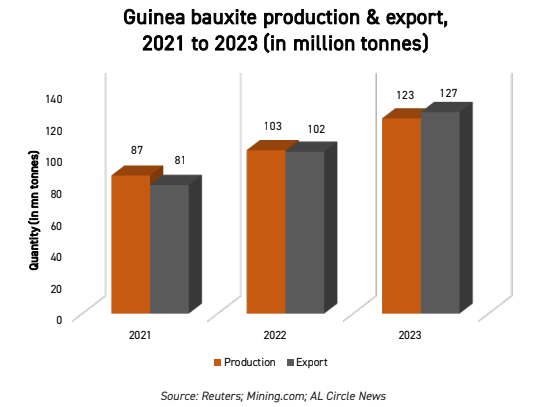
Guinea is a growing hub for bauxite mining. Its production as well exports is witnessing a steady rise over the years. From 87 million tonnes of production and 81 million tonnes of exports in 2021, Guinea’s output and exports grew to 103 million tonnes and 102 million tonnes, respectively, and further rose to 123 million tonnes and 127 million tonnes in the subsequent year. Eventually, in 2024, production and exports reached around 137 million tonnes and 146 million tonnes.
Why is Guinea revoking bauxite mining licences or withdrawing concessions? Is this course correction or disruption ahead?

In an international conference, honorable Bouna Sylla, current Minister of Mines and Geology for the Republic of Guinea cited the country witnessed a 10x growth in bauxite production in the past ten years. It exported over 609,232,070 tonnes of bauxite in ten years to feed the world market.

The problem is, in an effort to capitalise on the growing bauxite market, several mining companies operating in Guinea have come under scrutiny for selectively extracting high-grade ore while leaving behind significant deposits of medium-grade bauxite. Dr Ashok Nandi, President of the International Bauxite, Alumina, and Aluminium Society (IBAAS), India, traces this practice back to CBG’s use of a high alumina cut-off grade for resource estimation, a methodology that has since been adopted by other major operators in the country. He warns that this approach is leading to the underutilisation of substantial volumes of low to medium-grade bauxite, which remain viable for alumina production. In response, Guinea’s military-led government, following its recent rise to power through successive coups, is moving to reform mining laws and renegotiate contracts to promote more efficient resource management and maximise national returns.

Log in to https://www.alcircle.com/news/why-is-guinea-revoking-bauxite-mining-licences-or-withdrawing-concessions-is-this-course-correction-or-disruption-ahead-114108 read the full story for FREE
Source: https://www.alcircle.com/news/why-is-guinea-revoking-bauxite-mining-licences-or-withdrawing-concessions-is-this-course-correction-or-disruption-ahead-114108


Data Source Statement: Except for publicly available information, all other data are processed by SMM based on publicly available information, market communication, and relying on SMM‘s internal database model. They are for reference only and do not constitute decision-making recommendations.

For any inquiries or to learn more information, please contact: lemonzhao@smm.cn
For more information on how to access our research reports, please contact:service.en@smm.cn
Related News
SHFE Aluminum Edged Up After Halting Its Decline, Spot Aluminum Stabilized and Improved [SMM South China Spot Aluminum Daily Review]
2 hours ago
SHFE Aluminum Edged Up After Halting Its Decline, Spot Aluminum Stabilized and Improved [SMM South China Spot Aluminum Daily Review]
Read More
SHFE Aluminum Edged Up After Halting Its Decline, Spot Aluminum Stabilized and Improved [SMM South China Spot Aluminum Daily Review]
2 hours ago
SHFE Cast Aluminum Alloy Warrants Drop by 2,047 mt to 42,944 mt on March 24
3 hours ago
SHFE Cast Aluminum Alloy Warrants Drop by 2,047 mt to 42,944 mt on March 24
Read More
SHFE Cast Aluminum Alloy Warrants Drop by 2,047 mt to 42,944 mt on March 24
[SMM Flash News] SHFE data showed that as of March 24, the total registered volume of cast aluminum alloy warrants was 42,944 mt, a decrease of 2,047 mt from the previous trading day. By region, the total registered volume was Shanghai (2,755 mt, down 422 mt), Guangdong (17,257 mt, down 210 mt), Jiangsu (4,209 mt, down 813 mt), Zhejiang (13,672 mt, down 483 mt), Chongqing (3,723 mt, down 119 mt), and Sichuan (1,327 mt, increase 0 mt).
3 hours ago
What Could Change if Middle East Aluminum Trade Reroutes—and Supply Becomes Substitutable
3 hours ago
What Could Change if Middle East Aluminum Trade Reroutes—and Supply Becomes Substitutable
Read More
What Could Change if Middle East Aluminum Trade Reroutes—and Supply Becomes Substitutable
Strait of Hormuz disruptions and Iran tensions are driving up aluminum prices and premiums. Aluminium Bahrain and Qatalum have cut output, while feedstock is tight. Rerouting via Port of Sohar or Saudi ports raises costs and delays. Buyers are turning to China, India, Russia, Canada, and scrap to offset risk. Prolonged disruption could reduce Middle East market share and reprice it as higher-risk supply.
3 hours ago