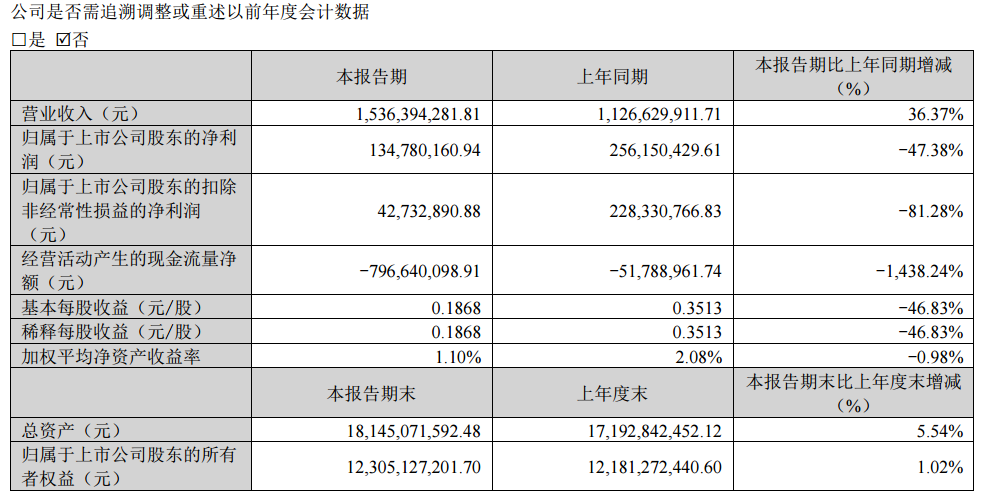
On April 25, Sinomine Resource Group released its Q1 2025 performance report. According to the announcement, the company achieved a total revenue of 1.536 billion yuan, up 36.37% YoY. Net profit attributable to shareholders of the publicly listed firm was 135 million yuan, down 47.38% YoY.
Sinomine Resource Group stated that in Q1 2025, the company achieved sales of 8,964.43 mt of lithium chemical products, up 13% YoY. However, due to market fluctuations in the lithium battery and new energy sector, the selling price of lithium chemical products declined significantly YoY, leading to a decrease in the gross profit margin of the company's lithium battery and new energy business. Facing downward pressure in the industry, the company actively implemented various cost-reduction and efficiency-enhancement measures to mitigate the risks of market price fluctuations.
In Q1 2025, the company's rare light metal (cesium, rubidium) business maintained a good growth momentum, generating a total operating revenue of 345 million yuan during the reporting period, up 94% YoY, and achieving a gross profit of 231 million yuan, up 92% YoY. Among them, the fine chemical business of cesium and rubidium salts achieved sales of 265 dmt of cesium salt products, up 78% YoY. As a leading enterprise in the global cesium and rubidium salt market, the company continues to consolidate its dominant position in the global cesium salt market by leveraging the resource advantages of the Tanco mine in Canada and the Bikita mine in Zimbabwe.
Meanwhile, it should be noted that in Q1 2025, the company's copper smelting business at the Tsumeb smelter in Namibia incurred a net profit loss of 100.4 million yuan due to a significant decline in industry processing fees (TC/RC) caused by tight global copper concentrate supply. This had a phased impact on the company's performance during the reporting period. The company has formulated relevant cost-reduction and efficiency-enhancement measures to gradually reduce losses in the copper smelting business and will form new profit growth points as soon as possible by releasing the capacity of the germanium business. It strives to achieve a turnaround for the Tsumeb subsidiary in Namibia at the earliest opportunity.
During an investor activity survey, the company mentioned that in 2024, its self-owned mines achieved sales of 39,477 mt of lithium chemicals, up 164% YoY. The company fully leveraged its resource advantages, adjusted the raw material supply structure, and increased the proportion of spodumene concentrates, thereby reducing the production cost of lithium chemicals. Despite significant fluctuations in the market price of lithium chemical products in 2024, the company effectively mitigated market risks and smoothly navigated the industry cycle through business strategies and cost-reduction measures such as significantly increasing the self-sufficiency rate of lithium ore, adjusting the raw material supply structure, expanding municipal power supply capacity, and constructing PV power plants.
In the future, the company plans to invest in and construct a 30,000 mt/year lithium sulfate plant in Zimbabwe, which is expected to further reduce transportation costs and thus lower the production cost of lithium chemicals.
Regarding the future development outlook of the lithium battery business, Sinomine Resource Group stated that in the lithium battery and new energy business, the company will maintain the comprehensive cost of lithium chemicals at a leading level in the industry. It aims to complete the layout of a 30,000 mt/year lithium sulfate production capacity in Africa by 2026.
It is worth mentioning that on April 25, Sinomine Resource Group also issued a feasibility announcement regarding the company's engagement in commodity futures and options hedging business. The announcement mentioned that the company is primarily engaged in the development and utilization of new energy raw materials for lithium batteries, with its main products being lithium chemicals such as lithium hydroxide and lithium carbonate. In recent years, the selling prices of the company's lithium chemical products have been significantly influenced by market price fluctuations. To mitigate the operational risks posed by product price fluctuations, the company intends to utilize the hedging functions of financial instruments to conduct commodity futures and options hedging business on product risk exposures related to its production and operation activities, effectively reducing the risks associated with market price fluctuations of products and ensuring the stable and sustainable development of its main business.
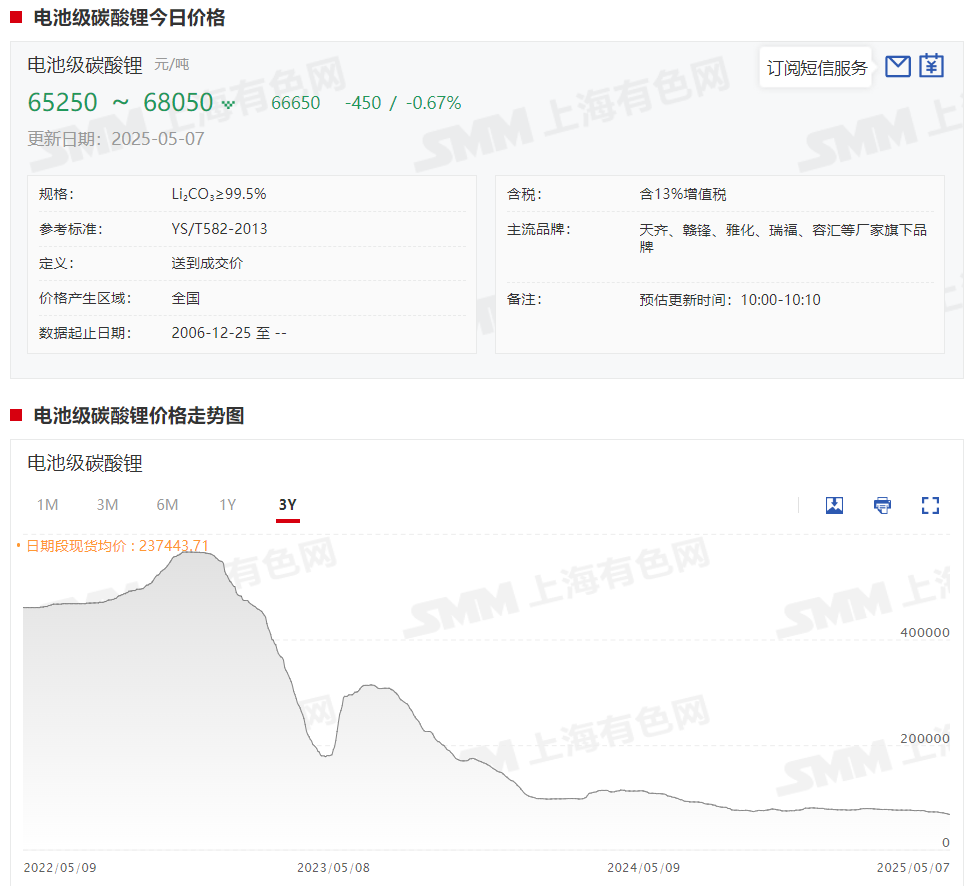
The significant price fluctuations of lithium carbonate and lithium hydroxide are also reflected in their spot prices. According to SMM spot quotes, taking battery-grade lithium hydroxide as an example, its price dropped from a high of 560,000 yuan/mt in November 2022 to 67,360 yuan/mt on May 6, representing a decline of 87.97%. For battery-grade lithium carbonate, the price fell from a high of 567,500 yuan/mt in 2022 to 66,650 yuan/mt on May 7, marking a decline of 88.26%.
》Click to view SMM spot quotes for new energy products
The combined amount of margins and premiums for Sinomine Resource Group and its subsidiaries to engage in commodity futures and options hedging business shall not exceed 200 million yuan. The aforementioned limit can be utilized on a rolling basis within the validity period. The varieties of commodity futures and options hedging business are limited to those directly related to the company's production and operation, specifically lithium chemical futures and options.
The company stated that engaging in commodity futures and options hedging business aims to hedge against risks such as product price fluctuations, thereby achieving stable operation, which is necessary. The company has established clear regulations on the limits, varieties, and specific implementation of the hedging business, and the targeted risk control measures adopted are feasible. By conducting commodity futures and options hedging business, the company can achieve asset preservation for the purpose of risk hedging, enhance the financial stability of the company, and meet the requirements for stable operation. Therefore, the company's engagement in commodity futures and options hedging business is both necessary and feasible.
![[Lithium Battery: Times BAIC Battery Factory's First Cell Rolls Off Production Line]](https://imgqn.smm.cn/usercenter/KySZv20251217171726.jpg)
![[Lithium Battery: Nation's Largest Single-Station Vehicle-To-Grid Flash Charging Demonstration Station Launches]](https://imgqn.smm.cn/usercenter/EPIrk20251217171726.jpg)