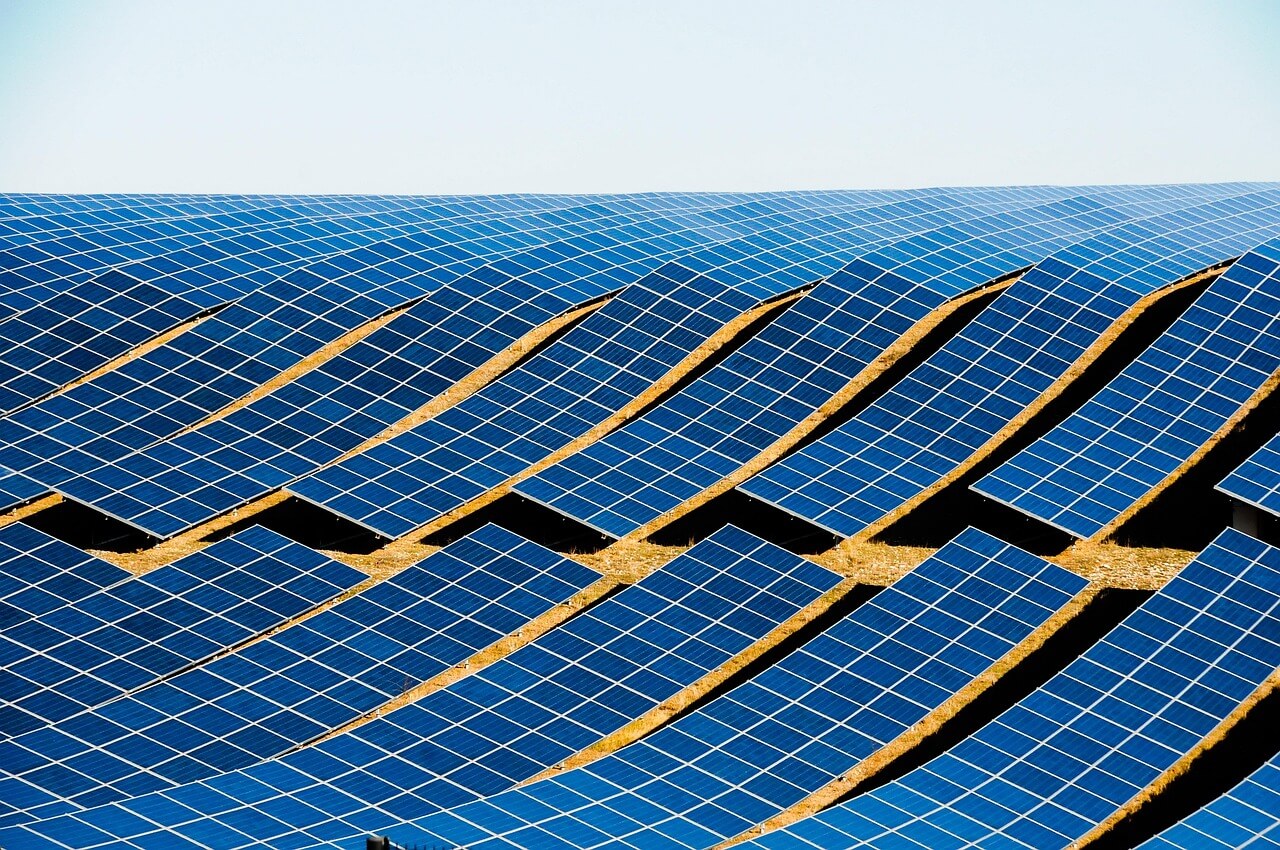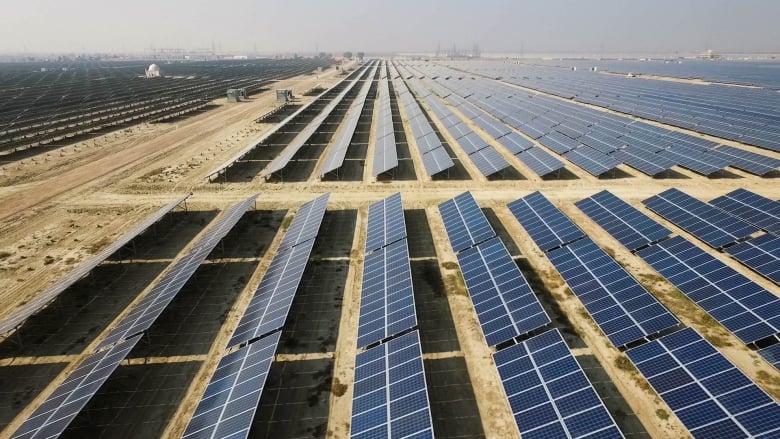
Pakistan added a record 17GW of new solar capacity in 2024. Image: World Bank.
The world reached 2.2TW of cumulative installed solar capacity in 2024, with China alone accounting for 1TW of total operating capacity.
This is a headline conclusion from the latest report from the International Energy Agency’s Photovoltaic Power Systems Programme (IEA-PVPS), published this week. The report breaks down global capacity installations and technology trends over the past 12 months and highlights the rapid growth in PV installations in markets around the world.
For instance, while China’s 357.3GW of new operating capacity was significantly higher than any other country, 34 countries around the world added at least 1GW of new PV capacity in 2024. Indeed, the world added 602GW of new capacity in 2024, an increase over the 456GW added in 2023, and more than double the 242GW added in 2022. The capacity additions of a number of leading markets are shown in the graph below.
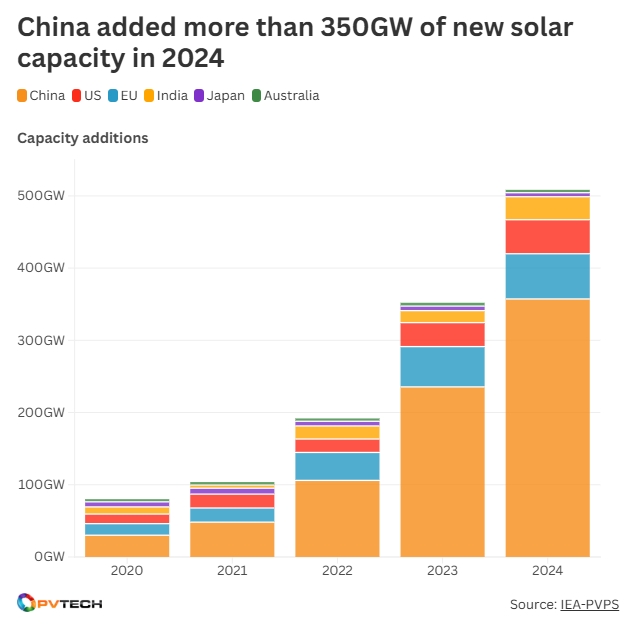
The EU has remained the number two market in the world for annual capacity additions over the last five years, despite growing installation rates in the US and India. India’s addition of 31.9GW of new capacity in 2024 is almost double the capacity additions of 2023, and reflects record installation figures for the country, backed by a mammoth tender for 73GW of new utility-scale renewable power capacity.
China, the EU, the US and India are the top four markets for both 2024 capacity additions and cumulative deployed capacity. The two lists (comprising the top ten markets plus the EU) feature nine of the same markets, though one notable exception is Pakistan, which did not make the top ten in terms of cumulative capacity, but added a record 17GW of new capacity in 2024, fifth only to the big four markets.
Much of Pakistan’s growth has come in the rooftop solar sector. Earlier this year, Waqas Moosa, chairman of the Pakistan Solar Association (PSA), told PV Tech Premium that soaring energy prices have encouraged people to reduce their reliance on the central electricity grid and they have turned to rooftop solar as a way of generating power for themselves. Figures from BloombergNEF show that, in 2023, Pakistan’s demand for power from the grid fell by 9.1% year-on-year.
Pakistan’s ‘bull run’ on Chinese modules
Moosa also described a “bull run” on Chinese solar panels in Pakistan in the first half of 2024, and this appears to have continued until the end of the year. According to the China Chamber of Commerce, Pakistan imported 24GW of Chinese modules between 2023 and 2024, with 17GW imported in 2024 alone.
This emphasis on imports means that Pakistan is something of a unique market among the leaders in capacity additions, in that it has not made significant investments in domestic manufacturing capacity.
China, the US and India have made significant strides towards greater cell and module manufacturing capacity, and while Moosa has said that Pakistan could focus on the manufacturing of specialised products, for instance modules for use in the distributed sectors, Pakistan remains a ways behind many other markets in terms of sheer manufacturing capacity.
“The Pakistani market this year is the result of the convergence of several factors from rising electricity costs, low-cost imports, and a rapidly expanding network of module importers and resellers—the large volume of imported modules in 2023 indicated that 2024 would be dynamic,” wrote the IEA-PVPS authors in their report, suggesting that the rapid growth in the Pakistan solar sector has put pressure on energy infrastructure.“The Pakistani market this year is the result of the convergence of several factors from rising electricity costs, low-cost imports, and a rapidly expanding network of module importers and resellers—the large volume of imported modules in 2023 indicated that 2024 would be dynamic,” wrote the IEA-PVPS authors in their report, suggesting that the rapid growth in the Pakistan solar sector has put pressure on energy infrastructure.
“With an estimated new capacity over 17GW, real concerns are being raised about the local grids ability to remain stable and the viability of the whole electricity system, that has high legacy capacity costs.”
Solar penetration grows, brings curtailment in its wake
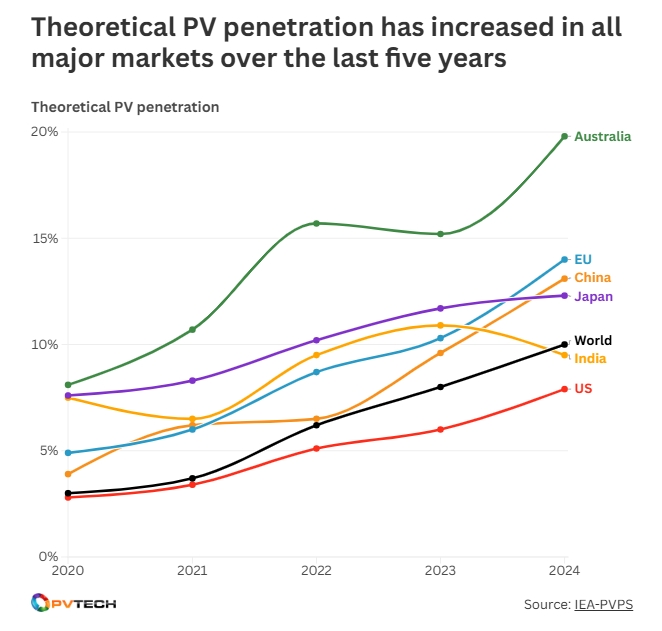
The IEA-PVPS report said the global average solar penetration rate – the percentage of a country’s energy demand that is met by the theoretical maximum generation of its operating solar projects – has exceeded 10% for the first time.
The report notes that there are now 27 countries with an estimated penetration rate above 10%, up from 18 in 2023, and includes a number of leading PV markets, including the EU and China.
These figures reflect the role of solar in relation to the countries’ energy mixes as a whole, not just the growth of the solar sector. For instance, there is not consistent growth in the Indian solar penetration rate, despite sustained growth in solar capacity additions, as India continues to invest in new fossil fuel power plants – the country commissioned 4GW of new coal capacity in 2024 – that reduce the weight of solar in the country’s power mix. These trends are shown in the graph below, with the global average included in black.
The report also notes that curtailment has become “a real issue” as solar takes up a greater portion of generation capacity. It said the penetration rate, when considered alongside curtailment, is actually “lower than indicated”. For instance, Chile saw its theoretical PV penetration rate cut by 3.3% in 2024 due to the curtailment of 6TWh of renewable power.
While Chile has become something of a poster child for significant grid challenges and curtailment issues, this has also helped push forward the discussion regarding the role of storage in the global energy mix in general, and the PV sector in particular. This year, both Europe and the US have highlighted the need for more resilient grid infrastructure, either through grid expansion and modernisation or the use of storage systems, and this is reflected in the IEA-PVPS report.
“For those countries with the highest penetration rates, curtailment is increasingly prevalent and investments in grid decongestion and interconnections, as well as flexibility, storage and sector coupling will be needed in the future to take advantage of peak capacity,” wrote the report’s authors.
Credit: IEA: World reaches 2.2TW of cumulative installed solar capacity - PV Tech
![[SMM PV News] Slovakia Adds 243 MW of Solar in 2025](https://imgqn.smm.cn/usercenter/vghcI20251217171739.jpg)
![[SMM PV News] GCL Secures 1.2 MW Commercial Perovskite Tandem Module Order from Huaneng](https://imgqn.smm.cn/usercenter/VqcvE20251217171739.jpg)