Myanmar Ore Resumes Imports: What Impact on the Rare Earth Market? [SMM Commentary]

Published: Mar 28, 2025 19:14
[SMM Review: What Impact Will the Resumption of Myanmar Ore Imports Have on the Rare Earth Market?] On March 26, the Kachin State government announced that the legally mined and long-stored rare earth in the eastern province mining area would officially be exported starting from March 27, 2025. Previously, the control of the mining area by the Kachin Independence Army had led to a halt in rare earth mining and border closures, severely affecting the supply of medium-heavy rare earth. The Kachin State government's legal release of the stored rare earth may alleviate the tight supply situation in the market in the short term.

SMM March 28 News: On March 26, the Kachin State government announced that the legally mined and long-stored rare earths from the eastern province mining area would officially be released starting March 27, 2025. Previously, the control of the mining area by the Kachin Independence Army in Myanmar had led to a halt in rare earth mining and border closures, severely affecting the supply of medium-heavy rare earths. The Kachin State government's legal release of the stored rare earths may alleviate the tight market supply in the short term.
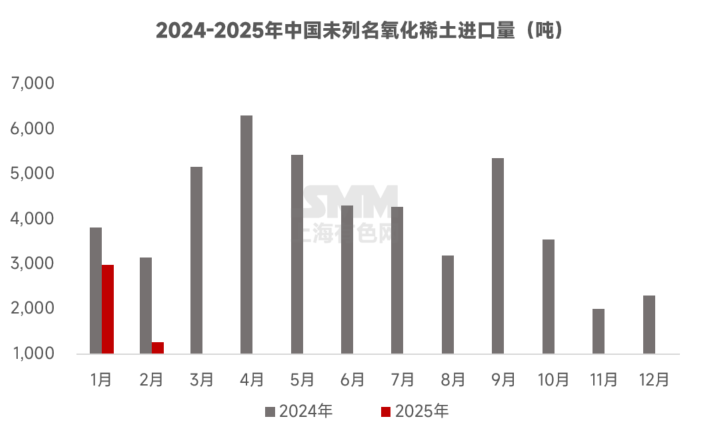
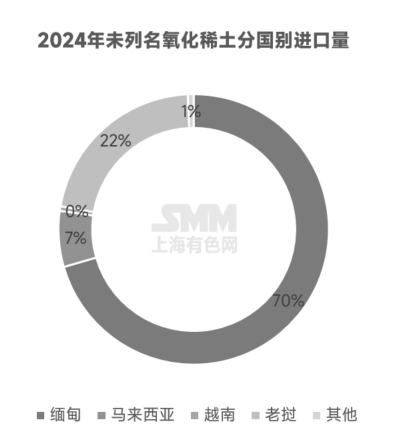
Since H2 2024, due to supply disruptions in Myanmar, rare earth prices have seen a significant increase. Following this news, some industry players began actively offloading goods in the market, leading to a downward trend in the prices of mainstream rare earth products. According to the import data for the entire year of 2024, 70% of China's imports of unlisted rare earth oxides came from Myanmar. The resumption of imports is expected to stabilize the supply of rare earth ore. However, considering the stricter control of smelting and separation indicators under the new rare earth regulations, the supply of rare earth oxides in the market may not be affected.
Overall, the Kachin State government's decision may alleviate the tight supply in the rare earth market and curb rapid price increases in the short term. However, in the long term, rare earth prices will still be influenced by the growing demand in the end-use sector, policy regulations, and geopolitical risks.

》Apply for a free trial of the SMM Metal Industry Chain Database

Data Source Statement: Except for publicly available information, all other data are processed by SMM based on publicly available information, market communication, and relying on SMM‘s internal database model. They are for reference only and do not constitute decision-making recommendations.

For any inquiries or to learn more information, please contact: lemonzhao@smm.cn
For more information on how to access our research reports, please contact:service.en@smm.cn
Related News
South Korea to Exempt Tariffs on Overseas-Sourced Critical Minerals
3 hours ago
South Korea to Exempt Tariffs on Overseas-Sourced Critical Minerals
Read More
South Korea to Exempt Tariffs on Overseas-Sourced Critical Minerals
On the 25th, it was confirmed that the South Korean government will exempt tariffs of 3–8% on critical minerals such as lithium, graphite, and rare earth elements when domestically owned companies directly produce and import them from overseas. The Ministry of Trade, Industry and Energy has pre-announced a new regulation outlining tariff exemptions for overseas resource development projects. Under the policy, a total of 14 critical minerals—including lithium, graphite, nickel, cobalt, manganese, copper, zinc, and rare earth elements such as lanthanum, cerium, neodymium, terbium, dysprosium, yttrium, and scandium—will be eligible for duty exemption when brought into the country. The regulation is set to take effect on April 3.
3 hours ago
Rare Earth Prices Fluctuated Relatively Little, While Downstream Procurement Demand Remained Weak [SMM Rare Earth Weekly Review]
4 hours ago
Rare Earth Prices Fluctuated Relatively Little, While Downstream Procurement Demand Remained Weak [SMM Rare Earth Weekly Review]
Read More
Rare Earth Prices Fluctuated Relatively Little, While Downstream Procurement Demand Remained Weak [SMM Rare Earth Weekly Review]
[SMM Rare Earth Weekly Review: Rare Earth Prices Saw Relatively Small Fluctuations, While Downstream Procurement Demand Remained Weak] The Pr-Nd oxide market was relatively calm this week. Demand from downstream metal plants was sluggish, but upstream supply also remained tight. Suppliers were unwilling to make shipments at low prices, and the back-and-forth negotiations between upstream and downstream remained in a stalemate. Pr-Nd oxide prices saw small fluctuations to 710,000-715,000 yuan/mt.
4 hours ago
Energy Fuels Produces First Terbium Oxide in US, Boosting Domestic Rare Earth Supply Chain
5 hours ago
Energy Fuels Produces First Terbium Oxide in US, Boosting Domestic Rare Earth Supply Chain
Read More
Energy Fuels Produces First Terbium Oxide in US, Boosting Domestic Rare Earth Supply Chain
US rare earth producer Energy Fuels announced that its White Mesa mill in Utah has successfully produced its first batch of terbium oxide with a purity of 99.9. This marks the first time in decades that the US has produced this heavy rare earth element from primary mineral raw materials, using monazite mined in Florida and Georgia. The company had previously trial-produced dysprosium oxide at the facility and is expected to expand heavy rare earth capacity in the coming years. It is estimated that upon completion of the second-phase expansion in 2029, the White Mesa mill will have the annual capacity to produce dysprosium oxide (288 mt), terbium oxide (80 mt), and Pr-Nd oxide (6,000 mt), supporting the development of a domestic rare earth supply chain in the US.
5 hours ago