[SMM Analysis] 0BB Technology and Cost of Encapsulation Films for Different Routes (Part 2)

Published: Jan 5, 2025 22:04
The welding method is the mainstream process for SMBB. Compared to traditional welding, 0BB welding with dispensing has advantages in terms of acceptance and equipment upgrades. The film-coating process is easy to penetrate the market and has achieved mass production. 0BB technology improves efficiency and, in the future, combined with copper interconnection and thin silicon wafer technology, will drive the development of heterojunction batteries.

In traditional welding methods, further thinning of silicon wafer welding strips poses a risk of grid breakage, and further thinning of encapsulation film weight is challenging. Currently, the cost of skin film is around 3 yuan/㎡, but it still requires pairing with encapsulation film, which has a high cost. With future mass production and technological optimization, costs are expected to decrease further. The paired encapsulation film has currently been reduced to 200g/㎡ and is still in the testing phase, with some sample modules being tested by component manufacturers. The one-piece film, extruded in a single process, has a lower cost compared to the combination of skin film and encapsulation film. Currently, First, Betterial, Sveck, and Lushan are leading in R&D. First's CH(15) and CH(E) series products use EVA as the raw material and adopt direct lamination or dispensing solutions, suitable for Topcon modules CF15(E)/(H) and HJT modules CF15(H). The glue-integrated film weighs 300-500g/㎡, and the G400 co-extruded EPE is suitable for HJT. The T400EPE co-extruded film is suitable for Topcon integrated encapsulation. Both dispensing and lamination methods do not use flux, saving equipment maintenance time and flux costs.

Compared to traditional welding methods, 0BB technology offers an efficiency advantage of 3-5W. In the future, by optimizing encapsulation film materials, an additional 5W efficiency improvement is expected. In the development of heterojunction (HJT), copper interconnection metallization technology not only facilitates silver-free processes but also protects silicon wafers through mild processing, enhancing compatibility with 0BB thin wafers. In the future, the combination of copper interconnection, thin silicon wafers, and 0BB interconnection will become a key technological direction for heterojunction development.
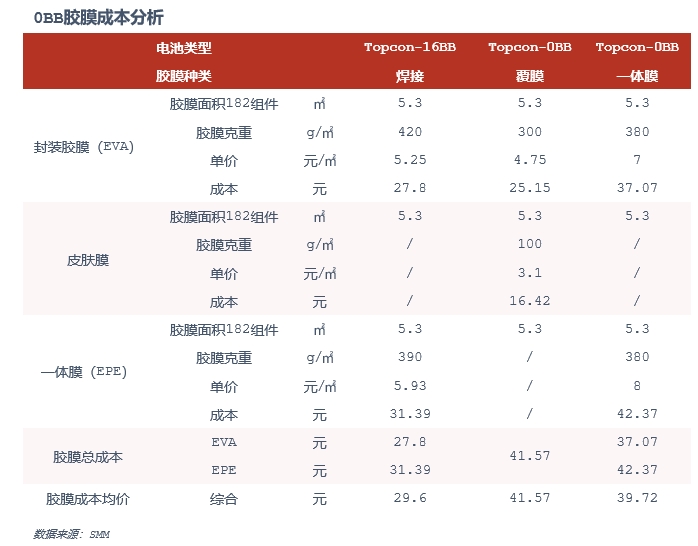
 

Data Source Statement: Except for publicly available information, all other data are processed by SMM based on publicly available information, market communication, and relying on SMM‘s internal database model. They are for reference only and do not constitute decision-making recommendations.

For any inquiries or to learn more information, please contact: lemonzhao@smm.cn
For more information on how to access our research reports, please contact:service.en@smm.cn
Related News
[SMM PV News] EU Proposes 'Industrial Accelerator Act' Mandating Local Content for Solar and BESS
9 hours ago
[SMM PV News] EU Proposes 'Industrial Accelerator Act' Mandating Local Content for Solar and BESS
Read More
[SMM PV News] EU Proposes 'Industrial Accelerator Act' Mandating Local Content for Solar and BESS
[SMM PV News] EU Proposes 'Industrial Accelerator Act' Mandating Local Content for Solar and BESS
The European Commission's newly drafted Industrial Acceleration Act (IAA) requires publicly subsidized clean energy projects to use EU-manufactured components. Photovoltaic projects must integrate EU-made inverters and solar cells within 3 years, a transition period praised by some for balancing reshoring but criticized by others as too slow to counter Chinese competition. Besides, BESS over 1 MWh face an aggressive timeline requiring EU-made battery management systems within 1 year and EU cells within three, which industry experts warn could stall storage rollouts. Additionally, the Act enforces strict barriers on strategic investments over €100 million from nations that 'control more than 40% of global capacity,' mandating technology transfers and capping foreign equity ownership at 49%.
9 hours ago
[SMM PV News] Brazil's 439 MW Bom Jardim Solar Complex Begins Testing
9 hours ago
[SMM PV News] Brazil's 439 MW Bom Jardim Solar Complex Begins Testing
Read More
[SMM PV News] Brazil's 439 MW Bom Jardim Solar Complex Begins Testing
[SMM PV News] Brazil's 439 MW Bom Jardim Solar Complex Begins Testing
Brazil's 439 MW Bom Jardim solar complex in Ceará has begun testing four of its 10 plants. Backed by a BRL 2.13 billion ($407 million) investment and qualifying for REIDI tax incentives, the 706-unit project targets full commercial operation by December 2027. Generated power will be routed via an 8 km transmission line to the 230 kV Icó Substation, with the development expected to create over 20,000 direct and indirect jobs.
9 hours ago
[SMM PV News] Japan Adds Up to 6 GW Solar in 2025
9 hours ago
[SMM PV News] Japan Adds Up to 6 GW Solar in 2025
Read More
[SMM PV News] Japan Adds Up to 6 GW Solar in 2025
[SMM PV News] Japan Adds Up to 6 GW Solar in 2025
Japan installed an estimated 5.8 to 6 GW of solar in 2025, pushing its cumulative capacity past 100 GW. According to RTS Corp, growth was driven by C&I power purchase agreements and new-build rooftop solar mandates in Tokyo and Kawasaki. Installations in 2026 are expected to remain steady, with a potential market rush before FiT/FiP subsidies for >10 kW systems end in FY2027. Long-term, Japan aims for solar to be its largest power source by 2040 (targeting up to 280 GW) and is actively subsidizing perovskite technology to hit a 20 GW target.
9 hours ago
[SMM Analysis] 0BB Technology and Cost of Encapsulation Films for Different Routes (Part 2) - Shanghai Metals Market (SMM)