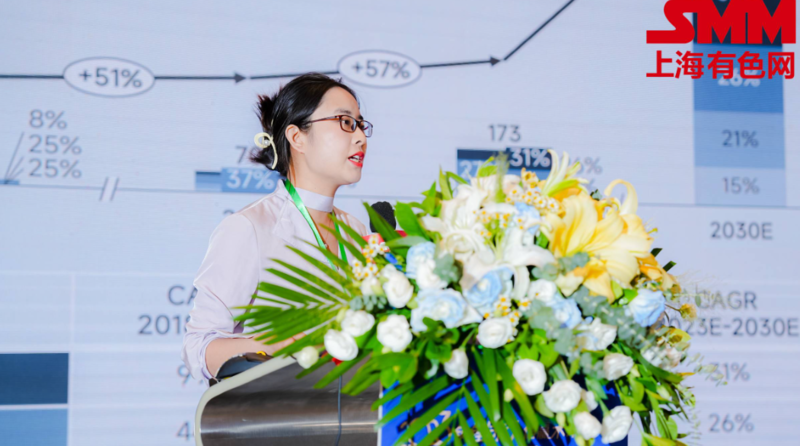
At the forum of the China New Energy Industry Annual Conference 2023 and the SMM Lithium Cobalt Nickel Industry Annual Conference 2023, hosted by SMM, Wang Cong, the General Manager of the New Energy Business Department of SMM Industry Research Institute, made a prediction about the future global lithium market supply and demand. She stated that SMM anticipates a reverse in the global lithium salt supply-demand balance in 2023, due to an ongoing increase in smelting capacity and resource increment. Looking further ahead, both lithium carbonate and lithium hydroxide will likely maintain a surplus. In this context of resource oversupply, high-cost resource projects are at risk of being phased out.
The demand for lithium in the energy storage and NEV market takes the lead.
As the global process of carbon neutrality continues to advance, the transition to an energy structure dominated by clean, low-carbon energy has become a clear trend. Economically powerful regions, such as China, the United States, and the European Union, will also serve as the core entities for long-term carbon reduction.
As for the global NEV market, SMM believes that, benefiting from the global implementation of dual-carbon policies, the NEV market, after a period of rapid explosion, will continue to maintain a trend of steady growth in the future. Furthermore, China's new energy vehicles are expected to occupy a leading position in the market for the long term.
Global energy storage market
Due to issues such as power supply, the energy storage market in Europe and North America got off to an early start. SMM projects that the annual compound growth rate of the energy storage market demand in Europe from 2021 to 2023 will be around 62%. After setting its carbon neutrality target, China's energy storage industry has also entered a high-speed growth period. It's projected that the annual compound growth rate of the energy storage market demand in China from 2021 to 2023 will be around 105%.
Moving forward, with the ramp-up of economies, the joint promotion of "dual carbon" construction by other emerging countries, and issues such as regional imbalances in electricity use and production, SMM anticipates that the demand for energy storage batteries in regions other than North America, Europe, and China is expected to maintain high growth.
With the dual drivers of the NEV and storage markets, global demand for lithium batteries is experiencing high growth.
Given the sustained growth in the demand for new energy vehicles in recent years and the explosive growth in the energy storage market, battery demand has shown a significant increase.
When broken down by battery material type, ternary batteries and LFP batteries absolutely dominate within the lithium battery sector. However, with LFP batteries' exceptional cost-effectiveness and safety advantages, it's forecasted that their penetration rate in the NEV and energy storage markets will continue to steadily increase in the future.
SMM anticipates that by 2027, the market share of ternary and LFP batteries within the lithium battery sector will further increase. The ternary battery share could be around 29%, and the LFP battery share could be around 66%, together accounting for roughly 95% of the total market share.
According to SMM, several leading overseas battery and vehicle companies have announced plans to increase their investment in the LFP layout. It's expected that the dominant position of LFP in the global cathode material system will further consolidate. SMM forecasts that by 2023, the proportion of LFP in the global cathode material output could reach around 54%.
It's worth mentioning that since the start of 2023, the prices of nickel and cobalt have maintained relatively low levels compared to previous years, highlighting the cost advantage of medium nickel. Given the low cost, the advancement of high-voltage technology, and significant safety performance, it's projected by SMM that the future nickel market will be evenly split between medium-nickel high-voltage and high-nickel routes. The global high nickelization progression may slow down.
Supply Side: Confirmed growth in primary and secondary lithium resources.
Global Lithium Resource Supply from 2018 to 2027E
SMM has reviewed and forecasted the global lithium resource supply from 2018 to 2027. Our analysis suggests that with the continuous release of various types of raw materials, the global lithium resource supply is expected to increase year by year. Notably, the proportion of lithium resources from the recycling end is expected to remain around 6% to 7% in the future.
Looking at it by country, SMM anticipates that by 2027, Australia and Chile, which once dominated the lithium resource supply in 2022, may see a slight reduction in their share of the lithium resource supply. In terms of types of raw materials, it is expected that by 2027, the proportion of lithium resource supply from the recycling end will rise from 5% in 2022 to around 7%.
Global Lithium Resource Supply Balance from 2018 to 2027E
SMM has compiled the global lithium resource supply balance from 2018 to 2027. Looking at it in terms of time periods:
2018-2020: A period of concentrated release of resource supply, leading to severe supply-demand mismatches; lithium prices continued to fall, resulting in the bankruptcy and clearance of several mining companies, and the majority of resource projects under construction were forced to delay.
2021-2022: Rapid growth in lithium demand driven by NEV end-user demand; on the supply side, the majority of projects were resumptions, with insufficient supply growth, resulting in a re-emergence of resource gaps and driving a rapid rise in lithium prices.
2023-2024: A period of concentrated release from newly added and expanded projects such as salt lakes and spodumene. Although demand maintains a steady upward trend, the growth rate is not as high as in the initial stage, which drives a reversal in the supply-demand structure of lithium salts.
2025-2027: The global energy storage market becomes a new point of demand growth, coupled with the steady upward trend in NEV market demand. SMM anticipates a slight alleviation of resource oversupply during this period.
In the longer term, the main trend of resource oversupply is expected to persist, with high-cost resource supplies potentially facing the risk of clearance.
SMM has forecasted the weighted average cost curve for global lithium resources in Q1 2024, broken down by type of raw material. SMM anticipates that the raw material costs of salt lakes will remain relatively stable in Q1 2024, unaffected by labor and technology in the short to medium term. Mines in Australia, due to years of technology accumulation and equipment improvements, will maintain relatively low costs. However, mines in Africa face significant cost influences, including road conditions affecting the use of mining equipment, high hidden costs, and additional fees during port exports, which make the costs of African mines significantly higher than those in other mainstream regions.
Also worth noting is that, under the current lithium price impact, some mines in Africa, due to their high hidden costs, have experienced several reductions and stoppages in production amid this year's price downturn. There are also rumors circulating about mine transfers. If the demand for lithium carbonate fails to meet expectations later this year, Africa's supply may continue to decrease, somewhat alleviating the overall degree of resource oversupply.
Supply side: Divergent development of battery-grade lithium carbonate and battery-grade lithium hydroxide.
In terms of the forecast for the global share of lithium salt demand, SMM anticipates that between 2023 and 2027, lithium salt demand will achieve a compound annual growth rate of 20%. Moreover, benefiting from the increased application rate of the global LFP system, coupled with the rise of the medium nickel ternary proportion, the demand share for lithium carbonate may steadily increase in the long term.
In terms of lithium hydroxide, considering the continuous decline of the ternary proportion due to the erosion of LFP, coupled with the slowdown in the process of high nickelization, the future demand growth for lithium hydroxide is expected to be slower.
Regarding lithium salt production capacity and output, SMM projects that between 2023 and 2024, the global production capacity for both lithium carbonate and lithium hydroxide may exhibit rapid expansion. In terms of output, lithium carbonate production, driven by demand, is growing more rapidly and has a better operating rate compared to lithium hydroxide.
Regarding the forecast of the global lithium carbonate supply and demand structure from 2020 to 2027, SMM believes that with the continuous release of smelting capacity and resources, a reversal in global lithium salt supply and demand will be achieved in 2023. In the long term, both lithium carbonate and lithium hydroxide will continue to be in a state of oversupply, with lithium hydroxide experiencing a higher degree of surplus.
Furthermore, according to SMM's research on the primary lithium carbonate production cost curve, raw material costs play a dominant role in the cost structure of lithium salt production. Integrated lithium salt companies will hold an absolute cost advantage. Under the pattern of lithium salt oversupply, high-cost smelting capacities dependent on external procurement may face the risk of being cleared out.
Summary
In terms of end-user demand:
Driven by the ongoing global carbon neutralization process, the NEV and energy storage markets are experiencing explosive growth, and the demand for lithium batteries will continue to rise. Given their significant cost-effectiveness and safety, the penetration rate of the LFP system will steadily increase globally. The low cost of nickel and cobalt, combined with the support of medium-nickel high-voltage technology, may slow down the trend of high nickelization.
In terms of lithium resources:
The period from 2023 to 2024 will witness a concentrated release of lithium resources, leading to a reversal in resource balance, and resource oversupply will continue in the long term. Under the trend of resource oversupply, high-cost resource projects will be at risk of being cleared out.
In terms of lithium salts:
Driven by the increased usage proportion of LFP battery cells and the medium-to-low nickel ternary route, the share of lithium carbonate in lithium salt demand will continue to rise. In an oversupply situation for lithium salts, high-cost smelting capacities that rely on external procurement may face the risk of being phased out.