SHANGHAI, Aug 9 (SMM) –
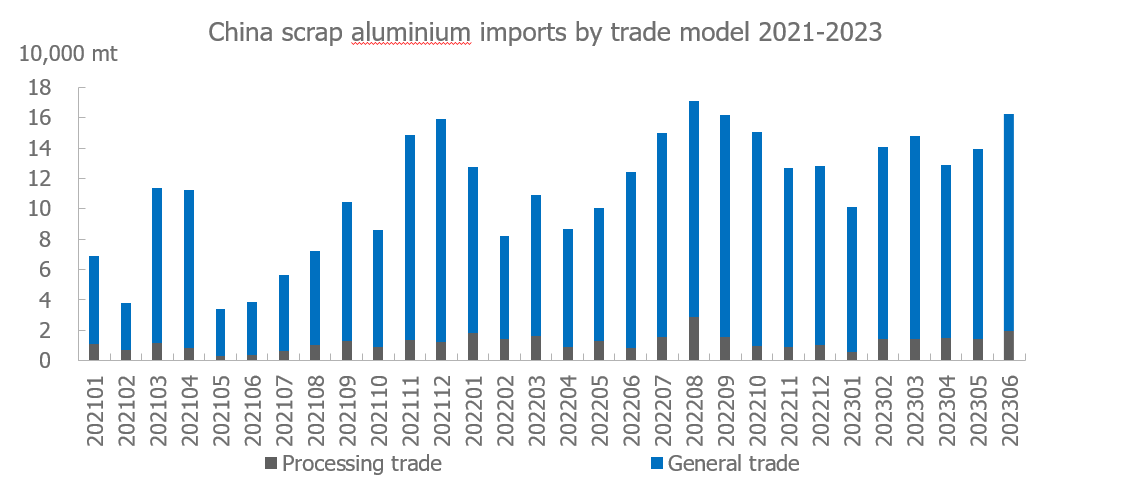
Since July, the domestic scrap aluminium market has been grappling with escalating supply-demand conflicts, occasionally reaching a point where scrap aluminium becomes a scarce commodity. The constrained domestic supply of scrap aluminium has undeniably opened doors for imported scrap aluminium. As per the most recent import data from the General Administration of Customs, June 2023 saw the import of 162,700 mt of scrap aluminium, marking a 30.59% growth from June 2022 and a 16.55% rise from May 2023. The total scrap aluminium imports for the first half of 2023 stood at 821,400 mt, representing a year-on-year increase of 30.29%.
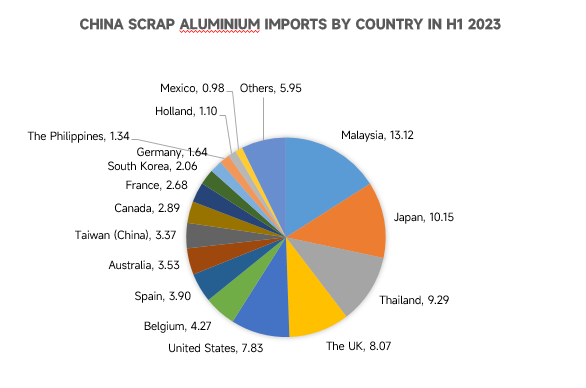
Data from SMM reveals a marked rise in China's scrap aluminium imports this year, outpacing the figures from previous years. Further, by June, the import levels have already exceeded the cumulative figures from January to July of last year. Breaking down the import data by country, Malaysia retains its leadership with an import volume of 24,400 mt from this country. The total volume of scrap aluminium imports from Thailand has also crossed the 20,000 mt mark. Additionally, import volumes from the US, Japan, the UK, and Spain have all recorded exceeded 10,000 mt.
Given the current state of domestic supply and demand for scrap aluminium in China, the domestic supply remains constricted. Amidst the low-level fluctuations in aluminium prices, upstream suppliers are exercising caution. While the downstream demand hasn't been robust, there persists a solid demand. Consequently, we anticipate that scrap aluminium imports will maintain their upward trajectory in July.
Considering the import of scrap aluminium, and with the prevailing tight domestic supply, the forthcoming implementation of new standards for secondary cast aluminium alloys, set to take effect from December 1, poses a question: could this herald a fresh development opportunity for the future of scrap aluminium imports? SMM asserts that imported scrap aluminium will remain a significant component of China's scrap aluminium supply chain, and this year, the monthly import volumes could consistently break previous records. The implementation of new import standards for secondary cast aluminium alloys could potentially usher in a novel phase of development for scrap aluminium imports.
Firstly, the contraction of the overall supply of scrap aluminium in China for 2023 has been substantiated. This can be attributed to several factors: a marked drop in the amount of social scrap aluminium entering the recycling process, and in conjunction with the lackluster performance of the aluminium consumption market in 2023, the supply of newly generated scrap aluminium in the downstream processing of aluminium products has similarly decreased. However, the domestic need for scrap aluminium in China remains pressing. Despite the current tepid market performance, the progress of the dual carbon goal, along with the ongoing expansion and fresh investments in recycled aluminium projects, have buoyed the industry. SMM data indicates that in just the first half of 2023, approximately 23 new and restarted secondary aluminium projects emerged in China, with a combined capacity of 7.72 million mt. The secondary aluminium industry's demand for scrap aluminium is expected to grow steadily.
Secondly, the newly released official guidelines for the updated Recycled Cast Aluminium Alloy Raw Material GB/T 38472-2023 are set to officially come into force from December 1, 2023, superseding the currently implemented GB/T 38472-2019 standard entirely. The updated standard explicitly categorizes turnings as a primary material for recycled aluminium, and also encompasses wrought aluminium alloys, thereby approving the import of compliant aluminium blocks, recycled aluminium ingots, among others. The enforcement of these novel regulations could potentially amplify the import volume of corresponding scrap aluminium varieties.
Nonetheless, it's worth emphasizing that as China heightens its focus and regulation of the recycling industry for renewable resources, coupled with the industry's gradual maturation, the domestic supply of scrap aluminium will maintain its dominance going forward. With the market's gradual resurgence and the rise in the volume of social scrap aluminium, this domestic supply will continue to play an integral role.