Key Points: Ouyang Minggao, an academician of the Chinese Academy of Sciences, pointed out that large-scale mass production of all-solid-state batteries still requires 3-5 years, and test vehicles are expected to appear by the end of 2026. China’s patent count has already risen to first place globally, while the cost of the core material, sulphide electrolyte, has fallen from 20 million yuan/mt to the million-yuan level. However, he stressed that the technology is extremely difficult and advised consumers that there is “no need to wait”; LFP batteries remain the current “ballast stone.” Industry consensus: 2026 is the starting point for semi-solid-state battery vehicle installation, while commercialisation of all-solid-state batteries is expected after 2030.
On March 13, 2026, at the Expert Media Exchange Conference of the 2026 CAAM Think Tank Research Institute and the media briefing for the High-Level Forum on Intelligent EV Development, Ouyang Minggao, an academician of the Chinese Academy of Sciences and a professor at Tsinghua University, systematically elaborated on his latest views regarding the industrialisation of solid-state batteries.
I. Industrialisation Timetable: Large-Scale Mass Production Still Requires 3-5 Years
Academician Ouyang Minggao clearly pointed out that despite strong market enthusiasm, large-scale mass production of all-solid-state batteries still needs time.
Test vehicles are expected to appear: From the end of 2026 to 2027, some test vehicles equipped with all-solid-state batteries are expected to debut.
Large-scale popularization: For all-solid-state batteries to achieve genuine large-scale popularization and practical application, another 3 to 5 years will most likely be required.
II. Clear Technology Roadmap: 400 Wh/kg by 2030, 500 Wh/kg by 2035
Academician Ouyang Minggao clearly divided the industrialisation-related technological breakthroughs for solid-state batteries into three generations and provided specific timelines and targets.
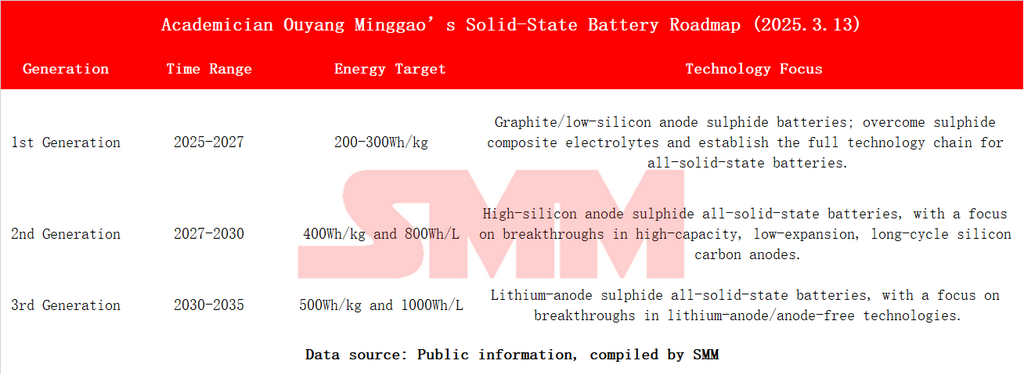
III. Latest Progress and Technical Challenges
1. China is rapidly catching up: China has developed at an astonishing pace in the field of solid-state batteries. Beginning in 2024, it started rapidly catching up, and by 2025, the number of newly disclosed all-solid-state battery patents in China had reached 6,312, accounting for 44.1 of the global total, surpassing Japan and ranking first in the world.
2. Declining cost of key materials: The cost of the core material, sulphide solid-state electrolyte, has dropped sharply from the early 20 million yuan/mt to below 1 million yuan/mt, while capacity has also been increasing rapidly, laying the foundation for industrialisation.
Key materials. Current SMM sulphide electrolyte (LPSC) market prices: kg-level prices are around 10,000 yuan, and mainstream prices for mt-level procurement are 5,000 yuan/kg. In 2026, as the cost decline in the main raw material lithium sulphide drives sulphide electrolyte prices down rapidly, mt-level prices are expected at 3-5 million yuan. Raw material side, current lithium sulphide prices are 2,000 yuan/kg, P₂S₅ 60 yuan/kg, and lithium chloride 110 yuan/kg. 3. Extremely High Technical Barriers: Ouyang Minggao emphasized that solid-state batteries are a revolutionary technology with enormous difficulty and cannot be achieved overnight. At present, they still face a series of scientific and technological challenges that require comprehensive solutions across key materials, interfaces, electrodes, and battery cells.
Electrolyte Stability: The electrochemical, air, and thermal stability of sulphide electrolytes, as well as their interface issues with electrode materials, are the current focus of research efforts.
Composite Electrode Stability: The interfacial reactions and cycling stability of composite cathodes and anodes are key difficulties that urgently need breakthroughs.
Thermal Stability of High-Capacity Battery Cells: As development moves from small laboratory battery cells to high-capacity battery cells for automotive use, the risks related to thermal management and interface failure will be significantly amplified.
IV. Recommendations for Consumers and the Industry
Consumers “Do Not Need to Wait”: For some consumers who are holding funds and waiting to buy solid-state battery car models, Ouyang Minggao advised that they “do not need to wait.” He believed that current EVs using liquid lithium batteries, especially LFP batteries, are already highly mature technologically and can fully meet current needs.
Industry Should “Advance Prudently”: He believed that automakers had better be cautious about selling all-solid-state battery vehicles over the next two years. He emphasized that technological development should proceed step by step and that companies should “not stumble forward in a rush,” so as to avoid safety issues caused by excessive haste.
Relationship With Existing Technologies
LFP Remains the “Ballast Stone”: Ouyang Minggao called the LFP battery “one of the best gifts God has given to the Chinese people.” He believed that even in the era of solid-state batteries, LFP would, by virtue of its advantages in cost, lifespan, and safety, continue to serve for a long time as the foundation and ballast stone of China’s battery industry.
Solid-State Is Not a “Hexagonal Warrior”: He emphasized that solid-state batteries are not omnipotent and cannot break the battery “impossible triangle” of energy density, safety, and cost. Their core value lies in providing higher specific energy while balancing safety and cost as much as possible.
V. Summary
Overall, the industry consensus also supports Academician Ouyang Minggao’s view: 2026 will mark the starting point for small-scale vehicle installation and validation of semi-solid-state batteries, while large-scale commercial application of all-solid-state batteries is expected only after 2030. For ordinary consumers, the current mature and continuously evolving lithium battery technology is the more pragmatic choice.
According to SMM forecasts, all-solid-state battery shipments will reach 13.5 GWh by 2028, while semi-solid-state battery shipments will reach 160 GWh. Global lithium-ion battery demand is projected to reach approximately 2,800 GWh by 2030, with the EV sector's lithium-ion battery demand showing a CAGR of around 11% from 2024 to 2030, ESS lithium-ion battery demand at a CAGR of about 27%, and consumer electronics lithium battery demand at a CAGR of roughly 10%. Global solid-state battery penetration is estimated at about 0.1% in 2025, with all-solid-state battery penetration expected to reach around 4% by 2030, and global solid-state battery penetration potentially approaching 10% by 2035.
**Note:** For further details or inquiries regarding solid-state battery development, please contact:
Phone: 021-20707860 (or WeChat: 13585549799)
Contact: Chaoxing Yang. Thank you!
![[SMM New Energy] Over 1B Yuan Invested: 2GWh Special-Purpose Solid-State Battery R&D and Production Project Commences](https://imgqn.smm.cn/usercenter/BQoXd20251217171731.jpg)
![[Phosphorus Chemical Industry: Wengfu's Wet-Process 85 Phosphoric Acid Rose by 700 yuan Within Half a Month, and Iron Phosphate Production Costs Came Under Upward Pressure]](https://imgqn.smm.cn/usercenter/DdWJZ20251217171731.jpg)