Indonesia's new nickel tariffs and Europe's CBAM have sharply raised overseas stainless steel costs, driving Asian mills to hike prices. Downstream demand remains mixed: Japan and South Korea are resilient, while the Taiwan, China region faces pressure. Wary of rapid price spikes, buyers are limiting purchases to rigid demand. The market will remain cautious until tariff details and actual demand are validated.
I. Macro Environment and Policy Resonance
The global stainless steel market is currently in a period of intense policy-driven volatility, where geopolitical conflicts and trade barriers have caused a significant shift in the cost center of overseas markets. Global energy supply shortages and high oil prices triggered by recent geopolitical conflicts have exacerbated inflation and economic growth pressures for energy-importing nations. To alleviate domestic budget pressures and further force the upgrading of the resource value chain, Indonesian President Prabowo has officially approved the imposition of export tariffs on nickel and coal. This macroeconomic adjustment has fundamentally ignited bullish sentiment within the raw material supply chain. Concurrently, the European market is deeply feeling the heavy impact of green trade barriers. The European Union's Carbon Border Adjustment Mechanism (CBAM), which officially took effect at the beginning of this year, coupled with exorbitant local energy prices and skyrocketing ferrochrome procurement costs, has caused the European chromium-based stainless steel alloy surcharge for April to surge by a maximum of 5.4% in a single month. This signifies that global stainless steel trade is profoundly transforming from simple production cost competition into a contest of navigating complex barriers such as carbon emissions.
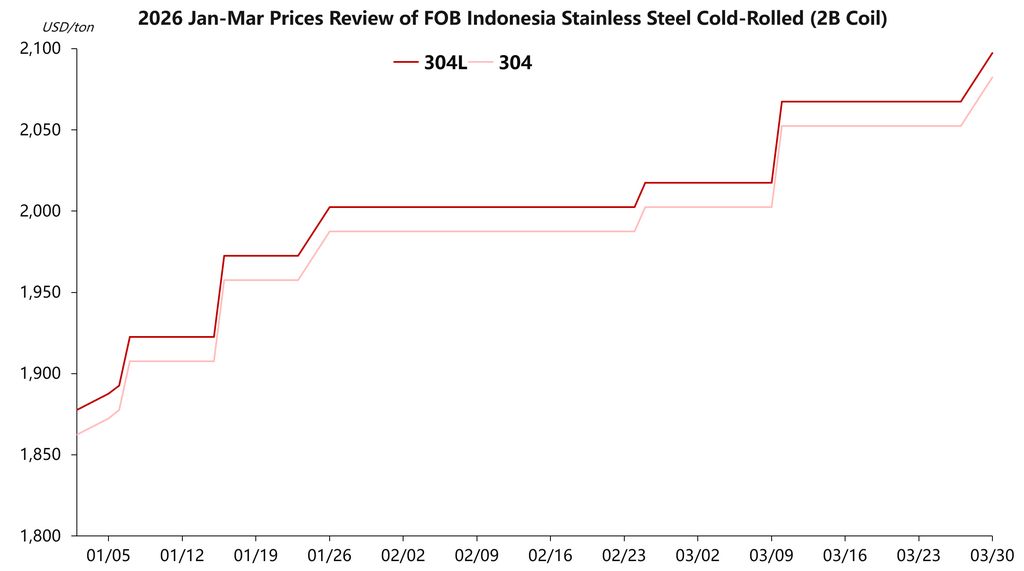
Figure 1: Review of FOB Indonesia Stainless Steel Cold-Rolled Prices
II. Overseas Supply and Demand Dynamics and Market Game
Driven by strong cost-side factors, the overseas supply side has demonstrated a clear willingness to support prices. Indonesian FOB export quotes for stainless steel have remained firmly at high levels, with 304 cold-rolled and 316L cold-rolled stabilizing near $2,052.50/ton and $3,852.50/ton, respectively. Under the combined influence of supply disruptions in Indonesian high-grade nickel ore and climbing domestic electricity costs, steel mills across various Asian regions have densely raised their benchmark prices. Multiple steel mills in the Taiwan region have significantly increased prices for the 316 and 304 series by 4,000 NTD/ton and 2,000 NTD/ton, respectively, while steel mills in Japan and South Korea have closely followed suit with defensive price adjustments. However, behind this strong upward push from the supply side, overseas downstream demand presents a notable structural bifurcation. The Japanese market has shown strong resilience, steadily supported by the semiconductor and automotive industries, while South Korea's booming shipbuilding industry has directly stimulated transaction activity for 316 series products. In contrast, the highly export-dependent Taiwan region continues to face significant order-intake pressure. Because the previous benchmark price increases were too rapid, the broader base of overseas downstream buyers currently harbors a strong fear of high prices. The overall procurement pace is strictly confined to rigid demand, leaving market trading deeply mired in a stalemated game.
III. Market Outlook and Core Variables
Looking ahead, the core pricing logic of the overseas stainless steel market will continue to revolve around the game between strong cost-push factors and demand validation. In the short term, the implementation of the specific tax rates for Indonesia's nickel export tariffs will be the largest macro variable influencing market sentiment, while the reshaping effect of Europe's CBAM on the global flow of semi-finished products will continue to ferment. It is expected that there is still room for further bullishness in the benchmark prices of overseas steel mills in April, but whether these exorbitant costs can be successfully passed down to the downstream sector critically depends on the actual restocking actions of international traders and end-users. Until substantial demand is fully validated and the current high-priced resources are effectively digested, the overseas stainless steel market is highly likely to maintain a stance of high-level oscillation and cautious observation.
![[SMM Analysis] Stainless Futures Rebound in the Final Week of “Golden March” as Macro Support Offsets Weak Fundamentals](https://imgqn.smm.cn/production/admin/votes/imagesFURVz20260313180700.jpeg)