【SMM Analysis】Pr-Nd Alloy Profits Hit 2-Year High as Raw Material Costs Decline

Published: Mar 20, 2026 19:10
【SMM Analysis】As of this week, the weekly net profit of Pr-Nd alloy reached 36,812.4 yuan, with a net margin of 4.1%. Compared with last week, net profit increased 134%, setting a new profit high for the past nearly two years. The main reasons behind this were the decline in raw material costs and relatively high metal quotes.
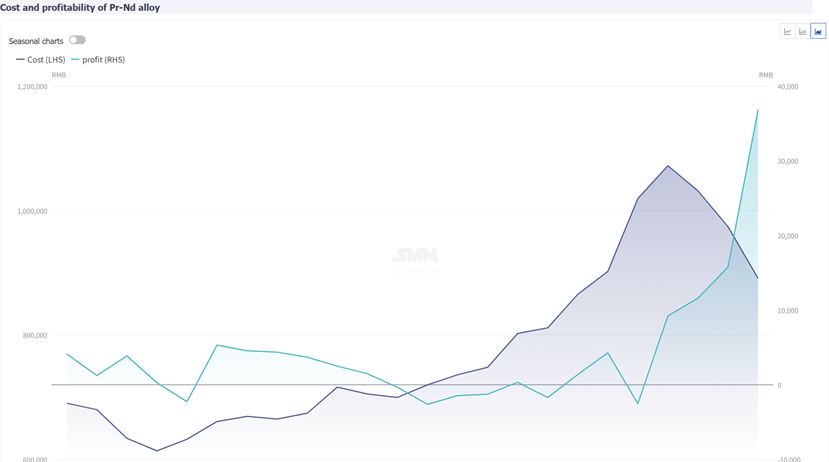
SMM, March 20: As of this week, the weekly net profit of Pr-Nd alloy reached 36,812.4 yuan, with a net margin of 4.1%. Compared with last week, net profit increased 134%, setting a new profit high for the past nearly two years. The main reasons behind this were the decline in raw material costs and relatively high metal quotes.


The main raw material for Pr-Nd alloy is Pr-Nd oxide, which accounted for more than 95% of its cost. Recently, affected by market sentiment, Pr-Nd oxide futures prices kept falling. Some traders lacked confidence in future prices and proactively cut prices to make shipments, which in turn caused Pr-Nd oxide spot prices to continue declining. Under this impact, the cash cost of Pr-Nd alloy had fallen significantly for three consecutive weeks, dropping 16.9% from 1,071,789.2 yuan at the end of February to 890,687.6 yuan.
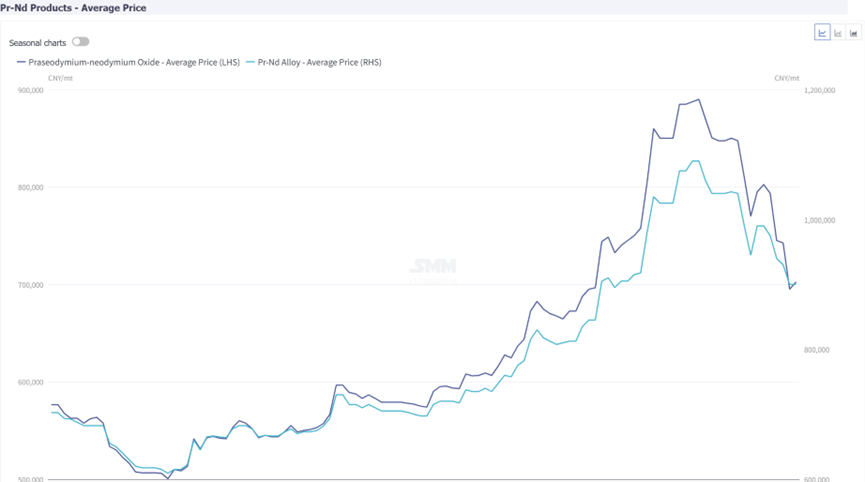
As for why Pr-Nd alloy quotes remained relatively high, the reason was that as the decline in Pr-Nd oxide prices continued to widen, cost pressure from inventory at metal enterprises became increasingly prominent. At the same time, spot inventory of Pr-Nd alloy was tight, and metal enterprises' production schedules for orders were relatively full, further intensifying their reluctance to sell at low prices. Against the backdrop of continued pullbacks in Pr-Nd oxide prices this week, although metal enterprises also lowered their quotes, the decline was smaller than that of Pr-Nd oxide. Moreover, when Pr-Nd oxide prices pulled back sharply, metal enterprises generally chose to suspend quotations to avoid wild swings in raw material market prices. Although the pullback in Pr-Nd oxide prices provided metal enterprises with an opportunity to buy low-priced raw materials to hedge against inventory cost pressure, under the market mentality of “rush to buy amid continuous price rise but refrain from selling amid falling prices,” their procurement behavior remained relatively cautious, mainly consisting of small-volume restocking for rigid demand, so inventory cost pressure still remained. In the short term, as market sentiment recovered, Pr-Nd oxide futures prices will be raised, and its spot prices will also recover accordingly. This change will push up the cash cost of Pr-Nd alloy, thereby reducing the net profit of Pr-Nd alloy.

Data Source Statement: Except for publicly available information, all other data are processed by SMM based on publicly available information, market communication, and relying on SMM‘s internal database model. They are for reference only and do not constitute decision-making recommendations.

For any inquiries or to learn more information, please contact: lemonzhao@smm.cn
For more information on how to access our research reports, please contact:service.en@smm.cn
Related News
South Korea to Exempt Tariffs on Overseas-Sourced Critical Minerals
Common.Time.hoursAgo
South Korea to Exempt Tariffs on Overseas-Sourced Critical Minerals
Read More
South Korea to Exempt Tariffs on Overseas-Sourced Critical Minerals
On the 25th, it was confirmed that the South Korean government will exempt tariffs of 3–8% on critical minerals such as lithium, graphite, and rare earth elements when domestically owned companies directly produce and import them from overseas. The Ministry of Trade, Industry and Energy has pre-announced a new regulation outlining tariff exemptions for overseas resource development projects. Under the policy, a total of 14 critical minerals—including lithium, graphite, nickel, cobalt, manganese, copper, zinc, and rare earth elements such as lanthanum, cerium, neodymium, terbium, dysprosium, yttrium, and scandium—will be eligible for duty exemption when brought into the country. The regulation is set to take effect on April 3.
Common.Time.hoursAgo
Rare Earth Prices Fluctuated Relatively Little, While Downstream Procurement Demand Remained Weak [SMM Rare Earth Weekly Review]
Common.Time.hoursAgo
Rare Earth Prices Fluctuated Relatively Little, While Downstream Procurement Demand Remained Weak [SMM Rare Earth Weekly Review]
Read More
Rare Earth Prices Fluctuated Relatively Little, While Downstream Procurement Demand Remained Weak [SMM Rare Earth Weekly Review]
[SMM Rare Earth Weekly Review: Rare Earth Prices Saw Relatively Small Fluctuations, While Downstream Procurement Demand Remained Weak] The Pr-Nd oxide market was relatively calm this week. Demand from downstream metal plants was sluggish, but upstream supply also remained tight. Suppliers were unwilling to make shipments at low prices, and the back-and-forth negotiations between upstream and downstream remained in a stalemate. Pr-Nd oxide prices saw small fluctuations to 710,000-715,000 yuan/mt.
Common.Time.hoursAgo
Energy Fuels Produces First Terbium Oxide in US, Boosting Domestic Rare Earth Supply Chain
Common.Time.hoursAgo
Energy Fuels Produces First Terbium Oxide in US, Boosting Domestic Rare Earth Supply Chain
Read More
Energy Fuels Produces First Terbium Oxide in US, Boosting Domestic Rare Earth Supply Chain
US rare earth producer Energy Fuels announced that its White Mesa mill in Utah has successfully produced its first batch of terbium oxide with a purity of 99.9. This marks the first time in decades that the US has produced this heavy rare earth element from primary mineral raw materials, using monazite mined in Florida and Georgia. The company had previously trial-produced dysprosium oxide at the facility and is expected to expand heavy rare earth capacity in the coming years. It is estimated that upon completion of the second-phase expansion in 2029, the White Mesa mill will have the annual capacity to produce dysprosium oxide (288 mt), terbium oxide (80 mt), and Pr-Nd oxide (6,000 mt), supporting the development of a domestic rare earth supply chain in the US.
Common.Time.hoursAgo
Register to Continue Reading
Gain access to the latest insights in metals and new energy
Already have an account?sign in here