A Panoramic View of Solid-State Battery Anodes: The Triple Game of Technology, Capacity, and Market

Published: Feb 9, 2026 22:06
The industrialization of solid-state battery anodes follows a clear technological progression, closely linked to the maturity of the electrolyte system: first, compatibility and improvement—silicon-based/composite anodes; second, upgrading and breakthroughs—pre-lithiation/composite lithium metal anodes; and third, the ultimate goal—pure lithium metal anode capacity deployment.
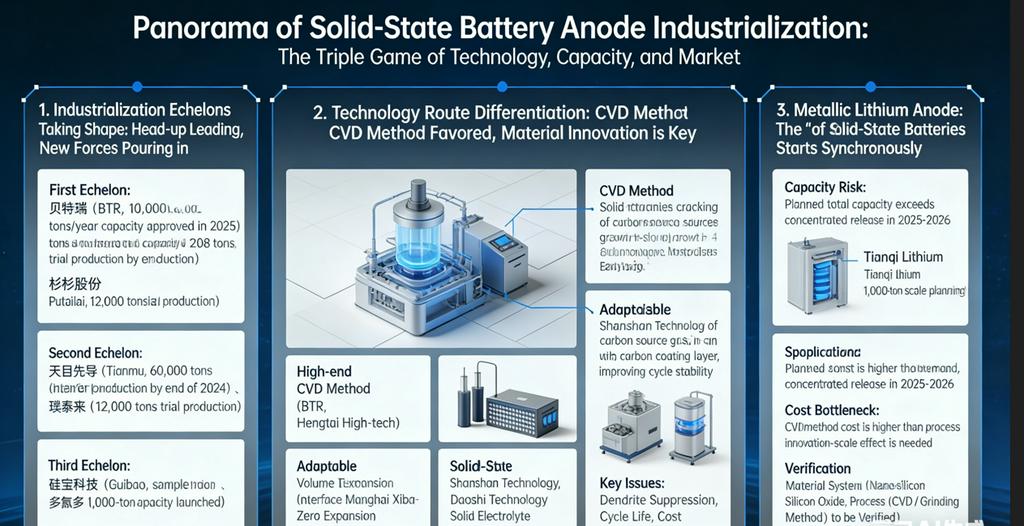
The industrialization of solid-state battery anodes follows a clear technological progression, closely linked to the maturity of the electrolyte system: first, compatibility and improvement—silicon-based/composite anodes; second, upgrading and breakthroughs—pre-lithiation/composite lithium metal anodes; and third, the ultimate goal—pure lithium metal anode capacity deployment.


According to SMM forecasts, all-solid-state battery shipments will reach 13.5 GWh by 2028, while semi-solid-state battery shipments will reach 160 GWh. Global lithium-ion battery demand is projected to reach approximately 2,800 GWh by 2030, with the EV sector's lithium-ion battery demand showing a CAGR of around 11% from 2024 to 2030, ESS lithium-ion battery demand at a CAGR of about 27%, and consumer electronics lithium battery demand at a CAGR of roughly 10%. Global solid-state battery penetration is estimated at about 0.1% in 2025, with all-solid-state battery penetration expected to reach around 4% by 2030, and global solid-state battery penetration potentially approaching 10% by 2035.

**Note:** For further details or inquiries regarding solid-state battery development, please contact:
Phone: 021-20707860 (or WeChat: 13585549799)
Contact: Chaoxing Yang. Thank you!
Data Source Statement: Except for publicly available information, all other data are processed by SMM based on publicly available information, market communication, and relying on SMM‘s internal database model. They are for reference only and do not constitute decision-making recommendations.

For any inquiries or to learn more information, please contact: lemonzhao@smm.cn
For more information on how to access our research reports, please contact:service.en@smm.cn
Related News
Toyota and Nissan See Sales Growth in China, While Honda Continues to Decline Amid EV Launch Delays
Common.Time.minsAgo
Toyota and Nissan See Sales Growth in China, While Honda Continues to Decline Amid EV Launch Delays
Read More
Toyota and Nissan See Sales Growth in China, While Honda Continues to Decline Amid EV Launch Delays
Among Japan's three major automakers, Toyota and Nissan saw increased sales in China in January, while Honda continued to decline. Toyota's sales rose 6.6% YoY to 145,500 units, marking the first increase in five months. Nissan's sales grew 10.1% YoY to 50,024 units, the first rise in two months. Honda's sales fell 16.5% YoY to 57,489 units, declining for the 24th consecutive month, due to delays in launching new EV models.
Common.Time.minsAgo
Mercuria Acquires First Copper and Cobalt Batch from DRC's State-Owned EGC Company
Common.Time.minsAgo
Mercuria Acquires First Copper and Cobalt Batch from DRC's State-Owned EGC Company
Read More
Mercuria Acquires First Copper and Cobalt Batch from DRC's State-Owned EGC Company
Energy and commodities trader Mercuria recently announced the completion of its first copper and cobalt transaction with the Democratic Republic of Congo's (DRC) state-owned cobalt company, EGC, marking a significant step forward in their cooperation in the field of critical metals. The deal was reached against the backdrop of the DRC government's introduction of a cobalt export quota system last year, while also requiring the implementation of EGC's mineral supply chain management and responsible sourcing standards in the artisanal and small-scale mining sector. Under the arrangement, the copper cathodes involved in the transaction will be shipped to markets such as the US, the UAE, or Saudi Arabia.
Common.Time.minsAgo
EGC and Trafigura transport copper and cobalt to global markets via the Lobito Atlantic Railway.
Common.Time.minsAgo
EGC and Trafigura transport copper and cobalt to global markets via the Lobito Atlantic Railway.
Read More
EGC and Trafigura transport copper and cobalt to global markets via the Lobito Atlantic Railway.
The Democratic Republic of Congo's (DRC) state-owned cobalt company, EGC, and the commodity trader Trafigura recently completed the first shipment of copper and cobalt products to the international market via the Lobito Atlantic Railway (LAR), marking a significant advancement in the logistics system for DRC's ore exports. The Lobito Railway, approximately 1,300 kilometers long, connects the deep-water port of Lobito on Angola's Atlantic coast to the DRC border city of Luau and further extends to Kolwezi, the core area of DRC's copper-cobalt resources. This reduces the land transport time from the mining area to African ports to approximately seven days, making it the shortest and most efficient route connecting DRC's mineral resources to the global market.
Common.Time.minsAgo