[SMM Analysis] Titanium Dioxide Prices Rise Post-Holiday, Geopolitical Risks Cloud Export Outlook

Published: Mar 3, 2026 13:02
As of March 3, domestic titanium dioxide prices edged up, driven by post-holiday price hike announcements from both chloride and sulfate producers. The rally is supported by rising sulfuric acid costs, improving demand, and low inventory levels. However, escalating geopolitical tensions have disrupted shipping routes, affecting key export markets including India and the Middle East. Near-term focus remains on downstream restocking and the evolving geopolitical landscape.

Cost, Demand, and Supply Resonate, Titanium Dioxide Sees Post-Holiday Price Hikes

As of March 3, SMM data showed that domestic titanium dioxide prices were stable with an upward trend. Among them, the price of anatase titanium dioxide was quoted at 12,100-12,500 yuan/mt, with an average of 12,300 yuan/mt; the price of rutile titanium dioxide was quoted at 12,800-14,500 yuan/mt, with an average of 13,650 yuan/mt; the price of chloride process titanium dioxide was quoted at 14,000-17,200 yuan/mt, with an average of 15,600 yuan/mt.

After the Chinese New Year holiday, the titanium dioxide market regained momentum. In the week following the holiday, several chloride process enterprises first issued price adjustment letters, leading the gains in March orders; subsequently, from last Saturday to this Tuesday, many sulphuric acid process titanium dioxide enterprises also followed up by issuing price increase letters, raising their quotes, sparking a wave of price hikes in the industry post-holiday.

SMM analysis indicated that this round of price increases was mainly driven by three factors: First, cost support strengthened, as the current high prices of sulphuric acid kept raw material costs elevated, and the industry generally faced losses pressure in H2 2025; second, demand showed a positive recovery, with domestic trade orders steadily increasing and foreign trade orders recovering since November 2025, signaling a positive release from the demand side; third, supply tightened, as some outdated capacity was gradually phased out, optimizing the industry's capacity structure, and concentrated factory maintenance during the Chinese New Year period led to low inventory levels overall.

In summary, under the multiple favorable conditions of cost support, demand recovery, and supply tightening, titanium dioxide enterprises took advantage of the March order window to raise their quotes, laying a solid foundation for the 2026 titanium dioxide market. 
Geopolitical Conflicts Disrupt Ocean Shipping, Titanium Dioxide Foreign Trade Faces Early Year Challenges

On February 28, the US and Israel launched a joint military strike against Iran, suddenly escalating geopolitical tensions, further intensifying the uncertainty of the global supply chain, potentially causing significant disruptions to the titanium dioxide foreign trade market that had been gradually recovering since the beginning of the year.

According to the SMM survey, the escalation of the conflict has led to increased volatility in the shipping market: some routes in the Middle East have suspended operations, with ocean freight rates surging dramatically; in India, affected by the disruption of the Persian Gulf route, ocean freight rates doubled over three consecutive days; although the overall impact on the European market was relatively limited, ocean freight prices also showed an upward trend.

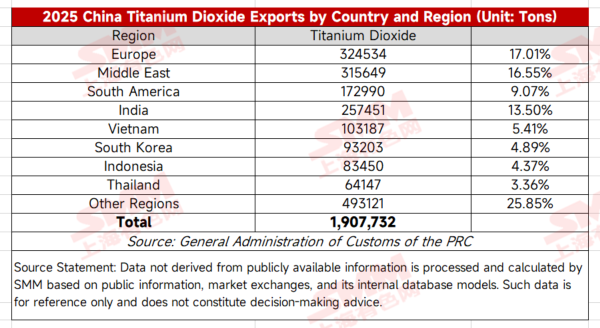
In terms of export structure, China's titanium dioxide market is highly dependent on overseas markets. Customs data shows that in 2025, China's total titanium dioxide exports reached 1.908 million mt, with Europe accounting for 17% (325,000 mt), the Middle East 17% (320,000 mt), and the Indian market 13.5% (257,000 mt). These regions collectively account for nearly half of the total export volume, and the transportation disruptions caused by the geopolitical conflicts have already had a substantial impact on the related markets.

The current foreign trade market faces dual uncertainties: first, the sharp rise in ocean shipping costs, leading to delays in some shipments, putting cost side pressure on exporters and agents; second, although India canceled anti-dumping duties on Chinese titanium dioxide starting from October 2025, short-term fluctuations in shipping capacity may interfere with the pace of new orders. Overall, the post-holiday recovery process of the foreign trade market is encountering significant external resistance.

Looking ahead, whether domestic titanium dioxide price increases can truly materialize will depend on observing the downstream resumption pace in March and the follow-up of new orders. In terms of foreign trade, it is necessary to closely monitor the duration of the impact of geopolitical conflicts on ocean shipping and freight rates, as well as the order recovery pace in key markets such as India and the Middle East. 

Data Source Statement: Except for publicly available information, all other data are processed by SMM based on publicly available information, market communication, and relying on SMM‘s internal database model. They are for reference only and do not constitute decision-making recommendations.

For any inquiries or to learn more information, please contact: lemonzhao@smm.cn
For more information on how to access our research reports, please contact:service.en@smm.cn
Related News
Ganzhou Tungsten Association Significantly Raises Its March 2026 Tungsten Market Forecast Price
Common.Time.minsAgo
Ganzhou Tungsten Association Significantly Raises Its March 2026 Tungsten Market Forecast Price
Read More
Ganzhou Tungsten Association Significantly Raises Its March 2026 Tungsten Market Forecast Price
[Tungsten Industry News Flash] SMM, March 5: Ganzhou Tungsten Association’s forecast tungsten market prices for March 2026: 55% black tungsten ore concentrate at 900,000 yuan/standard tonne (65%WO3 basis), up 230,000 yuan/standard tonne MoM from February; ammonium paratungstate at 1.33 million yuan/mt, up 360,000 yuan/mt MoM; medium-grain tungsten powder at 2,200 yuan/kg, up 570 yuan/kg MoM.
Common.Time.minsAgo
Magnesium Market’s Short-Term Volatile Pattern Unchanged; Downstream Resumption of Work and Geopolitical Developments Become Key Variables [SMM Magnesium Weekly Review]
1 hour ago
Magnesium Market’s Short-Term Volatile Pattern Unchanged; Downstream Resumption of Work and Geopolitical Developments Become Key Variables [SMM Magnesium Weekly Review]
Read More
Magnesium Market’s Short-Term Volatile Pattern Unchanged; Downstream Resumption of Work and Geopolitical Developments Become Key Variables [SMM Magnesium Weekly Review]
[SMM Weekly Magnesium Review: The Short-Term Volatile Pattern in the Magnesium Market Remained Unchanged, with Downstream Resumption and Geopolitical Developments Becoming Key Variables] This week, the domestic dolomite market held steady, with the supply side showing regional structural divergence: top-tier enterprises in the Wutai area halted production, while other major producing regions replenished capacity in a timely manner, keeping overall national supply broadly stable. On the demand side, operating rates at primary magnesium enterprises in Shaanxi, Shanxi, and Inner Mongolia remained stable, rigid demand was released in an orderly manner, and raw material inventory was ample, reinforcing the foundation for market stability. The domestic magnesium ingot market consolidated at high levels, the tug-of-war between sellers and buyers intensified, and prices fluctuated rangebound. On the supply side, support came from costs and tight spot cargo, enterprises showed strong reluctance to sell, low-priced supply was scarce, and bargaining room was extremely limited. On the demand side, both domestic and overseas demand were weak: in domestic trade, downstream buyers only restocked for rigid demand and purchasing intensity was relatively weak; in export markets, escalation in the Middle East situation disrupted shipping and pushed up ocean freight rates, export shipments were suspended, overseas purchasing plans were delayed, and amid the supply and demand stalemate, prices lacked momentum for a one-way move. The export market for magnesium ingot was hit by fluctuations in ocean freight rates and international developments, with strong wait-and-see sentiment across the industry, weak transactions, and rising uncertainty. The magnesium powder market, supported by raw materials, stayed stable with slight adjustments, mainly fulfilling earlier orders; new orders were few, and both domestic and export markets remained cautious. The magnesium alloy market held up well: magnesium ingot and aluminum ingot prices reinforced cost support, enterprise operating rates rebounded slightly, and demand recovered as downstream die-casting plants gradually resumed operations. Market transactions were mild, and prices were expected to remain largely stable in the short term.
1 hour ago
Production Declines + Foreign Trade Under Pressure! In February, the Magnesium Market Was Attacked on Both Fronts; Can Domestic Demand Fill the Gap and Sustain Hopes for a March Recovery? [SMM Analysis]
Common.Time.hoursAgo
Production Declines + Foreign Trade Under Pressure! In February, the Magnesium Market Was Attacked on Both Fronts; Can Domestic Demand Fill the Gap and Sustain Hopes for a March Recovery? [SMM Analysis]
Read More
Production Declines + Foreign Trade Under Pressure! In February, the Magnesium Market Was Attacked on Both Fronts; Can Domestic Demand Fill the Gap and Sustain Hopes for a March Recovery? [SMM Analysis]
[Production Declines + Foreign Trade Under Pressure! The Magnesium Market Faced Challenges on Both Fronts in February; Can Domestic Demand Fill the Gap and Sustain Hopes for a March Recovery?] In February 2026, magnesium prices fluctuated rangebound within a price range of 16,400-16,800 yuan/mt, with the February average price at 16,464 yuan/mt, flat MoM.
Common.Time.hoursAgo