5. April 2026
As of April 2, 2026 by Florian Grummes
Since the outbreak of the US-Iran war on February 28, 2026, financial and commodity markets have experienced a severe correction and roller-coaster ride. While the gold price surged rapidly to $5,419 per ounce during the first two days of the war, it fell back to a low of $4,099 over the following three weeks.
Silver came under even greater pressure: from the high of $96.42, it temporarily dropped -36.8% to $61.00. However, since these panic lows on March 23, the precious metals have recovered noticeably within ten days – gold to $4,800, silver to $76.41.
On this Maundy Thursday, however, deep red signs prevail once again, as US President Trump announced a continuation of attacks overnight.
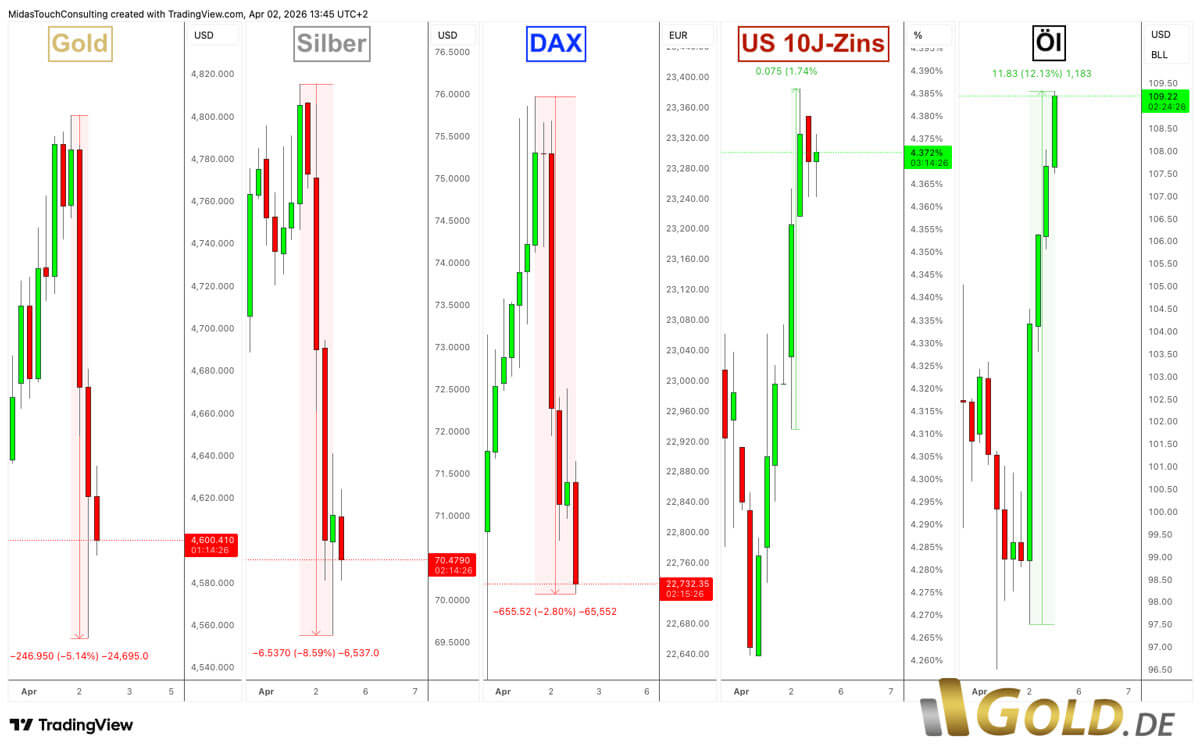
Markets on Maundy Thursday, April 2, 2026. ©GOLD.DE
The gold price was immediately sold off from $4,800 to $4,554, while silver slid from $76.41 to $69.63, dropping -8.84% within eight hours (!).
Simultaneously, both the oil price (+12.13%) and global bond yields (US 10-year Treasury yield: 4.37%) rose sharply again. Markets are swinging with high volatility between hope and panic, and much suggests that the full extent of this geopolitical tragedy has not yet been priced into equity markets.
The geopolitical and macroeconomic dynamics surrounding the US-Iran conflict are having far-reaching consequences for commodity, bond, and equity markets. The dense and complex interplay of geopolitical tensions, de-dollarization, rising interest rates, commodity shortages, and global liquidity constraints offers little prospect of relief in the foreseeable future. On the contrary – much suggests that the situation will unfortunately continue to escalate.
Investors should therefore exercise utmost caution, maintain high liquidity, and strategically accumulate precious metals during significant pullbacks. Gold and silver are not only classic safe-haven investments, but also a silent statement – a reflection of the fragility of modern civilization, insurance against human hubris.
Friedrich August von Hayek already reminded us that today’s world, which sustains billions of people, rests on the foundation of private property. His words carry more weight today than ever: if this moral foundation is undermined, the system that created prosperity and order collapses. In this sense, gold and silver are more than just commodities – they are symbols of true ownership, incorruptible and independent of state arbitrariness or monetary manipulation. They represent what Hayek understood as true order: a system of trust that has inherent stability.
Silver in USD – Weekly Chart in Correction Mode
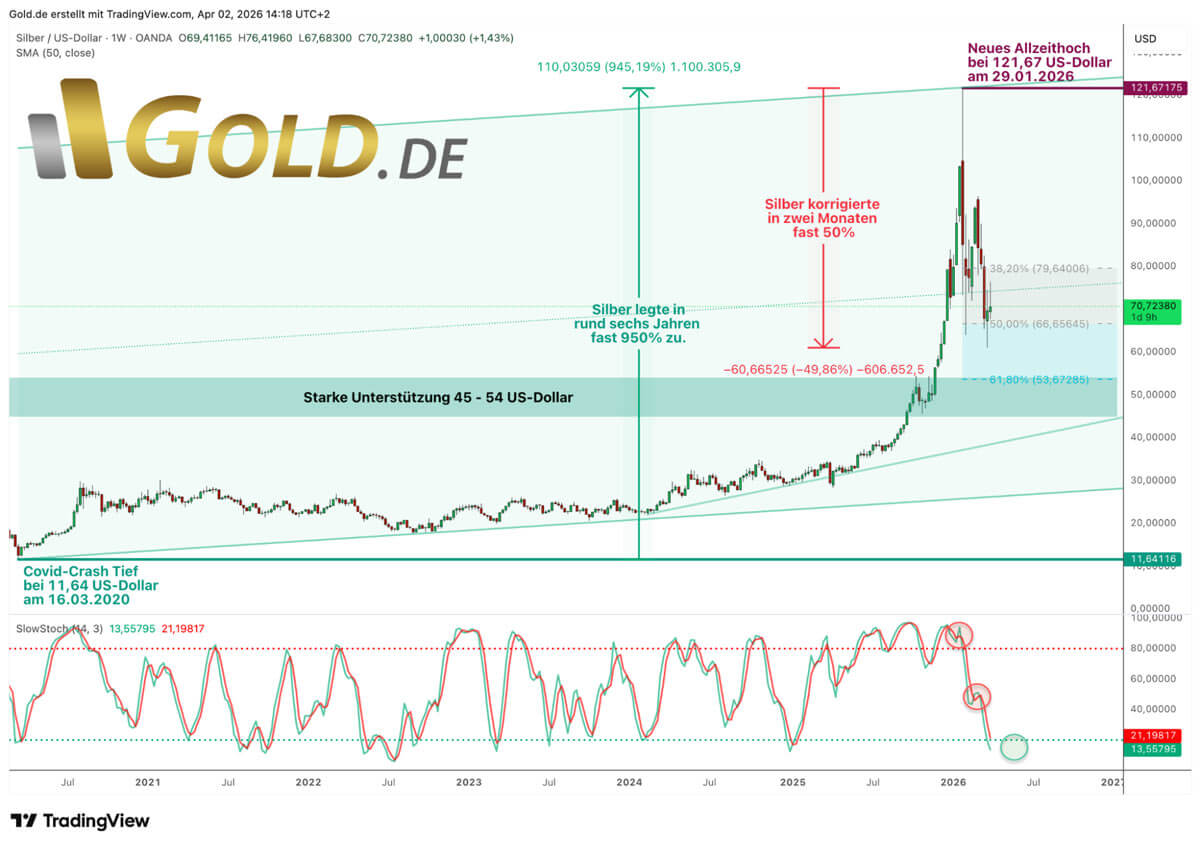
Silver in US dollars, weekly chart from April 2, 2026. ©GOLD.DE
Looking at the big picture, the silver price has risen by an impressive 945% in nearly six years since the panic low during the Corona crisis on March 16, 2020. On January 29, it finally reached an exuberant high of $121.67.
The subsequent correction phase since late January has so far led to a low of $61 – a decline of approximately 50% from the new silver all-time high. The bears have thus successfully breached both the 38.2% and 50% retracement levels, largely correcting the steep price increase since mid-November.
While the weekly stochastic has now reached oversold territory, a new buy signal has not yet been generated.
The next classic Fibonacci level awaits at 61.8%, or $53.67. In this area, silver would enter the broad support zone around the former resistance at $50, which held for decades. We consider it likely that the market will test this zone again – either directly or through a protracted and complicated correction phase.
Silver in USD – Recovery on Daily Chart Still Has Room
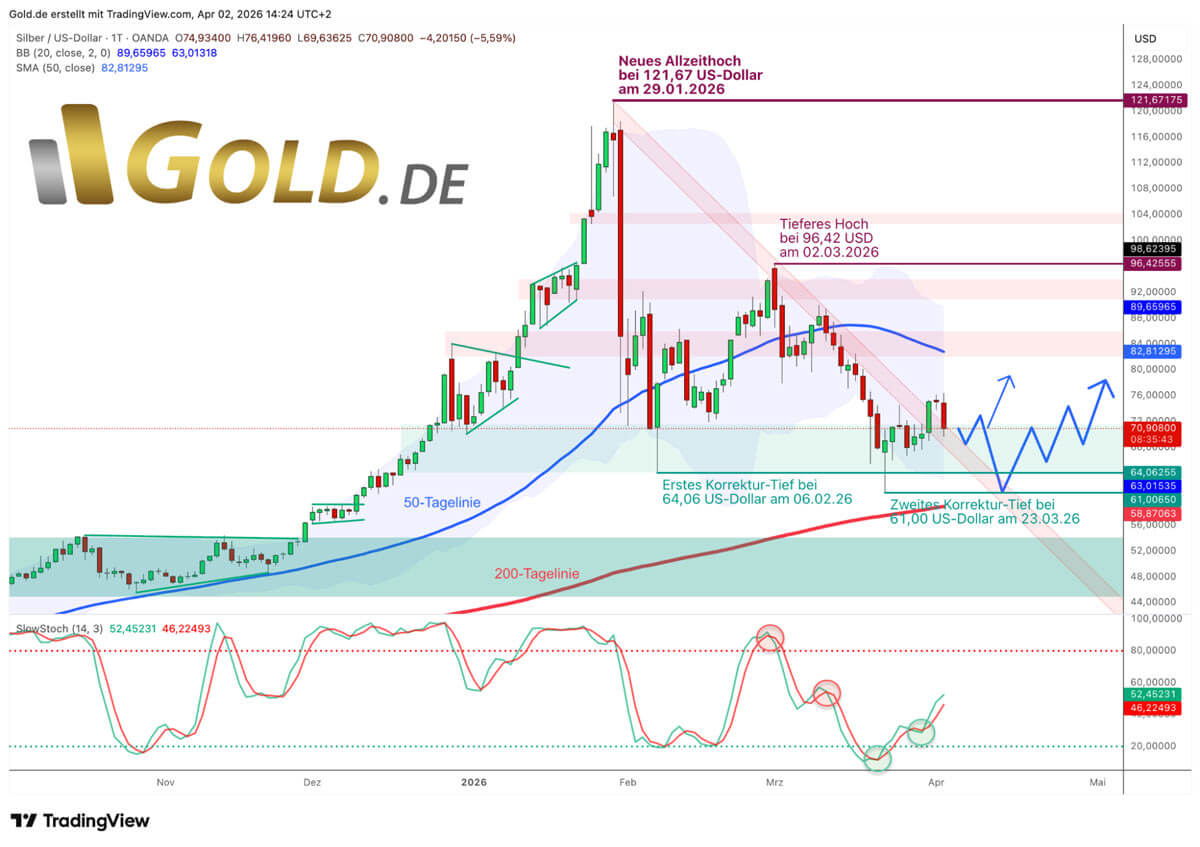
Silver in US dollars, daily chart from April 2, 2026. ©GOLD.DE
As suspected two weeks ago, the correction in the silver price initially continued. The sell-off accelerated from March 18 and led to another panic low on March 23, this time at $61. Subsequently, the silver price recovered hesitantly at first, then more clearly the day before yesterday, reaching $76.41.
However, the sharp pullback on this Maundy Thursday (down -8.84% within eight hours at its peak) already raises doubts about the sustainability of the recovery that has begun. Such strong and impulsive pullbacks are more characteristic of a continuing corrective market environment.
Nevertheless, the new stochastic buy signal on the daily chart has survived the recent pullback so far. To further brighten the technical picture, however, the bulls would need to push through a continuation of the recovery to the falling 50-day line ($82.80) as soon as possible.
Overall, the current picture for the silver market is mixed and partly contradictory: while the weekly chart suggests further correction potential, a first recovery has already established itself on the daily chart. As long as silver prices can hold above $68, the chances are good that the upward movement will continue toward $80 to $83.
Conclusion: Silver – Fragile Recovery
In the end, the picture condenses into an uncomfortable but clear insight: the current weakness in silver is less an isolated market phenomenon than an expression of a profound upheaval in the global financial system. Between geopolitical escalation, structural liquidity pressure, and growing pressure from bond markets, even classic safe havens are coming under temporary pressure.
The fragile recovery in silver thus symbolizes a world in transition – toward a new order in which trust is no longer taken for granted but increasingly questioned. In the short term, the environment remains characterized by high volatility, contradictory signals, and tactical setbacks. Further pullbacks, including toward the major support zone around $50, are not only possible but even likely in the context of an ongoing correction.
In the long term, however, the benchmark is shifting: in a system of growing debt, political interference, and monetary uncertainty, real, non-arbitrarily reproducible assets are gaining increasing importance. Silver thus remains – despite all fluctuations – a strategic building block.
Not because it rises in the short term, but because it embodies something that is increasingly being lost in the global financial system: scarcity, substance, and true ownership.