SMM, June 15:
Metal markets:
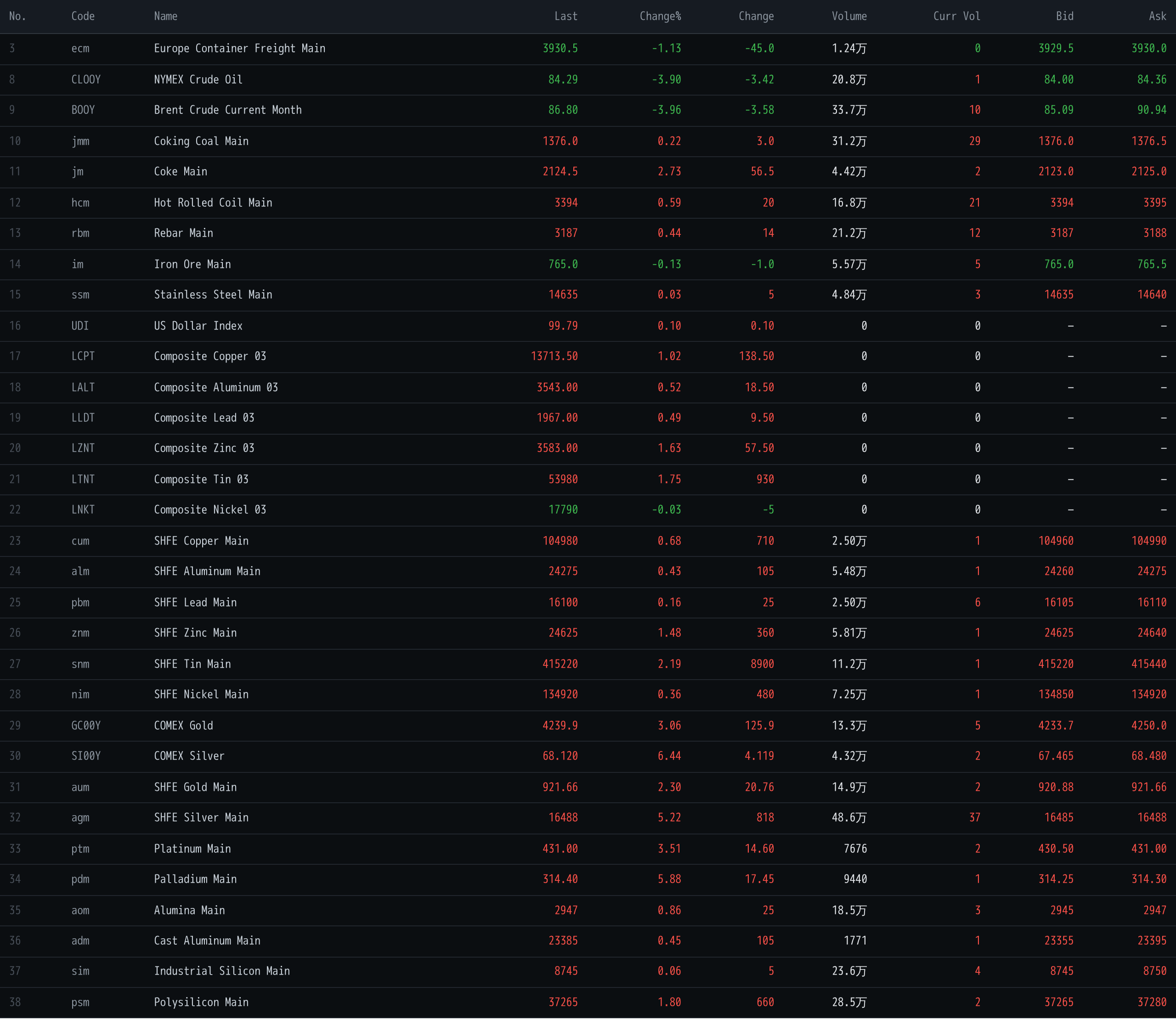
Last Friday’s overnight session saw broad gains across base metals in and outside China, with only LME nickel edging down 0.03%. SHFE tin led the gains, rising 2.19%. LME copper, LME zinc, LME tin and SHFE zinc all gained over 1%: LME copper rose 1.02%, LME zinc rose 1.63%, LME tin rose 1.75% and SHFE zinc rose 1.48%, while the rest of the metals gained less than 1%. In addition, the alumina main contract rose 0.86% and the foundry aluminum main contract rose 0.45%.
Last Friday’s overnight session for ferrous metals saw rises across the board except for iron ore, which fell 0.13%. Rebar rose 0.44% and HRC rose 0.59%. On the coking coal and coke front, coking coal rose 0.22% and coke rose 2.73%.
Last Friday’s overnight session saw precious metals rebound collectively. COMEX gold rose 3.06% and COMEX silver rose 6.44%. However, due to notable earlier declines, COMEX gold still recorded a weekly loss of 2.87%, marking its second consecutive weekly drop. COMEX silver recorded a weekly loss of 1.42%, marking its fifth consecutive weekly drop. Domestically, SHFE gold rose 2.30% and SHFE silver rose 5.22%. SHFE gold posted a weekly loss of 6.79%, also marking its fifth consecutive weekly drop. SHFE silver plummeted 10.14% for the week, also marking a five-week losing streak.
Bank of China issued an announcement, stating that global geopolitics and the US Fed's monetary policy are currently subject to considerable uncertainty. Under the influence of multiple factors, price fluctuations of precious metals in and outside China have further intensified. To protect the interests of clients involved in precious metals-related businesses—such as accumulated gold, accumulated interest gold, account precious metals, two-way account precious metals, and agency services for individual Shanghai Gold Exchange operations—the bank specifically reminds you to guard against market risks, engage in rational investment based on your own financial situation and risk tolerance, reasonably control your precious metals positions, mitigate the impact of short-term price fluctuations through long-term investment, and prevent the risk of capital losses caused by market volatility.
As of 8:31 a.m. on June 13, the closing prices from last Friday’s overnight session are as follows:
Macro front
Domestic front:
[PBoC: In the first five months, aggregate social financing rose by 1.748 trillion yuan; new loans stood at 911 billion yuan; May M2 increased 8.6% YoY] PBoC’s preliminary statistics show that the cumulative increase in the aggregate social financing scale for the first five months of 2026 was 17.48 trillion yuan, 1.16 trillion yuan less than the same period last year. Specifically, RMB loans extended to the real economy rose by 9 trillion yuan, a YoY decline of 1.38 trillion yuan; foreign currency loans extended to the real economy, converted into RMB, rose by 115.3 billion yuan, a YoY increase of 211.6 billion yuan; entrusted loans decreased by 103.1 billion yuan, a YoY increase in decline of 91.8 billion yuan; trust loans rose by 5.7 billion yuan, a YoY decline in growth of 57 billion yuan; undiscounted bankers’ acceptances decreased by 17.2 billion yuan, a YoY increase in decline of 151.4 billion yuan; net financing from corporate bonds was 1.67 trillion yuan, a YoY increase of 757.7 billion yuan; net financing from government bonds was 5.67 trillion yuan, a YoY decrease of 634 billion yuan; and domestic stock financing by non-financial enterprises was 230.5 billion yuan, a YoY increase of 79.9 billion yuan. In the first five months, RMB loans increased by 9.11 trillion yuan. By sector, household loans decreased by 631.4 billion yuan, of which short-term loans fell by 694.2 billion yuan and medium and long-term loans rose by 62.8 billion yuan; loans to enterprises and public institutions grew by 9.63 trillion yuan, with short-term loans up 3.77 trillion yuan, medium and long-term loans up 4.99 trillion yuan, and bill financing up 699.9 billion yuan; loans to non-bank financial institutions decreased by 279.7 billion yuan. PBOC data showed that at end-May, broad money (M2) stood at 353.67 trillion yuan, up 8.6% YoY. Narrow money (M1) totaled 114.89 trillion yuan, up 5.5% YoY. Currency in circulation (M0) reached 14.69 trillion yuan, up 11.9% YoY. Net cash injection in the first five months was 590.7 billion yuan.
According to the PBOC website, to maintain ample banking system liquidity, on June 15, 2026, the People’s Bank of China will conduct a 600 billion yuan outright reverse repo operation through fixed-quantity, rate-based tender and multiple-price bidding, with a tenor of 6 months (183 days), maturing on December 15, 2026.
US dollar:
As of the overnight close last Friday, the US dollar index edged up 0.1% to 99.79, posting a weekly decline of 0.28%, with markets closely watching US-Iran peace talks.
Multiple US media reported on the 12th that a senior US administration official said that day the US side is “80% to 85%” confident of signing a memorandum of understanding (MoU) with Iran within the coming days. The official also expressed confidence that Israel would support this US-Iran MoU. According to CNN, CBS and others, the official said on a press conference call, “We are not yet fully at the finish line, but we are very close.” The official noted that the specific venue and date for signing the MoU have not been determined, but US President Trump previously suggested signing it in a European country, which could be an option. (Xinhua)
Iranian media reported on the 12th that Foreign Minister Abbas Araghchi stated that once the final stage of negotiations between Iran and the US is completed, the MoU will be signed and announced immediately. The first stage will be signed electronically remotely, “possibly within the next few days.” (Xinhua)
HSBC analysts noted in a report that the US dollar exchange rate is currently below levels implied by market expectations for US interest rates. They said the dollar’s reaction has been relatively limited as market expectations recently shifted from anticipated rate cuts to potential rate hikes. They believe this may reflect loose financial conditions in the US and hopes for a resolution to the Middle East conflict. They stated that the dollar requires clear stimulus from monetary policy. If the US Fed fails to support rate hike expectations at this week's meeting, the dollar "could be in trouble." (Jin10 Data App)
Traders expect the Fed to keep rates unchanged at 3.5%–3.75%, but see a more than 50% probability of a hike before year-end. Market pricing dialed back slightly after Thursday’s comments from Trump on a potential deal.
In other currencies:
ING analyst Chris Turner noted that for the EUR/USD exchange rate, the Fed’s upcoming policy meeting may matter more than the ECB’s Thursday rate hike decision. The ECB has signaled further tightening, with markets speculating about another hike in July. However, he stated that because the market has already priced in an aggressive ECB tightening cycle and is reluctant to push that expectation higher, EUR/USD remains below 1.16. Moreover, markets see a possible Fed hike later this year. He indicated that unless the Fed pushes back against this expectation at its Wednesday meeting, the dollar should stay firm. (Jin10 Data App)
On the data front:
This week, from China, the data to be released include China’s May total retail sales of consumer goods YoY, May industrial value-added above designated size YoY, May share of Swift RMB in global payments, May total electricity consumption YoY (TBD), and May total electricity consumption (TBD). From the US, releases will include the US Fed interest rate decision (upper bound) as of June 17, June NY Empire State manufacturing index, May industrial production MoM, June NAHB housing market index, weekly change in ADP employment as of May 30, May housing starts annualized, May building permits total, May import price index MoM, May retail sales MoM, April business inventories MoM, May pending home sales index MoM, initial jobless claims for the week ending June 13, June Philadelphia Fed manufacturing index, and May Conference Board leading index MoM. From the UK, releases will include May CPI MoM, May retail price index MoM, April three-month ILO unemployment rate, May unemployment rate, May claimant count change, Bank of England rate decision as of June 18, June GfK consumer confidence index, and May seasonally adjusted retail sales MoM. From the eurozone, releases will include April seasonally adjusted trade balance, April industrial production MoM, June ZEW economic sentiment index, May final CPI YoY, May final CPI MoM, and April seasonally adjusted current account. From Switzerland, releases will include the May consumer confidence index, May trade balance, and Swiss National Bank policy rate as of June 18. From Japan, releases will include the Bank of Japan target rate as of June 16 and May core CPI YoY. From Canada, releases will include April wholesale sales MoM and April retail sales MoM. Germany’s June ZEW economic sentiment index, Germany’s May PPI MoM, and the Reserve Bank of Australia rate decision as of June 16 will also be published.
Additionally, on June 15, China will see the maturity of 218.5 billion yuan in 7-day reverse repos and 600 billion yuan in six-month outright reverse repos, the National Energy Administration is set to release data on nationwide electricity consumption around the 15th of each month, the National Bureau of Statistics (NBS) will publish the monthly report on residential selling prices in 70 large and medium-sized cities, and the State Council Information Office will hold a press conference on economic performance. The China Academy of Information and Communications Technology (CAICT) will convene a seminar to launch the High-Quality Token Service Capability Climbing Plan (tentative), and China's refined oil products will enter a new pricing window.
On June 18, the US Fed's FOMC will release its interest rate decision and summary of economic projections, and Fed Chairman Warsh will hold a monetary policy press conference. ECB President Lagarde will deliver a speech. BOJ Deputy Governor Uchida Shinichi will hold a monetary policy press conference, and the BOJ will announce its interest rate decision. RBA Governor Block will hold a monetary policy press conference. The Swiss National Bank will announce its interest rate decision, and the Bank of England will announce its interest rate decision and minutes. The G7 Summit will open, running until June 17.
In the Crude Oil Market:
Last Friday, oil prices fell overnight in both markets, with US crude dropping 3.9% and Brent crude dropping 3.96%. Expectations for a US-Iran peace agreement continued to rise, putting oil prices under pressure and pulling them back. On a weekly basis, oil prices also declined, with US crude down 6.9% and Brent crude down 6.76%.
In early trading in the US stock market, according to CCTV, Iranian Foreign Minister Abbas Araghchi said the Islamabad memorandum of understanding has never been this close to being reached, causing oil prices to plunge and US stock indices to extend intraday gains. Iranian Foreign Ministry Spokesperson Baghaei stated that the two sides have now reached an understanding on most issues, and Iran is in the final stages of consolidating the MOU text. At midday in the US stock market, CCTV reported that Pakistani Prime Minister Sharif Shehbaz said the final agreed peace agreement text has been completed, and the two countries are moving forward to implement the next steps. Oil prices continued to decline. During the session, US stocks briefly fell after Trump criticized Iran for leaking agreement terms, but then Wall Street News mentioned that the UAE has agreed to unlock large-scale funds to Iran, with the first tranche of about $3 billion already transferred, further boosting optimism about reaching an agreement. (Wall Street News)
US Energy Secretary Wright stated that currently about 7 million barrels of oil and fuel pass through the Strait of Hormuz each day, a volume that accounts for about half of the stranded cargo when the Iran conflict first erupted. Wright said that no Iranian crude can currently be shipped through the Strait of Hormuz. He added that if an agreement is reached, he expects all products will be able to pass freely through the Persian Gulf. Wright also noted that if no agreement is reached, the US military will resume transportation along the route. Wright stated that the US will not impose an oil export ban to curb oil prices. (Jinshi Data APP)
US Energy Secretary Wright stated on Friday local time that US refiners can still absorb more Venezuelan crude oil. Wright said that Venezuela currently sends about half of its total exports of 1.2 million barrels per day to the US, and this proportion could rise in the coming months. Wright also said that Iran is currently not exporting any oil or refined products. During the Middle East conflict, the US has actively filled the gap in oil exports. (Jinshi Data APP)
Triggered by the most severe supply disruption on record from the Iran conflict, US emergency stockpile crude exports have surged to an all-time high. Customs data compiled by Kpler Ltd. show that nearly 22 million barrels of crude from the US Strategic Petroleum Reserve (SPR) have been sold to overseas markets so far this year. This volume has already surpassed the previous record set four years ago. Although exports of crude from the US emergency stockpile are not uncommon, the scale of shipments this year shows that, as the near-closure of the Strait of Hormuz triggers supply disruptions, global markets are increasingly relying on US supplies to weather the crisis. For every three barrels of crude released from the emergency stockpile, roughly one barrel is exported. The volume headed overseas could be even higher, as the Trump administration continues to release the full promised 172 million barrels of crude. This is part of a larger effort by the International Energy Agency (IEA) to help buffer the impact of the Iran war on global energy markets. (Wallstreetcn)
![SHFE tin swung wildly between 394,000 and 411,000 yuan/mt throughout the week. Amid the supply-demand stalemate, it is expected to continue consolidating at highs [SMM Tin Morning Meeting Summary]](https://imgqn.smm.cn/usercenter/SkvFp20251217171752.jpg)
![The most-traded SHFE tin contract returned to the 410,000 mark, spot market trading cooled down [SMM Tin Morning News]](https://imgqn.smm.cn/usercenter/LLUUJ20251217171751.jpeg)
![The US and Iran are about to sign a peace agreement, LME zinc stops falling and rebounds [SMM Zinc Morning Meeting Summary]](https://imgqn.smm.cn/usercenter/ipTIN20251217171755.jpg)