【SMM Analysis】Slowdown in Approval Processes and Seasonal Lull Weigh on NdFeB Exports; Outlook for June Remains Weak

Published: Jun 25, 2026 17:29
According to SMM statistics, China’s exports of NdFeB magnets totaled 4,730 tons in May 2026, marking a month-on-month decline of 7.72%. However, volumes surged by 281.84% year-on-year. The sharp YoY increase is primarily attributed to a low base effect caused by export controls in May 2025. The MoM drop, meanwhile, reflects both seasonal weakness in overseas demand and tangible changes in domestic export licensing procedures.
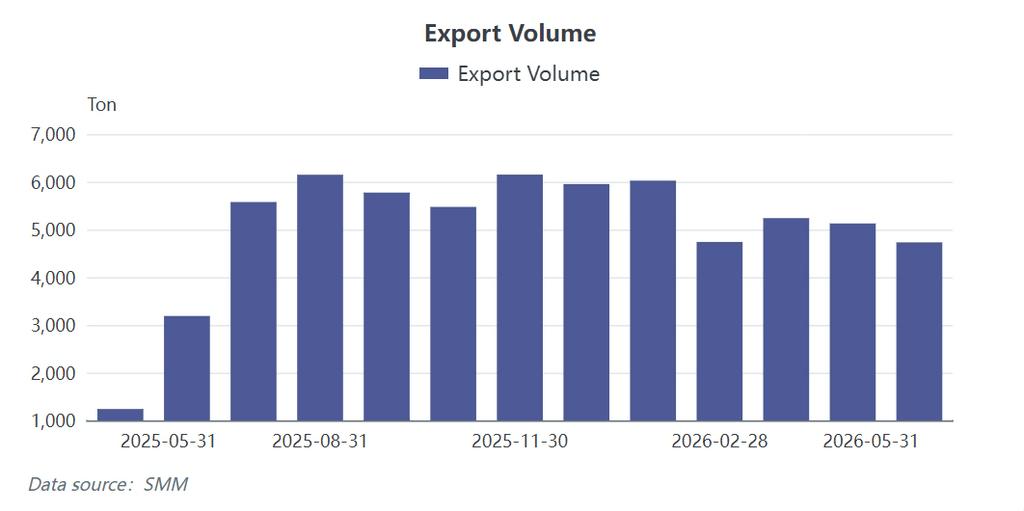
【Data Overview】

According to SMM statistics, China’s exports of NdFeB magnets totaled 4,730 tons in May 2026, marking a month-on-month decline of 7.72%. However, volumes surged by 281.84% year-on-year. The sharp YoY increase is primarily attributed to a low base effect caused by export controls in May 2025. The MoM drop, meanwhile, reflects both seasonal weakness in overseas demand and tangible changes in domestic export licensing procedures.

【May Data Breakdown: Falling Demand Meets Slower Clearance】

The pullback in May exports was driven by two main factors.

First, the market entered a typical seasonal lull. As Europe is a major destination for Chinese NdFeB exports, demand from downstream sectors—particularly automotive and industrial motor manufacturers—usually slows down ahead of the summer shutdown period. This led to a reduction in new procurement orders from European buyers.

More critically, clearance processes at ports became less efficient. Although high-level Sino-U.S. meetings in May signaled a constructive tone, regulatory scrutiny over products containing heavy rare earths—such as dysprosium and terbium—has not eased in practice. License issuance for these magnet grades by the Ministry of Commerce has lengthened noticeably. Some shipments originally scheduled for May departure were held at port pending final approval, resulting in lower reported export volumes compared to factory production schedules. Additionally, the release of inventories that had been stockpiled at ports during last year’s control measures contributed to the distorted YoY comparison.

【June Outlook: Escalating Frictions Further Constrain Approvals】

Entering June, export pressures have intensified amid renewed trade frictions between China and the U.S. Based on SMM’s surveys of major magnet producers, export volumes are expected to decline further and are unlikely to reach the previously forecast level of 5,500 tons.

This expectation is largely due to a marked slowdown in the approval process. Recent updates to U.S. military procurement lists and related export restrictions have prompted a cautious response from Chinese authorities regarding strategic material exports. Industry feedback indicates that applications for export licenses covering heavy rare earth-containing magnets now face longer review cycles and greater uncertainty. While overseas inquiries have increased—partly driven by concerns over future supply security—the actual ratio of inquiries converting into approved shipments remains low.

Supply chain adjustments are also influencing the data. Due to ongoing uncertainties surrounding raw material availability, some overseas processors are revising their procurement strategies, either by reducing inventory levels or exploring capacity shifts to regions such as Southeast Asia. These localized adjustments are reflected in the declining export figures for certain feedstocks and semi-finished magnetic products.

【Market Feedback and Corporate Response】

Feedback from manufacturers highlights growing challenges related to delivery lead times. Approval processes that previously took two weeks may now extend beyond a month. This not only increases working capital requirements but also makes companies more cautious when committing to long-term orders.

Notably, while exports of raw material-intensive products are softening, shipments of downstream finished goods—such as motors and automotive components—have remained relatively stable. This suggests global supply chains are adapting by increasing inventory buffers at the finished-goods level to hedge against upstream volatility.

【Outlook】

In the near term, reported NdFeB export volumes are likely to remain under pressure. Market participants should focus less on the volume of overseas inquiries and more closely monitor the actual pace of export license approvals, which has become the primary bottleneck. Companies are advised to enhance communication with relevant authorities, ensure thorough documentation for material traceability, and adjust production and logistics planning to accommodate extended approval timelines.
Data Source Statement: Except for publicly available information, all other data are processed by SMM based on publicly available information, market communication, and relying on SMM's internal database model. They are for reference only and do not constitute decision-making recommendations.

For any inquiries or for more information, please contact: lemonzhao@smm.cn
For more information on how to access our research reports, please contact:service.en@smm.cn
Related News
Energy Fuels-VAC: The U.S. Blueprint for Rare Earth Security【SMM Analysis】
Common.Time.minsAgo
Energy Fuels-VAC: The U.S. Blueprint for Rare Earth Security【SMM Analysis】
Read More
Energy Fuels-VAC: The U.S. Blueprint for Rare Earth Security【SMM Analysis】
Using the Energy Fuels-VAC merger as a lens, this article analyzes the U.S. playbook of acquiring de-risked, international rare earth assets. Despite sovereign backing creating a $110/kg price floor for non-Chinese supply, structural bottlenecks in heavy rare earth refining and limited market share (~15%) mean China’s dominance remains unshaken in the near term.
Common.Time.minsAgo
Energy Fuels' Acquisition of VAC and US International Mature Rare Earth Asset Acquisition Landscape [SMM Analysis]
Common.Time.minsAgo
Energy Fuels' Acquisition of VAC and US International Mature Rare Earth Asset Acquisition Landscape [SMM Analysis]
Read More
Energy Fuels' Acquisition of VAC and US International Mature Rare Earth Asset Acquisition Landscape [SMM Analysis]
Taking Energy Fuels' $1.9 billion acquisition of Germany-based VAC as a starting point, this article systematically reviews the US's recent acquisition trajectory for mature international rare earth assets. From taking a controlling stake in the Serra Verde heavy rare earth mine in Brazil and acquiring the UK's LCM alloy plant, to securing capacity from Australia's Lynas, the US is leveraging state capital to bypass lengthy certification cycles through cross-border acquisitions, building a non-China "mining-refining-magnet" supply chain. The article notes that although the $110/kg government price anchor has rewritten project IRR models, Western magnet capacity accounts for only 15% of the global total, and the heavy rare earth closed loop cannot be verified until after 2027, making it difficult to shake China's dominance in the short term.
Common.Time.minsAgo
This week, rare earth prices outside China remained stable, while the US continued to acquire mature rare earth enterprises outside China [SMM Rare Earth Ex-China Weekly Review].
1 hour ago
This week, rare earth prices outside China remained stable, while the US continued to acquire mature rare earth enterprises outside China [SMM Rare Earth Ex-China Weekly Review].
Read More
This week, rare earth prices outside China remained stable, while the US continued to acquire mature rare earth enterprises outside China [SMM Rare Earth Ex-China Weekly Review].
This week, the overseas rare earth market remained stable overall. Quotes for cerium oxide, lanthanum oxide, Pr-Nd oxide, dysprosium and terbium oxides, and corresponding metals on FOB/CIF terms were largely steady. The mild adjustments in China’s domestic prices had not yet been transmitted outside China, with sluggish trading and continued shrinkage in deliveries. On the project front, the focus was on building non-China supply chains in the West: Australia’s Iluka Eneabba refinery secured a A$1.65 billion federal non-recourse loan and signed a four-year, 1,200 mt magnetic material rare earth offtake agreement with an unnamed global automaker; US-based Energy Fuels planned to acquire German magnetic material producer VAC for $1.9 billion, complemented by a combined $1.45 billion dual-line loan from the US Strategic Capital Office and the Department of Defense to expand capacity at its White Mesa facility; Canada’s Ucore shipped NdPr oxide samples with 99.5% purity for downstream qualification; in South America, Aclara received environmental approval for its Penco project in Chile; local processing projects in Nigeria and South Africa also advanced simultaneously.
1 hour ago