May 2026 Petroleum Coke Imports: Volume Contraction with Price Spikes, High Costs Persist [SMM Analysis]

Published: Jun 24, 2026 19:11
According to SMM surveys, although prices from Brazil and Argentina have pulled back slightly, overall price levels remain high. Going forward, the import market will continue to feature diversified sources and persistent differentiation in price spreads by country and product category.
SMM, June 24:

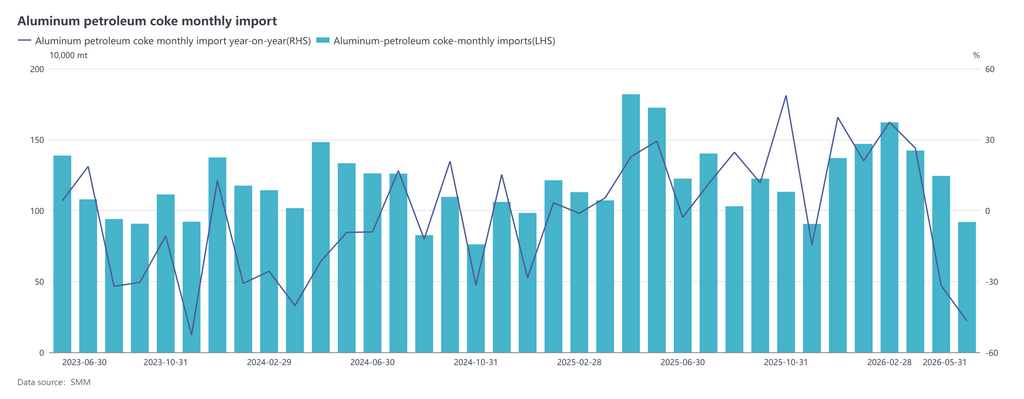
Customs statistics showed that China’s total petroleum coke imports in May 2026 were 918,600 mt, down 26.10% MoM and down 46.84% YoY. The average import price for the month was $323.26/mt, up 32.13% MoM and up 62.96% YoY, presenting a typical pattern of contracting volumes and rising prices. In January-May, cumulative imports of petroleum coke were 6.6708 million mt, down 5.65% YoY.

By source, import origins were highly concentrated in May, with the US, Russia, and Oman as the top three suppliers, corresponding to import volumes of 305,000 mt, 118,700 mt, and 88,400 mt, accounting for 33%, 13%, and 9% of total imports for the month, respectively. On the price front, differentiation by country was pronounced. Canada, Oman, and the US led the price increases—Canada’s month-on-month price was up $270.15/mt, while both Oman and the US saw increases exceeding $100/mt. Kazakhstan, the UK, and Saudi Arabia also posted moderate price gains, collectively lifting the average import price. Only imports from Indonesia, Brazil, and Argentina saw price declines; Indonesia’s price drop exceeded $120/mt, but the overall pullback was limited and insufficient to offset the cost increases from price rises in multiple supplying countries. Tightening supply from overseas smelters, coupled with higher ocean logistics costs, was the primary driver of the sharp increase in the average CIF price this month.

By product category, the proportion of uncalcined petroleum coke imports this year was roughly 26% low-sulphur coke (sulphur <3%) and 74% medium-to-high-sulphur coke. In the first five months, cumulative imports of low-sulphur uncalcined coke were 1.748 million mt, up 26.60% YoY; imports of other uncalcined coke were 4.9227 million mt, up 24.26% YoY.

In summary, the combined impact of concentrated maintenance and production cuts at overseas smelters and persistently rising ocean freight rates significantly tightened available overseas coke supply, sharply raising traders’ external purchase costs and prompting Chinese buyers to actively slow their purchasing pace. This directly resulted in a sharp pullback in May port arrivals and a simultaneous surge in prices. Currently, the maintenance cycle at major overseas producing regions has yet to conclude, making it difficult to reverse the strong overseas spot market in the short term, so China’s import costs are likely to remain high. SMM expects port arrivals of petroleum coke in June to recover slightly but unlikely to return to previous high levels. According to SMM surveys, although prices from Brazil and Argentina have pulled back slightly, overall price levels remain high. Going forward, the import market will continue to feature diversified sources and persistent differentiation in price spreads by country and product category.

Data Source Statement: Except for publicly available information, all other data are processed by SMM based on publicly available information, market communication, and relying on SMM's internal database model. They are for reference only and do not constitute decision-making recommendations.

For any inquiries or for more information, please contact: lemonzhao@smm.cn
For more information on how to access our research reports, please contact:service.en@smm.cn
Related News
[SMM Aluminum Flash News] GeT Alloys Replaces Heavy Fuel Oil with Tyre-Derived Fuel in Aluminium Recycling
1 hour ago
[SMM Aluminum Flash News] GeT Alloys Replaces Heavy Fuel Oil with Tyre-Derived Fuel in Aluminium Recycling
Read More
[SMM Aluminum Flash News] GeT Alloys Replaces Heavy Fuel Oil with Tyre-Derived Fuel in Aluminium Recycling
[SMM Aluminum Flash News] GeT Alloys Replaces Heavy Fuel Oil with Tyre-Derived Fuel in Aluminium Recycling
South Africa-based GeT Metal Group and its subsidiary GeT Alloys have launched a waste-to-energy project that converts end-of-life tyres into industrial fuel for aluminium recycling operations. The initiative is designed to process around 150,000 waste tyres annually and produce approximately 1.44 million litres of fuel, fully replacing the company’s annual heavy fuel oil consumption used in aluminium melting. GeT estimates the project will reduce heavy fuel oil use by 1.44 million litres per year and cut carbon dioxide emissions by around 720 tonnes. The programme will also divert nearly 12,500 waste tyres per month from landfills and illegal dumping sites. GeT Alloys recycles around 350 million used beverage cans, packaging materials and post-consumer aluminium scrap annually into aluminium ingots. Carbon black generated during tyre processing will be used in aluminium dross recovery, while recovered steel wire will be recycled into steel billets, creating a circular economy model across both aluminium and steel value chains.
1 hour ago
[SMM Aluminum Flash News] Woodside Signs Gas Supply Agreement with Alcoa to Support Alumina Production
1 hour ago
[SMM Aluminum Flash News] Woodside Signs Gas Supply Agreement with Alcoa to Support Alumina Production
Read More
[SMM Aluminum Flash News] Woodside Signs Gas Supply Agreement with Alcoa to Support Alumina Production
[SMM Aluminum Flash News] Woodside Signs Gas Supply Agreement with Alcoa to Support Alumina Production
Woodside Energy has signed a gas sale and purchase agreement with Alcoa of Australia to supply 31.1 petajoules (PJ) of natural gas from 2027 to 2030. The gas will be delivered to Alcoa’s alumina refineries in Western Australia, helping secure energy supply for one of the region’s key industrial sectors. Alumina is the primary raw material used in aluminium production, making reliable energy supply critical to maintaining stable output. Woodside said the agreement strengthens its long-term partnership with Alcoa and supports energy security for Western Australian industry. In 2025, Woodside supplied approximately 90.3 PJ of domestic gas, accounting for around 21% of the state’s total gas supply. Market participants expect the deal to improve cost predictability, reduce the risk of production disruptions and support the competitiveness of energy-intensive industries, including the aluminium sector.
1 hour ago
[SMM Aluminum Flash News] Fosbel Promotes Ceramic Welding Technology for Online Aluminium Furnace Repairs
1 hour ago
[SMM Aluminum Flash News] Fosbel Promotes Ceramic Welding Technology for Online Aluminium Furnace Repairs
Read More
[SMM Aluminum Flash News] Fosbel Promotes Ceramic Welding Technology for Online Aluminium Furnace Repairs
[SMM Aluminum Flash News] Fosbel Promotes Ceramic Welding Technology for Online Aluminium Furnace Repairs
Fosbel has highlighted its Ceramic Welding technology as a solution for repairing refractory linings in aluminum furnaces without requiring shutdowns. The process uses an exothermic reaction to fuse new refractory material directly onto existing linings while furnaces remain in operation at temperatures above 1300°F. The technology is suitable for 60%, 70% and 80% alumina refractories commonly used in aluminum furnace applications and is designed to repair worn areas such as metal lines, roofs and sidewalls. Fosbel said the technology can be used for both maintenance and preventive repair programs to extend furnace campaign life and reduce downtime. The company has also introduced Nano-Tec™ ceramic welding powders, thermal cleaning systems and Supertorch equipment to improve repair efficiency, reduce material loss and lower maintenance costs. Hot-repair technologies are increasingly being adopted by aluminum producers seeking higher furnace reliability and operational efficiency.
1 hour ago