Among precious and rare metals, osmium is a niche yet irreplaceable material, overshadowed by gold, silver, platinum and palladium but critical for high-end industry and scientific research thanks to its unique physical and chemical properties. This report breaks down osmium’s core attributes, supply, applications and market traits to unveil the “densest natural metal”.
I. Basic Profile: A Distinct Platinum Group Metal
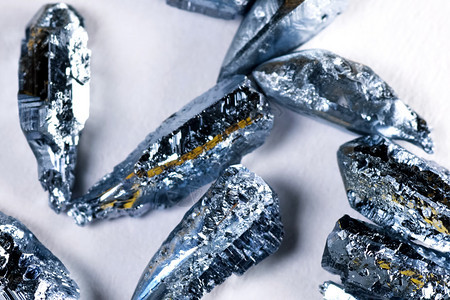
Osmium (Os, atomic number 76) is a Group Ⅷ transition metal and part of the platinum group metals (PGMs), extremely scarce in nature. It has no independent deposits, only extracted and purified via platinum ore smelting alongside platinum, iridium, ruthenium, rhodium and palladium, ruling out large-scale standalone mining.
Its standout properties: unmatched density (22.59g/cm³ at 20℃, higher than gold and platinum), exceptional heat resistance (melting point 3033℃, boiling point over 5000℃), and high hardness & corrosion resistance (Mohs hardness 7). It is highly brittle with poor plasticity, mostly used in powder or alloy forms.
Key Safety Warning: Osmium oxidizes to toxic, volatile osmium tetroxide (OsO₄) when heated above 100℃ in air. Full-process operations (smelting, storage, transport, processing) require inert gas protection, raising production and application thresholds.
II. Supply Landscape: Extreme Scarcity & Monopolized Output
Osmium is far rarer than gold and platinum, with a crustal abundance of just 0.001ppm, one of the lowest stable elements globally. Proven recoverable reserves are extremely limited and highly concentrated.
Global output hinges entirely on platinum mining and smelting, staying at a tiny scale: annual global production is roughly 1 ton (data from International Platinum Group Metals Association), while China’s annual output is less than 100kg. South Africa and Russia dominate global osmium resources and smelting capacity, forming a highly monopolized, inelastic supply market. Tight supply-demand balance persists, supporting strong price resilience and volatility.
III. Core Applications: High-End & Irreplaceable Scenarios
Despite low production and narrow application scope, osmium is a rigid material for high-precision sectors with no low-cost substitutes, focusing on four key fields:
-
Special Hard Alloys: Osmium-based alloys excel in hardness, wear and corrosion resistance, used for high-precision bearings (luxury watches, instruments), premium pen nibs, medical scalpels and high-end mechanical wear parts.
-
Industrial Catalysis: Osmium and its compounds act as high-efficiency catalysts for fine chemical and organic synthesis (hydrogenation, oxidation), boosting process efficiency and product purity with stable low-volume demand.
-
Scientific Research: Toxic osmium tetroxide is an irreplaceable stain for electron microscopy samples in materials and life sciences; high-purity osmium powder serves as a specialty lab consumable.
-
Aerospace & Military: Leveraging high density and thermal stability, osmium is used for specialty high-temperature components, precision guidance parts and high-end electrical contacts, with high added value and growing demand amid industrial upgrading.
IV. Core Market Traits
Osmium is a niche PGM marked by extreme resource scarcity, monopolized inelastic supply, rigid high-end demand and total irreplaceability. Unlike bulk commodities, its market is driven by supply shifts, high-end industrial demand and compliance costs, with a small scale and low trading frequency, remaining a critical material for high-end industry and scientific research.
![Platinum and Palladium Stayed in the Doldrums This Week; the Spot Market Cooled and Faced Severe Involution [SMM Platinum and Palladium Weekly Review]](https://imgqn.smm.cn/usercenter/yhuhG20251217171735.jpg)