June 21, 2026
As of June 19, 2026, by Florian Grummes
While the start of spring on March 23 initially sparked a broad recovery in the price of silver and even led to a surprising peak of $89.36, silver prices have come under significant pressure again since May 13. It wasn’t until a sell-off low of $61.50 that a strong—though so far short-lived—rally to $71.55 began last week.
Since Wednesday evening, however, precious metal prices have once again come under heavy selling pressure. The trigger was the Federal Reserve’s interest rate decision, which caused a sharp pullback in precious metal prices. The open price gap at $68.35 was quickly closed, after which the silver price fell further to $63.28. As a result, roughly two-thirds of the previous recovery has already been lost. Since the beginning of the year, silver has also posted a decline of about 10%. Compared to the price of gold, however, silver has proven somewhat more stable and has so far managed to narrowly hold above its March low of around $61.
Interest Rate Shock Following Leadership Change at the Fed
The already challenging macroeconomic and geopolitical environment is now facing additional headwinds from monetary policy. At its June 17, 2026, meeting, the new Fed Chair, Kevin Warsh, left key interest rates unchanged for the fourth consecutive time, but at the same time signaled that, from the central bank’s perspective, inflation remains significantly too high. This has brought the possibility of a more restrictive monetary policy more sharply into the markets’ focus, as several Fed policymakers consider an interest rate hike possible this year.
For precious metals, this is a rather negative signal, as a great many market participants remain heavily focused on U.S. monetary policy. Higher yields on U.S. Treasury bonds and a stronger dollar increase the opportunity cost of holding a non-interest-bearing asset like silver, thereby limiting its upside potential.
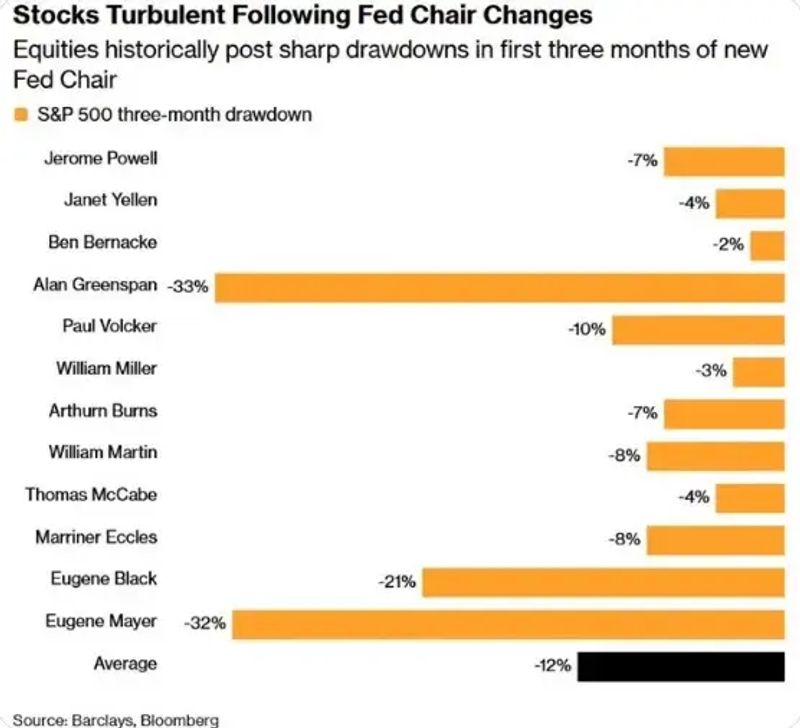
Price Declines Following a Change in Leadership at the U.S. Federal Reserve © Barclays, Bloomberg
Statistically speaking, a change in leadership at the U.S. Federal Reserve is often followed by significant price declines in the stock and financial markets during the first three months, as market participants must first reassess the monetary policy stance and reaction patterns. At the same time, decision-making processes and communication practices take time to establish themselves, which can lead to increased volatility and cautious positioning in the markets in the short term.
Of particular importance this time is the shift in communication at the top of the central bank. Under the new Fed Chair, Kevin Warsh, the previous practice of providing advance notice regarding the future path of interest rates has largely been discontinued, which could further increase uncertainty in the markets. Warsh intends to place a strong emphasis on combating inflation, a move that many market participants immediately interpreted as a signal of tighter monetary policy.
Restrictive Monetary Policy Weighs on the Markets
Instead of the previously hoped-for interest rate cuts, there are now increasing signs of possible rate hikes, which makes stocks less attractive, as higher interest rates increase financing costs and cause future earnings to be discounted more heavily. This uncertainty led to a significant decline in the S&P 500, with other indices also posting losses. In addition, Warsh’s first press conference reinforced the impression of a shift in policy within the Fed, causing investors to become more cautious for the time being and potentially withdraw capital from riskier investments. This underscores how sensitively the markets react to changes in monetary policy and how those changes are communicated.
Real Economy and Industry Are Weakening
In addition to monetary policy, the real economy is also sending mixed signals. Weak data from the freight and trucking sectors suggest that industrial activity is losing momentum, which is particularly relevant for silver given its heavy industrial use.
Unlike gold, silver is not only a monetary store of value but also an industrial metal. When the economy loses momentum, this can dampen physical demand and temporarily slow upward price movements.
Gold and Central Banks as a Strategic Tailwind
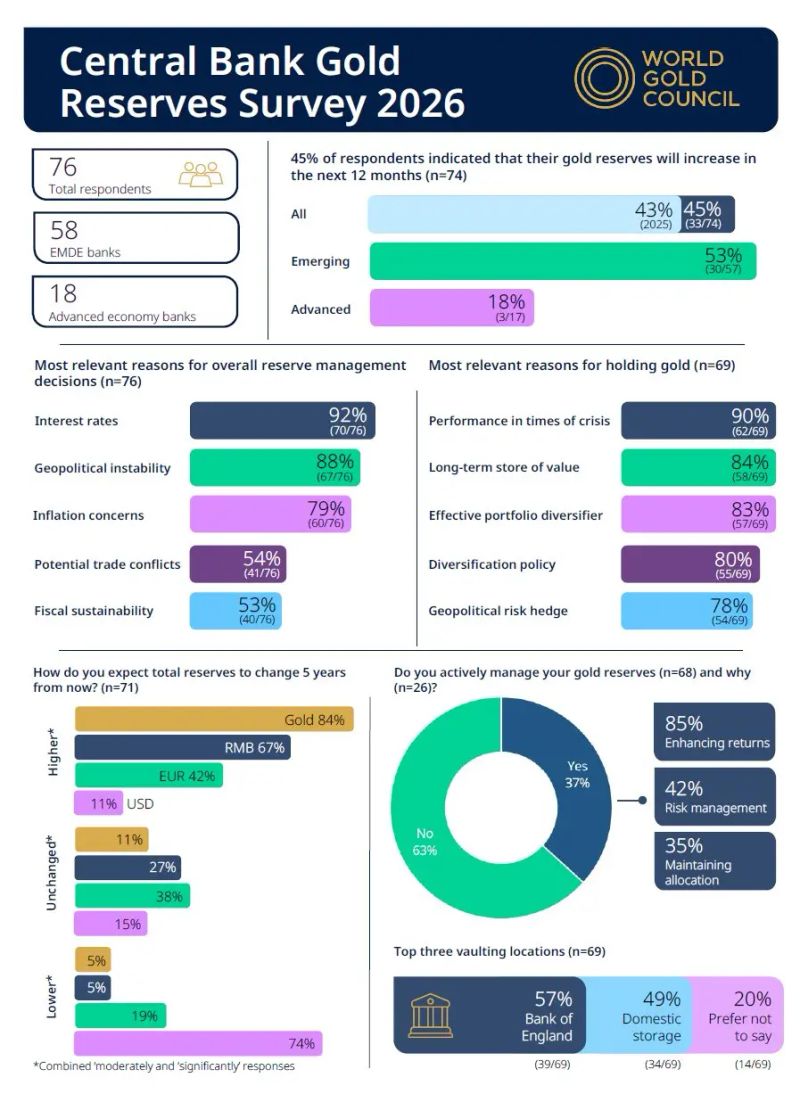
2026 Central Bank Gold Reserves Survey © World Gold Council
The same, gold remains the most important benchmark for the price of silver. While gold was able to recover quickly to over $4,380 following the recent correction—only to then plummet to $4,121—strategic demand from central banks remains a strong tailwind for the entire precious metals sector.
The Central Bank Gold Reserves Survey 2026 shows that, over the past four years, central banks worldwide have accumulated an average of 1,000 metric tons of gold per year—significantly more than in the previous decade. Furthermore, 89 percent of the central banks surveyed expect global gold reserves to rise over the next twelve months, while 74 percent anticipate a decline in the dollar’s share of global reserves.
This trend does not apply identically to silver, but it provides strong indirect support. When real assets, diversification, and geopolitical hedging gain importance, silver typically benefits as a downstream, more volatile companion to the gold market.
Silver in U.S. Dollars – Early Summer Volatility
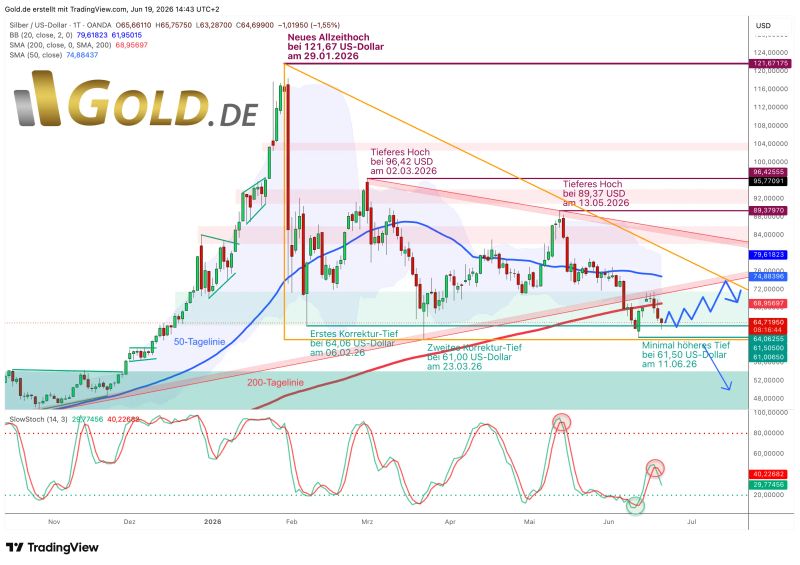
Silver in U.S. dollars, daily chart as of June 19, 2026. ©Gold.de
From a technical perspective, the silver price has been moving largely sideways since the first sell-off in early February. However, the series of lower highs underscores the clearly corrective nature of the movement.
In the range between approximately $61 and $64, the bulls have so far consistently repelled the bears’ attacks and repeatedly initiated bullish counter-moves. Most recently, silver rebounded last week from $61.50 to Monday’s high of $71.55.
This recovery, however, proved short-lived, and silver prices fell back to today’s low of $63.28. As a result, silver is now trading below both its slightly declining 50-day moving average ($79.01) and its still-rising 200-day moving average ($68.24). The 200-day moving average, in particular, should actually stabilize the current sell-off and allow for at least a broader consolidation around the $68 level in the coming weeks.
While the weekly stochastic has now reached oversold territory, the momentum oscillator on the daily chart is already pointing downward again.
Overall, this paints a picture that can, at best, be interpreted as an early-summer shakeout. In other words, before the summer rally begins, precious metal prices are slowly forming a solid foundation amid erratic and rather weak price action. Once that foundation is laid, a significant recovery should follow in response to the correction that has lasted about four and a half months. In the process, the silver price should then be able to reclaim its 50-day moving average.
However, should the stock markets come under pressure and hopes for a de-escalation and continued peace negotiations in the Middle East prove to be illusory, the outlook could darken significantly this summer. In this case, price action on the silver market could also be interpreted as a descending triangle. A break below the $60 to $61 level would confirm this scenario and trigger price targets well below $50.
Conclusion: Silver—A Summer Rally Despite an Interest Rate Shock?
Silver is currently at a macroeconomic and technical tipping point. In the short term, headwinds dominate: tighter monetary policy, rising real interest rates, and an economic slowdown all argue against a rapid and dynamic upward move. At the same time, the Fed’s policy shift is causing increased uncertainty—a factor that typically draws liquidity away from more cyclical assets like silver.
However, two stabilizing forces counter this: a correction that has already been underway for about four and a half months, and increasingly oversold market conditions. Combined with structurally strong demand for gold, this creates an environment that suggests a bottoming-out phase rather than an immediate trend reversal.
The support zone around $60 to $61 is therefore crucial. If this support holds, the current period of weakness is likely to turn out to be a classic early-summer bottoming process, from which a recovery toward the 50-day moving average and beyond should become possible as early as midsummer.
However, if silver falls sustainably below $60, this would confirm the formation of a descending triangle. In this scenario, the correction would transition into a new downtrend—with price targets well below $50.
The coming weeks are therefore likely to be shaped less by trend strength than by decision-making—with an uncomfortably high degree of dependence on geopolitical maneuvers, monetary policy communication, and macroeconomic surprises.
Author: Florian Grummes
Precious Metals Expert and Technical Analyst
www.goldnewsletter.de
Source: GOLD.DE