Aluminum Scrap Imports to China Fall, Driven by Global Tensions and High Energy Costs

Published: Jun 23, 2026 14:21
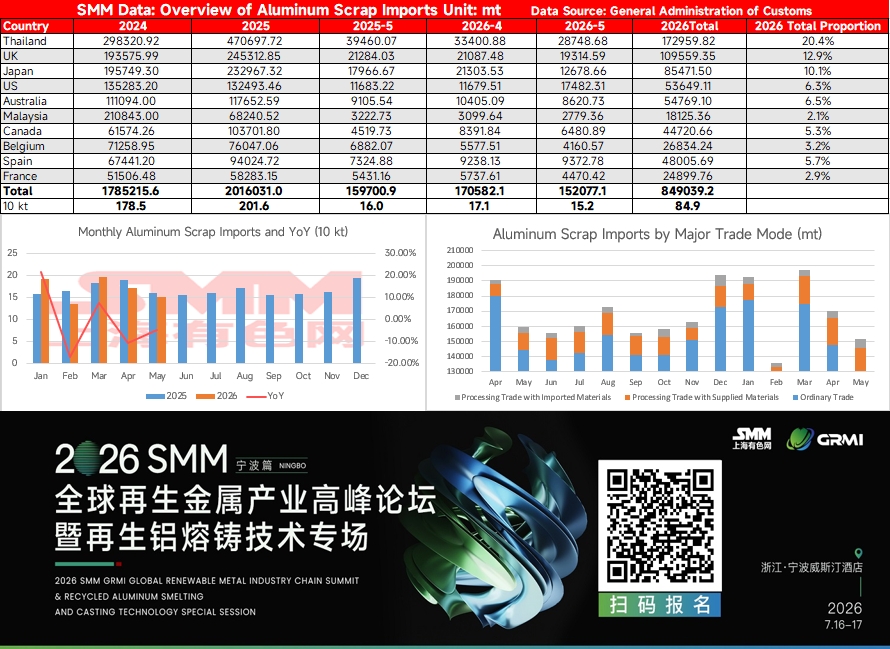
General Administration of Customs data showed that aluminum scrap imports in May 2026 stood at approximately 152,000 mt, down 11.1% MoM from 171,000 mt in April and also below the 160,000 mt recorded in May 2025, initially establishing a pullback trend in imports this year.

General Administration of Customs data showed that aluminum scrap imports in May 2026 stood at approximately 152,000 mt, down 11.1% MoM from 171,000 mt in April and also below the 160,000 mt recorded in May 2025, initially establishing a pullback trend in imports this year.

Escalating US-Iran tensions recently fueled risk-off sentiment, driving LME aluminum prices sharply higher and directly lifting spot aluminum scrap quotations outside China. Since aluminum scrap pricing generally tracks LME aluminum, overseas suppliers' willingness to hold prices firm strengthened notably, pushing up procurement costs for Chinese import traders. Traders reported that overall landed costs for imported aluminum scrap were already significantly above early-year levels and above domestic aluminum scrap prices, directly curbing procurement appetite.

Meanwhile, energy prices in Europe stayed high, with aluminum capacity in multiple countries remaining constrained by electricity cost pressures and primary aluminum resources generally tight. To fill the raw material gap, secondary aluminum enterprises in Europe intensified competition for aluminum scrap feedstock, reducing the willingness to export scrap to external markets and indirectly tightening supply channels to China. Shipments to China from European sources—including the UK, Spain, Belgium, and France—all pulled back to varying degrees in May 2026, with the combined effect of these factors not to be overlooked.

By source country structure, in January-May 2026, Thailand remained the top supplier at approximately 173,000 mt, accounting for 20.4%; the UK, Japan, and Australia ranked second through fourth, accounting for 12.9%, 10.1%, and 6.5%, respectively. In May, however, arrivals from major sources broadly contracted: Thailand's arrivals were about 28,700 mt, down 14% from 33,400 mt in April; monthly arrivals from the UK and Japan also pulled back in tandem, while declines from the US and Australia were equally pronounced. Notably, imported aluminum scrap typically involves a 1–3 month ocean freight lead time. The impact of traders' sharply reduced procurement volumes will transmit through this lead time and is expected to concentrate in Q3. If China's aluminum scrap demand does not weaken in tandem by then, the supply gap for imported cargo could widen, providing some support for domestic aluminum scrap prices.

Overall, under the combined influence of multiple factors—the upward shift in LME aluminum price center, restricted aluminum scrap exports from Europe, and domestic import traders proactively reducing inventory risk exposure—the contraction in imported aluminum scrap supply is unlikely to rapidly reverse in the near term. If downstream aluminum processing demand recovers seasonally as expected in Q3, the "scissors gap" between the import side and the demand side could periodically drive up aluminum scrap spot premiums. It is recommended to keep monitoring the changes in offering prices from key source countries and the pace of vessel arrivals. 
Data Source Statement: Except for publicly available information, all other data are processed by SMM based on publicly available information, market communication, and relying on SMM's internal database model. They are for reference only and do not constitute decision-making recommendations.

For any inquiries or for more information, please contact: lemonzhao@smm.cn
For more information on how to access our research reports, please contact:service.en@smm.cn
Related News
Hongjin New Materials & Chinese Robot Firm Develop High-Strength Aluminum for Robots
Common.Time.minsAgo
Hongjin New Materials & Chinese Robot Firm Develop High-Strength Aluminum for Robots
Read More
Hongjin New Materials & Chinese Robot Firm Develop High-Strength Aluminum for Robots
[SMM Flash] It is reported that Hongjin New Materials’ Nantong Research Institute, in collaboration with a leading embodied robot enterprise in China, has jointly developed a specialized high-strength, high-toughness aluminum alloy structural part, which has now achieved large-volume production. The aluminum parts have been fully integrated into the partner’s latest-generation flagship embodied robot, helping to advance both lightweighting and structural strength for the robot.
Common.Time.minsAgo
YIZUMI Wins Bid for Wuhu Base Magnesium Alloy Project by Liuzhou Wuling Motors
Common.Time.minsAgo
YIZUMI Wins Bid for Wuhu Base Magnesium Alloy Project by Liuzhou Wuling Motors
Read More
YIZUMI Wins Bid for Wuhu Base Magnesium Alloy Project by Liuzhou Wuling Motors
[SMM Flash News] According to reports, on June 16, 2026, the winning bid result for the Wuhu base magnesium alloy capacity construction project (Phase I) (800-850T magnesium alloy high-pressure die-casting island equipment update) was announced. YIZUMI Co., Ltd. was proposed as the winning bidder for this procurement project of Liuzhou Wuling Motors Industrial Co., Ltd. The announcement period began on June 16, 2026 and lasted for three working days.
Common.Time.minsAgo
Wencan Advances Automation, Upgrades Production Lines in China and Overseas Plants
Common.Time.minsAgo
Wencan Advances Automation, Upgrades Production Lines in China and Overseas Plants
Read More
Wencan Advances Automation, Upgrades Production Lines in China and Overseas Plants
[SMM Flash] According to reports, Wencan Co., Ltd. is advancing the automation and production line upgrading of several of its Bailian plants in phases. Currently, the renovation project at the Dalian plant has been completed, with improved capacity and quality control capabilities, which can better meet the demand for new energy brake parts in China. For overseas bases, the San Miguel plant in Mexico is setting up a high-pressure die casting production line, and the Hungarian plant is adding a low-pressure die casting production line, further enriching the new energy product matrix. In the long term, production line upgrades help reduce losses and improve operational efficiency.
Common.Time.minsAgo