On May 27, the U.S. International Trade Commission (ITC) announced a partial final determination in the Section 337 investigation involving TOPCon (Tunnel Oxide Passivated Contact) solar cells, modules, panels, components thereof, and downstream products containing the same. The ITC decided not to review the Administrative Law Judge’s (ALJ) initial determination issued on April 27, thereby approving BYD America LLC’s motion to intervene in the investigation as a third party.
It is important to note that this “partial final determination” does not constitute a substantive ruling on whether TOPCon products infringe intellectual property rights, violate Section 337 of the Tariff Act, or warrant the issuance of exclusion orders. Rather, it is a procedural confirmation regarding BYD America LLC’s intervention in the case. Nevertheless, the participation of downstream companies such as BYD indicates that the scope of the investigation is expanding beyond module manufacturers to downstream procurement, project development, and system application segments within the U.S. market.
I. Timeline of the Case: First Solar Files Complaint, ITC Launches Section 337 Investigation
The case originated on February 24, 2026, when U.S.-based thin-film solar manufacturer First Solar filed a complaint with the ITC seeking a Section 337 investigation. The complaint alleged that certain TOPCon solar cells, modules, panels, and related downstream products imported into, sold for importation into, or sold within the United States infringed its U.S. patent rights. The patent at issue is U.S. Patent No. 9,130,074, which relates to TOPCon manufacturing methods and associated technological claims.
On March 10, First Solar supplemented its complaint. Subsequently, on March 25, the ITC voted to institute the investigation and formally announced the case on March 26. On March 30, the Federal Register published the official notice of investigation, confirming that the scope of the case covers certain TOPCon solar cells, modules, panels, module components, and downstream products containing such products.
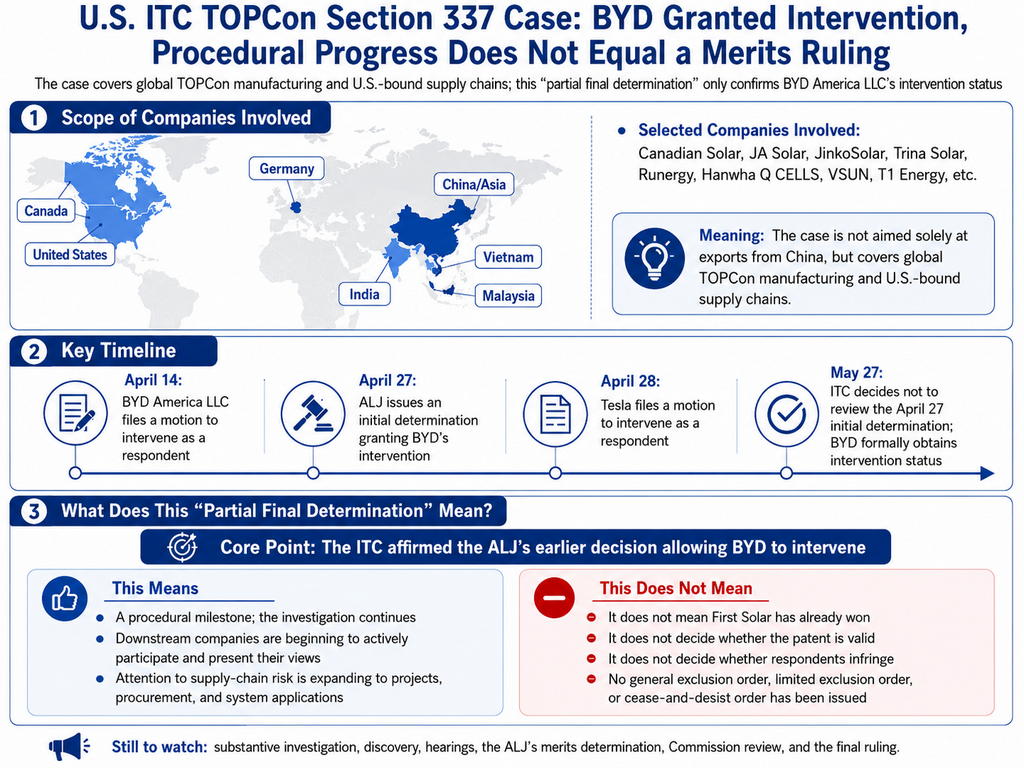
The list of named respondents demonstrates the broad scope of the investigation. In addition to major Chinese and Asian TOPCon module manufacturers, the case also involves companies and affiliated entities located in the United States, Germany, Canada, India, Vietnam, Malaysia, and other jurisdictions. Respondents include Canadian Solar, JA Solar, JinkoSolar, Trina Solar, Runergy, Hanwha Q CELLS, VSUN, T1 Energy, and numerous other participants across the global photovoltaic supply chain. This indicates that the investigation is not solely targeting exports from China, but rather encompasses the broader global TOPCon manufacturing and supply chain serving the U.S. market.
On April 14, BYD America LLC filed a motion with the ITC seeking intervention as a respondent in the investigation. On April 27, the ALJ issued an initial determination granting BYD America LLC’s motion to intervene. On April 28, Tesla also filed a motion to intervene as a respondent. On May 27, the ITC Commission decided not to review the ALJ’s April 27 initial determination, thereby formally granting BYD America LLC intervention status.
Market attention has largely focused on the term “partial final determination.” Under Section 337 procedures, an ALJ may issue initial determinations on procedural matters, including whether to permit intervention by non-parties. If the ITC Commission elects not to review such an initial determination, the ruling becomes the Commission’s final determination on that procedural issue.
Accordingly, the core significance of the ITC’s May 27 announcement is that the Commission affirmed the ALJ’s earlier decision permitting BYD America LLC to intervene. The ruling did not address the validity of First Solar’s patent, did not determine whether respondents’ TOPCon products infringe the asserted patent claims, and did not impose a general exclusion order, limited exclusion order, or cease-and-desist order.
In other words, the ruling represents a procedural milestone in the progression of the investigation rather than what the market would typically interpret as a “loss,” “import ban,” or “final merits decision.” Any assessment of the substantive impact on TOPCon exports to the United States will depend on subsequent stages of the investigation, including discovery, evidentiary hearings, the ALJ’s merits determination, Commission review, and any final remedial orders.
Although the ruling itself is procedural in nature, BYD America LLC’s successful intervention carries broader industry implications.
In its complaint, First Solar targeted not only TOPCon solar cells and modules, but also “downstream products containing the same.” For downstream U.S. companies, if products they procure, use, or sell contain allegedly infringing TOPCon modules, any future exclusion order or cease-and-desist order issued by the ITC could affect project deliveries, inventory sales, contractual performance, and after-sales obligations.
BYD’s intervention reflects downstream companies’ desire to preserve their rights to participate in the proceeding, submit evidence, present defenses, and influence the scope of potential remedies. Tesla’s intervention request further suggests that companies across the U.S. clean energy supply chain are evaluating the potential implications of the investigation for project procurement and product compliance. From an industry perspective, TOPCon has become one of the dominant technology pathways in the global crystalline silicon module market, while demand for high-efficiency modules in the United States remains robust. Should the Section 337 investigation ultimately result in exclusion orders, the impact could extend beyond named module manufacturers to project developers, EPC contractors, system integrators, and end-use application companies utilizing such products.
II. Potential Impact: Limited Near-Term Disruption, Medium- to Long-Term Risks Depend on Investigation Outcome
In the near term, the partial final determination is expected to have limited direct impact on TOPCon module trade flows. No exclusion order or cease-and-desist order has been issued by the ITC at this stage, and relevant products may continue to enter the U.S. market subject to existing trade policies, tariff rules, and contractual arrangements. Accordingly, the use of the term “final determination” should not be misinterpreted as indicating that the United States has banned imports of TOPCon modules.
However, the medium- to long-term risks associated with the investigation should not be underestimated. First Solar has requested remedies including a general exclusion order, or alternatively a limited exclusion order, as well as cease-and-desist orders. If the ITC ultimately finds a violation of Section 337, such remedies could materially affect the supply landscape for TOPCon products in the U.S. market.
A limited exclusion order typically applies only to products imported by specifically named respondents, whereas a general exclusion order has broader implications and may cover infringing products from all sources, including entities not originally named in the investigation. Given the highly globalized nature of today’s photovoltaic supply chain, the issuance of a general exclusion order could significantly disrupt U.S. imports of TOPCon modules, project procurement strategies, and supplier selection decisions.
For module manufacturers, future U.S. orders may face stricter intellectual property compliance reviews, enhanced contractual indemnification provisions, and more rigorous supply chain traceability requirements. For U.S. buyers, contractual clauses relating to patent infringement liability, alternative supply arrangements, delivery delays, and project damages are likely to become increasingly important. In terms of pricing, short-term market prices may not experience immediate disruption; however, if exclusion order risks escalate and TOPCon module availability in the U.S. market declines, module prices could receive temporary support. Such developments may also benefit First Solar’s thin-film products, U.S.-based manufacturing capacity, licensed supply chains, and alternative technologies such as HJT and BC architectures.
Key areas to monitor going forward include the following:
First, market participants will closely watch the ITC’s substantive determinations, including whether First Solar’s asserted patent claims are valid, whether respondents’ TOPCon products fall within the scope of the asserted patent claims, whether importation or sales activities constitute a Section 337 violation, and whether First Solar satisfies the domestic industry requirement under U.S. law.
Second, attention will focus on the scope of potential remedies. If the ITC ultimately finds a violation, the market’s primary concern will be whether the Commission issues a limited exclusion order or the broader and more consequential general exclusion order. The former would primarily affect specific respondents, while the latter could impose broader restrictions on TOPCon imports into the United States.
Third, the extent of downstream company participation will remain an important indicator. BYD’s approved intervention and Tesla’s intervention request suggest that downstream U.S. companies have already begun proactively addressing potential supply chain risks. If additional project developers, energy companies, or system integrators seek intervention, it would indicate that the investigation’s impact is continuing to expand.
Fourth, market participants will monitor respondents’ legal and commercial strategies. Defendants may pursue defenses based on patent invalidity, non-infringement arguments, product design differentiation, supply chain restructuring, licensing negotiations, or alternative technology pathways. For Chinese and Southeast Asian module manufacturing capacity, exports to the U.S. market may face increasingly stringent compliance requirements going forward.
![Brief Review of Spot Market and China Inventory (May 28, 2026) [SMM Silver Market Weekly Review]](https://imgqn.smm.cn/usercenter/obeMy20251217171735.jpg)
![Silver Market Price Review and Brief Comments on Expectations (May 28, 2026) [SMM Silver Market Weekly Review]](https://imgqn.smm.cn/usercenter/gpWpd20251217171734.jpeg)
![[SMM Photovoltaic] India's Uttar Pradesh YEIDA Zone Adding Combined 7GW of Solar Manufacturing Capacity](https://imgqn.smm.cn/usercenter/HfeeS20251217171739.jpg)