As of: April 30, 2026, by Florian Grummes
The correction in precious metal prices initially continued as expected over the course of this week. Since April 17, the gold price fell from 4,890 US dollars to an interim low of 4,510 US dollars, representing a decline of around 7.8%. The movement in silver was even more pronounced. The price lost approximately 14.7% during the same period, marking its yesterday’s low at 70.86 USD just ahead of the Fed’s interest rate decision.
However, the nine-day price decline led to a heavily oversold technical market position yesterday, allowing precious metals to show a significant recovery in an initial reaction. On a broader scale, both gold and silver continue to move between their 50-day and 200-day moving averages, suggesting that the healthy consolidation phase is likely to continue for the time being.
Consolidation Within the Overarching Uptrend
Neither this ongoing consolidation phase nor short-term technical movements change the bigger picture. Rather, such pullbacks create the foundation for a stabilization of the precious metal markets and pave the way for the next upward move.
Crucially, current price movements are primarily shaped by temporary factors, while the long-term fundamental drivers remain intact and are increasingly gaining importance.
Collapse of the Global Order and the Start of a New Commodity Supercycle
The developments of recent weeks in the Middle East highly likely signal the beginning of a new commodity supercycle, the structural drivers of which go far beyond short-term market fluctuations.
At the center of this is the gradual breakdown of the global order that has provided both geopolitical stability and economic integration since 1945 and the Bretton Woods system.
The increasing fragmentation into geopolitical blocs (primarily China and the USA)—recently intensified by the Iran war and the resulting international arms race—will lead to a reorganization of strategic priorities and a deglobalized world order.
For example, the United Arab Emirates left OPEC this week—a remarkable step that underscores the increasing tensions and growing fragmentation within traditional alliances in the global energy sector.
Loss of Trust Boosts Gold Demand
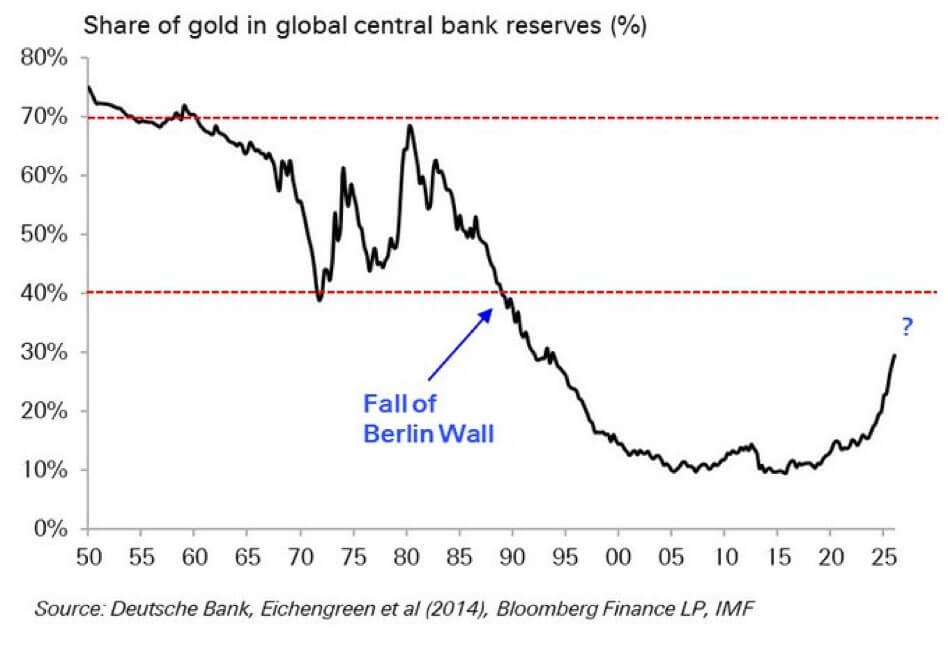 Gold’s share of global central bank reserves, as of April 30, 2026. ©Luke Gromen
In such a world, where trust between states is declining and economic dependencies are being deliberately reduced, real assets with intrinsic value gain significant importance.
Historically, such a loss of trust is often accompanied by increased accumulation of precious metals by central banks, which creates a fundamentally supportive macroeconomic environment for the gold price.
Central Banks Drive Structural Gold Purchases
Structural shifts in the global financial system also underpin the bullish outlook for gold. The US dollar’s share of global central bank reserves has dropped significantly from over 60% to about 40%, while the share of gold has tripled to around 30%. Emerging markets, in particular, are actively driving this development by building up gold as a strategic reserve.
This is happening not only for diversification reasons but also as a hedge against potential restrictions on access to dollar liquidity, such as geopolitically motivated exclusions from swap lines. In such a scenario, gold acts as a last resort—a universally accepted store of value outside of political control.
At the same time, current valuations suggest that gold remains undervalued by historical standards and could become many times more expensive if it returns to long-term average levels.
Gold Price: Pullbacks as a Buying Opportunity
The logical conclusion is clear: In a world of increasing geopolitical tensions and uncertainties, declining dollar dominance, structural commodity shortages, and growing strategic demand from central banks, gold possesses significant appreciation potential as the ultimate non-political reserve and is likely to continue rising significantly in the medium to long term. For investors, the pullback that has been underway since the end of January repeatedly offers good opportunities to buy more.
Gold – Recovery Has Begun
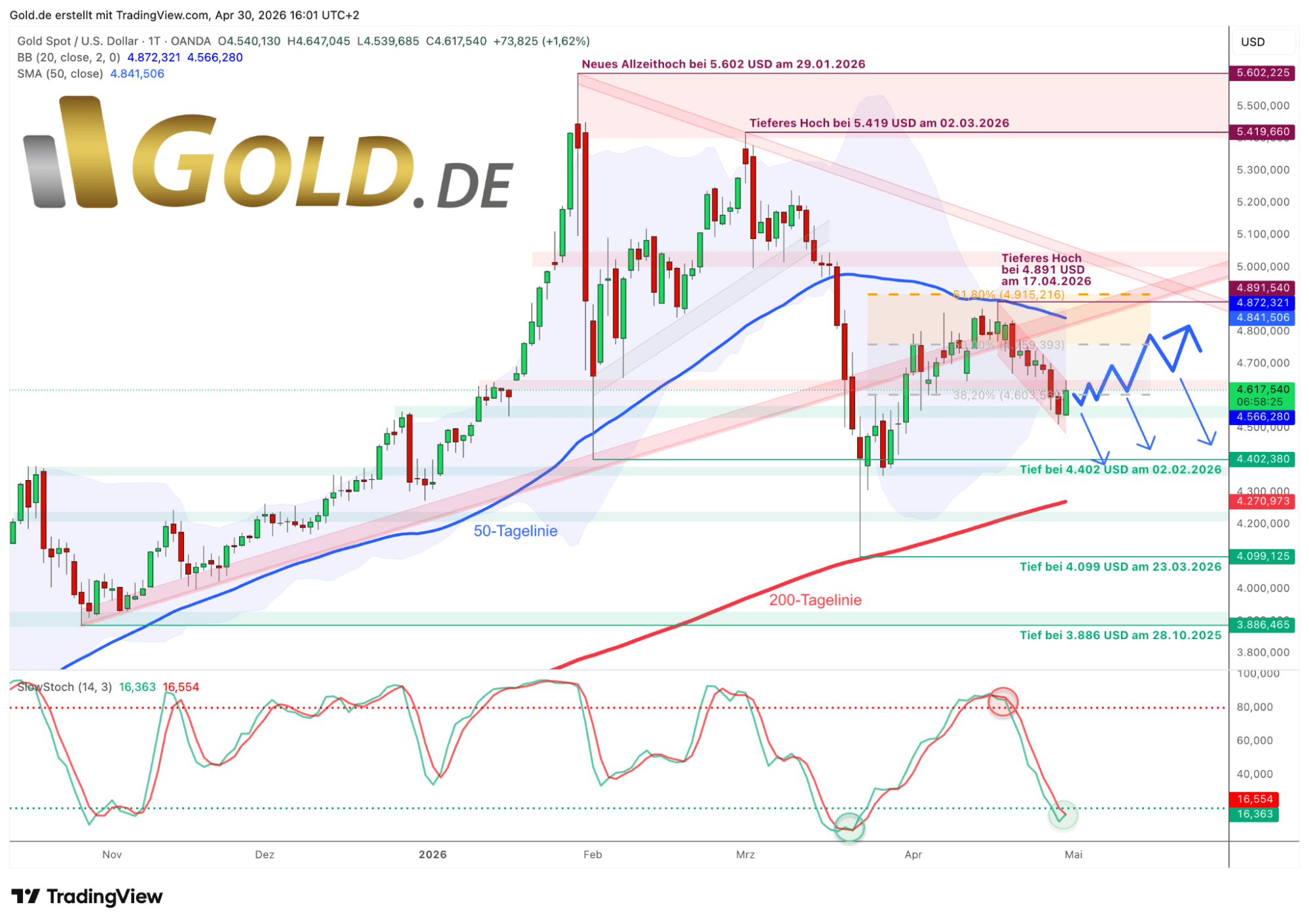 Gold in US Dollars, daily chart as of April 30, 2026. ©GOLD.DE
Since April 17, the gold price has fallen from 4,890 US dollars to an interim low of 4,510 US dollars, correcting by around 7.8%. Previously, prices had clearly bounced off the falling 50-day moving average (currently at 4,870 US dollars). Encouraged by this, the bears were able to ignite enormous selling pressure, so that even the lower Bollinger Band on the daily chart (currently at 4,569 US dollars) initially failed to provide support.
It was only at 4,510 US dollars and just a few hours before yesterday’s FED interest rate decision that more buyers than sellers returned to the gold market. A day later, however, the situation already looks a bit better, as the oversold condition triggered an initial recovery wave up to 4,647 US dollars.
The gold price was thus able to break out, at least to some extent, from the short-term downtrend channel of the last two weeks.
Daily Stochastic Delivers New Buy Signal
Looking ahead, the stochastic oscillator is now providing a new, albeit tentative, buy signal that allows for a continuation of the recovery. A renewed attempt toward the falling 50-day moving average (currently at 4,870 US dollars) therefore seems quite plausible. However, this potential recovery is only secure as long as the gold price can now stay above 4,550 US dollars. Regardless, the overarching consolidation phase remains intact.
Based on the weekly Bollinger Bands, the gold price is expected to move sideways in a wide range between approximately 4,300 and 5,200 US dollars in the coming months. The converging 50-day and 200-day moving averages further narrow the room for maneuver, so a contracting trading range between around 4,350 and 4,900 US dollars is more likely in the coming weeks. For us, another test of the rising 200-day moving average (currently at 4,271 US dollars) as a second leg is a given sooner or later.
Our absolute worst-case scenario envisions a possible correction low or trend reversal in the range between $3,400 and $3,600 later in the year. However, a correction over time is much more likely, meaning the described sideways movement between approximately 4,350 and 5,300 US dollars.
Conclusion: Gold Between Consolidation and a Structural Bull Market
The current phase of weakness in gold and silver should primarily be interpreted as a healthy consolidation within an intact uptrend. Technical excesses have been reduced, and prices are slowly stabilizing.
The recovery trend that started yesterday could expand into a larger recovery wave back to the 50-day moving average and the round psychological mark of 5,000 US dollars.
Pullbacks are typical for advanced bull markets and serve an important function: they clear out overheated market phases and create the foundation for the next upward move. Crucially, neither the long-term bullish chart structure nor the overarching support zones have been sustainably broken.
Even more important, however, is the look at the fundamental big picture, which continues to shift in favor of gold. The ongoing fragmentation of the world order, the loss of trust in existing currency systems, and the strategic realignment of central banks form a solid long-term foundation for rising precious metal prices.
Gold is increasingly establishing itself as a politically neutral reserve asset in a multipolar world—a trend clearly evidenced by declining dollar dominance and rising gold shares in central bank reserves. Against this backdrop, short-term fluctuations appear secondary.
Rather, the probability prevails that gold will continue its structural uptrend in the medium to long term. Pullbacks and sideways phases should therefore be understood less as a risk and more as strategic entry and accumulation opportunities in an unfolding supercycle.
Source: https://goldinvest.de/en/gold-price-drops-is-this-the-big-buying-opportunity/