March Phosphate Ore Imports 182kt, Up 88.2% MoM; Jordan Halts Exports

Published: Apr 20, 2026 14:07
In March 2026, China’s phosphate ore imports reached 182,000 mt, up 88.2% MoM and 144.4% YoY, with an average price of $79.9/mt, down 7.2% MoM.Affected by Strait of Hormuz disruptions, Jordan halted supplies for the first time since September 2023. Imports mainly came from Egypt (170,000 mt) and Pakistan (12,000 mt), through Guangxi, Hubei and Fujian.

According to customs data, in March 2026, China's phosphate ore imports totaled 182,000 mt, up 88.2% from 97,000 mt in February and up 144.4% compared to the same period last year (75,000 mt). Total import value in March was $14.552 million, up 74.6% MoM from $8.336 million in February. The unit price was $79.9/mt, down 7.2% significantly from $86.1/mt in February.
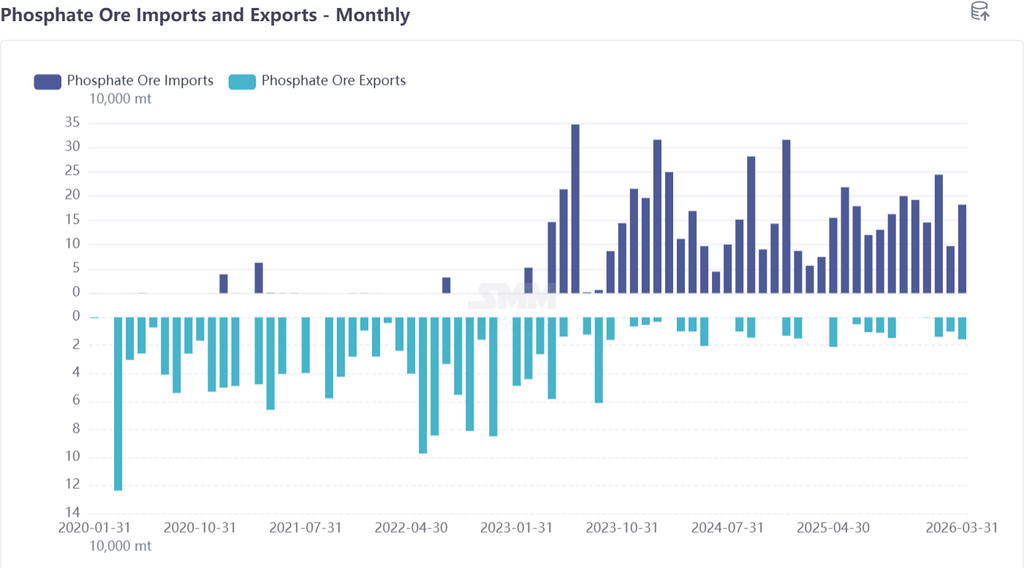
1. Phosphate ore imports: China's traditional major phosphate ore source countries were Egypt, Peru, and Jordan, with major importing provinces being Guangxi and Zhejiang, and major importing enterprises including Chuanjinnuo and other coastal phosphochemical enterprises. However, in March, due to logistics disruptions in the Strait of Hormuz, there were no phosphate ore imports from Jordan — the first time since September 2023 that no phosphate ore was imported from Jordan to China. The major source countries for phosphate ore imports in March were Egypt and Pakistan.
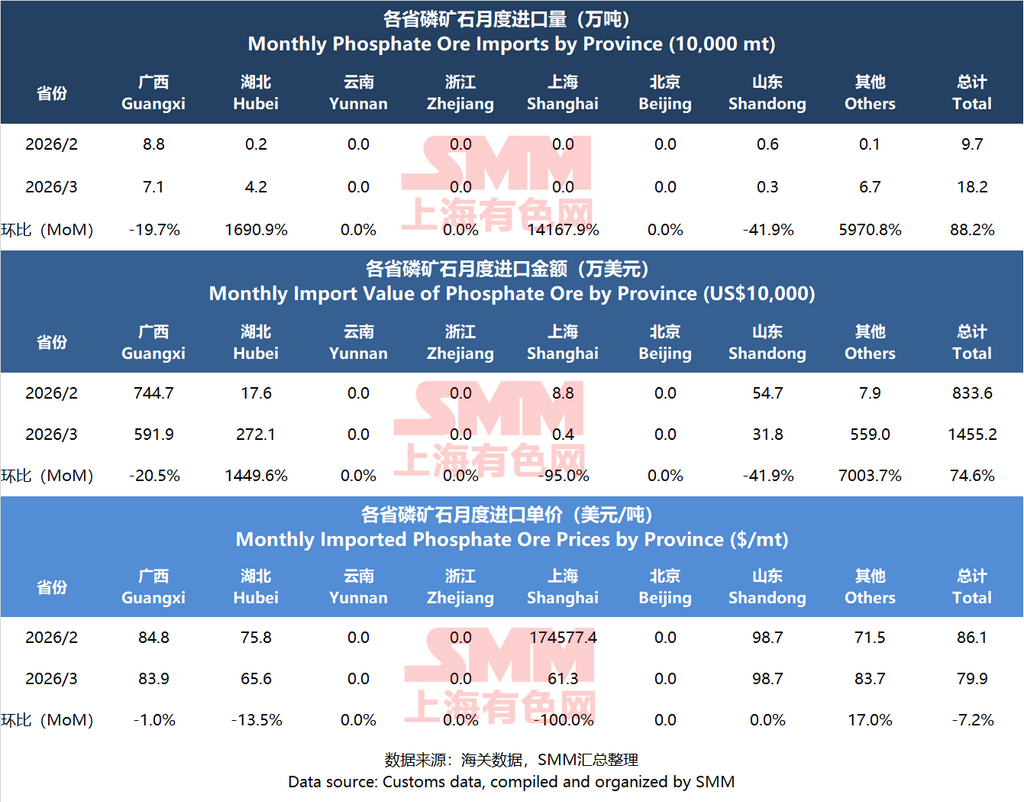
 

The top importing provinces in March were Guangxi (71,000 mt), Hubei (42,000 mt), and other regions such as Fujian (52,000 mt), while in February it was Guangxi (88,000 mt). Price side, the unit price was $79.9 in March versus $86.1 in February, showing a price decline in March.
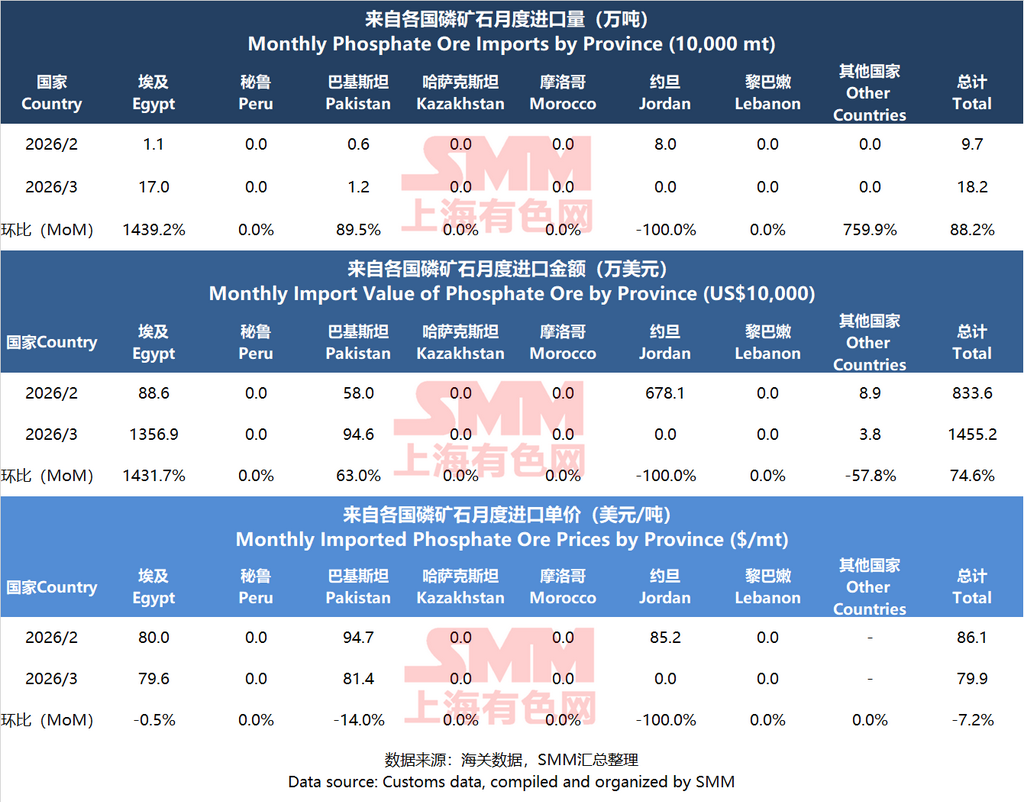
 

In March, China's phosphate ore imports mainly came from Egypt and Pakistan, with imports of 170,000 mt and 12,000 mt respectively. Affected by factors related to the Strait of Hormuz, phosphate ore from Jordan failed to be imported; however, imports from other regions had already filled the gap. As hindered transportation of high-priced Jordanian phosphate ore left no import volume to support prices, the import unit price of phosphate ore in March pulled back from February, falling below $80/mt.

2. Phosphate ore exports: Japan and South Korea became the main export destinations for phosphate ore in March, with shipments from Hubei to South Korea and Guizhou to Japan dominating.
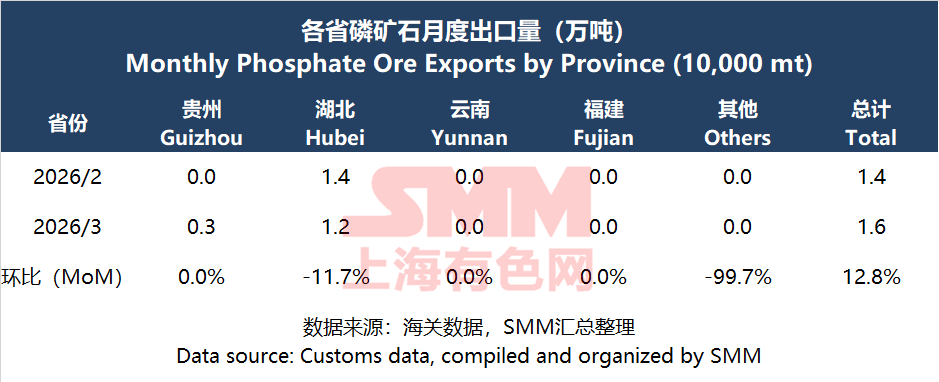
In March 2026, exports totaled 16,000 mt, up 55.7% from February, with the main export flow directed to Japan and South Korea. Hubei to South Korea and Guizhou to Japan accounted for 12,000 mt and 13,000 mt respectively, at unit prices of $185/mt and $328/mt.


Note: If you have any additions or corrections to the details mentioned in this article, please feel free to contact us at any time. Contact information is as follows:

Tel: 021-20707860 (or add WeChat 13585549799) Yang Chaoxing, thank you!

Data Source Statement: Except for publicly available information, all other data are processed by SMM based on publicly available information, market communication, and relying on SMM‘s internal database model. They are for reference only and do not constitute decision-making recommendations.

For any inquiries or to learn more information, please contact: lemonzhao@smm.cn
For more information on how to access our research reports, please contact:service.en@smm.cn
Related News
[Lithium Battery: New Ultra-Fast Charging Battery Industrialization Project To Be Launched In Zaozhuang, Shandong]
Common.Time.minsAgo
[Lithium Battery: New Ultra-Fast Charging Battery Industrialization Project To Be Launched In Zaozhuang, Shandong]
Read More
[Lithium Battery: New Ultra-Fast Charging Battery Industrialization Project To Be Launched In Zaozhuang, Shandong]
[Lithium Battery: New Ultra-Fast Charging Battery Industrialization Project To Be Launched In Zaozhuang, Shandong]
Recently, the Ecological Environment Branch of Zaozhuang High-tech Zone approved the environmental impact assessment documents for the new ultra-fast charging battery industrialization project of Shandong Xinbang New Energy Co., Ltd., giving the green light for construction. The project plans to construct electrode production workshops, cell workshops, formation and capacity grading workshops, module workshops, comprehensive warehouses, hazardous waste warehouses, a wastewater treatment station, and other supporting facilities. The main products will be energy storage battery packs and power batteries for new energy vehicles. The overall plant plans to include 2 ESS production lines, 3 BEV production lines, and 8 PACK production lines, with a planned total capacity of approximately 52 GWh.
Common.Time.minsAgo
South African businessman leads takeover of one of Africa’s largest nickel-cobalt mining operations
May 2, 2026 18:21
South African businessman leads takeover of one of Africa’s largest nickel-cobalt mining operations
Read More
South African businessman leads takeover of one of Africa’s largest nickel-cobalt mining operations
Sandile Zungu, a South African businessman, is leading an investment consortium together with his firm Zungu Investments and former Glencore nickel trading executive Jason Kluk to acquire a 54.17% controlling stake held by Sumitomo Corporation in the Ambatovy nickel-cobalt project in Madagascar. Sumitomo has decided to exit the project after incurring cumulative losses of approximately $3 billion over the past 20 years and expects to record a one-off loss of about $445 million from the transaction, while retaining certain offtake rights. Sumitomo stated that it is confident the new shareholder structure, formed by Essenwood Partners and Zungu Investments, has the necessary technical and commercial expertise to operate the large-scale nickel-cobalt project profitably.
May 2, 2026 18:21
India to build a six-month strategic stockpile of lithium, cobalt and rare earths as demand rises
May 1, 2026 07:00
India to build a six-month strategic stockpile of lithium, cobalt and rare earths as demand rises
Read More
India to build a six-month strategic stockpile of lithium, cobalt and rare earths as demand rises
Amid sustained demand growth, India plans to build a strategic reserve of critical minerals including lithium, cobalt, nickel, copper and rare earths. The stockpile will be sized to cover six months of domestic consumption, aiming to guard against risks of global supply disruptions and sharp raw material price volatility. Led by India’s Ministry of Mines and Ministry of Heavy Industries, the reserve covers key raw materials essential for new energy vehicles, energy storage and the electronics sector, fields where India currently relies heavily on imports. At present, the United States, China, South Korea and other countries have already established strategic reserve systems for critical minerals.
May 1, 2026 07:00