[SMM Analysis] Coal Cost Impact on Magnesium Prices: Regional Cost Gaps Narrowing

Published: May 29, 2026 19:10
[SMM Magnesium Market Analysis: Coal Cost Transmission Imbalance, Weakened Integrated Cost Advantages, and Continued Convergence of Regional Magnesium Ingot Cost Gaps] Recently, energy cost fluctuations in the magnesium industry far exceeded ferrosilicon price fluctuations. The influence of coal prices on magnesium prices increased significantly, and the cost structure of magnesium ingots underwent a notable shift.
Recently, energy cost fluctuations in the magnesium industry far exceeded ferrosilicon price fluctuations. The influence of coal prices on magnesium prices increased significantly, and the cost structure of magnesium ingots underwent a notable shift.

Currently, coal gas prices exhibited a fluctuating trend with wild swings, mainly affected by the coal supply-demand pattern, seasonal regulation, and energy policy adjustments, with price fluctuations far exceeding those of previous years. The underlying reason was that the semi coke industry could not absorb the rising coal costs on its own, resulting in severely imbalanced cost transmission. When coal prices rose, semi coke could only pass through a small portion of costs, with the vast majority amortized by primary magnesium smelters, and this trend continued to intensify.
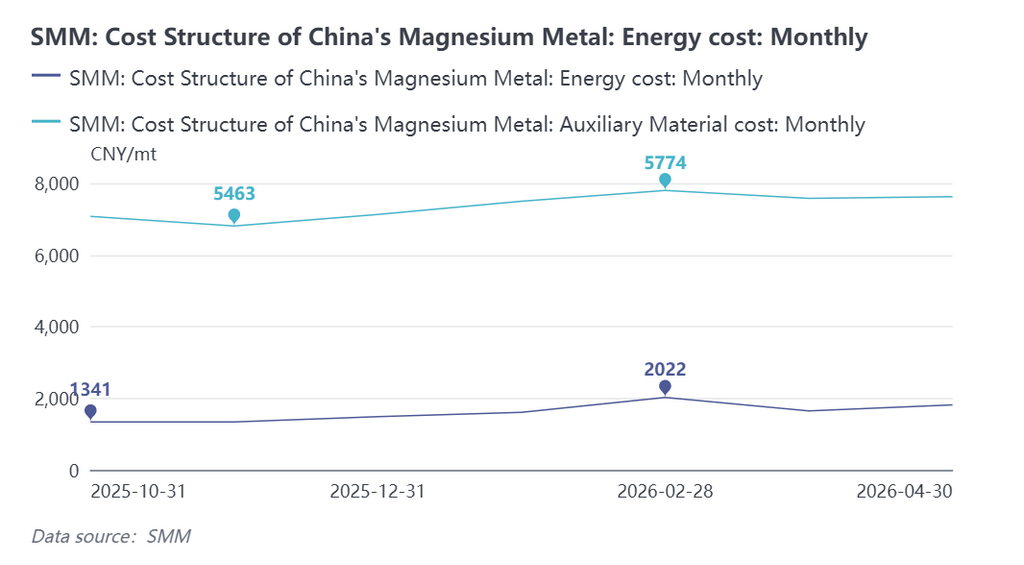
Recently, ferrosilicon market prices showed a relatively mild trend. Since 2026, mainstream prices of 75 ferrosilicon remained stable in the range of 5,700–6,100 yuan/mt, and the impact of ferrosilicon on magnesium costs weakened significantly. Overall, energy costs have replaced auxiliary materials as the core factor driving magnesium price trends.

Sustained losses in semi coke led to significantly higher coal gas costs that primary magnesium smelters needed to amortize. This transmission chain notably weakened the cost advantages of primary magnesium enterprises deeply tied to the semi coke industry.
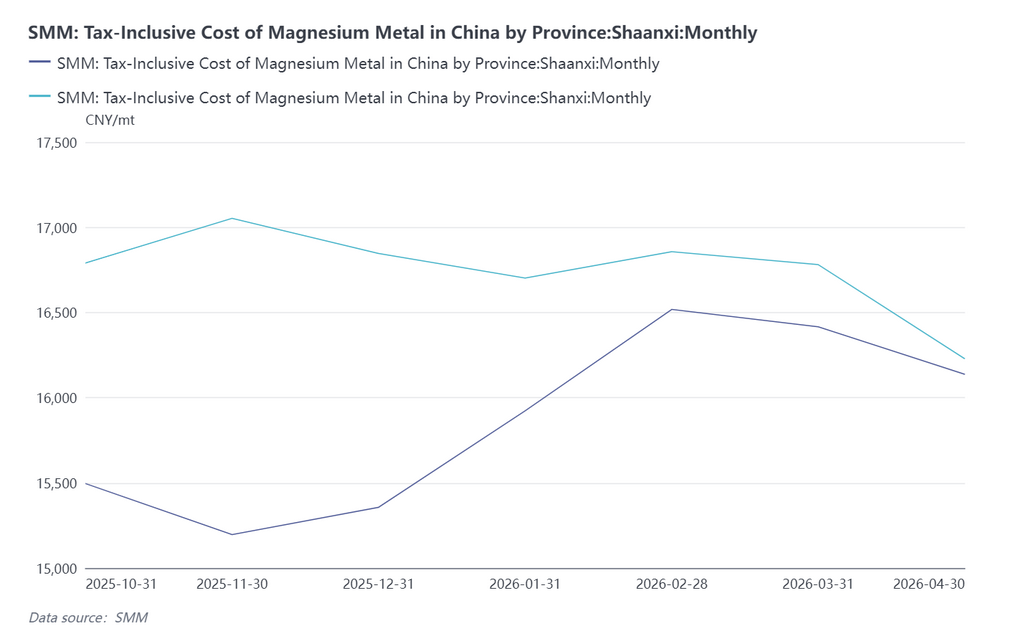
According to SMM's latest cost calculation data from April 2026, the regional cost landscape of primary magnesium smelting in China underwent a major reshaping. Smelting costs for primary magnesium in Shaanxi, which traditionally enjoyed energy industry chain advantages, continued to rise, while costs in Shanxi remained relatively stable. The price spread between the two regions narrowed significantly, and the differentiated regional cost advantages faded on a phased basis.

Overall, coal and coal gas costs have become the core factors driving primary magnesium prices, enterprise profitability, and industry dynamics, and the trend of increasing cost pressure on primary magnesium smelters continues.

Data Source Statement: Except for publicly available information, all other data are processed by SMM based on publicly available information, market communication, and relying on SMM's internal database model. They are for reference only and do not constitute decision-making recommendations.

For any inquiries or for more information, please contact: lemonzhao@smm.cn
For more information on how to access our research reports, please contact:service.en@smm.cn
Related News
China Upgrades Marine Resource Utilization: From Seawater to Mineral Extraction, Focusing on Magnesium
Common.Time.hoursAgo
China Upgrades Marine Resource Utilization: From Seawater to Mineral Extraction, Focusing on Magnesium
Read More
China Upgrades Marine Resource Utilization: From Seawater to Mineral Extraction, Focusing on Magnesium
[SMM Magnesium Express]According to Xinhua News Agency, the Ministry of Natural Resources released the "National Seawater Utilization Report 2025," indicating that China's utilization of marine resources is upgrading from "extracting water from the sea" to "extracting minerals from the sea." The report noted that Tianjin has initiated an international cooperation project titled "Key Technologies for Magnesium Extraction from Seawater/Concentrated Brine," forming a multidimensional industrial landscape for efficient resource development. Currently, there are 167 seawater desalination projects nationwide, with an annual capacity of 3.077 million tons. During the 14th Five-Year Plan period, efforts will continue to strengthen the technological reserves for strategic element extraction from seawater, contributing a "Chinese solution" to addressing global freshwater and strategic resource shortages. The industrialization process for seawater magnesium extraction is expected to accelerate.
Common.Time.hoursAgo
Magrathea Completes $100M Financing, Boosts U.S. Magnesium Smelting with Green Tech
Jun 15, 2026 17:59
Magrathea Completes $100M Financing, Boosts U.S. Magnesium Smelting with Green Tech
Read More
Magrathea Completes $100M Financing, Boosts U.S. Magnesium Smelting with Green Tech
[SMM Magnesium Express]U.S. company Magrathea announced the completion of a new round of financing, with cumulative capital support exceeding $100 million, accelerating the reconstruction of U.S. magnesium smelting capacity. The company has built the only newly constructed primary magnesium smelter in the U.S., signed multiple commercial agreements, and aims for an annual sales volume of over $500 million in the future. In March 2026, Magrathea secured a $24 million Series A funding round and established Arkansas Magnesia in a joint venture with TETRA. The first-phase commercial plant has initiated engineering design. The company has independently developed a new generation of electrolysis technology, enabling green production of metallic magnesium from seawater and brine. As the project progresses, the U.S. domestic magnesium supply chain's self-sufficiency is expected to gradually strengthen.
Jun 15, 2026 17:59
Tianjin Port Magnesium Ingot Prices Stable Amid Sluggish Demand and Freight Challenges
Jun 15, 2026 17:17
Tianjin Port Magnesium Ingot Prices Stable Amid Sluggish Demand and Freight Challenges
Read More
Tianjin Port Magnesium Ingot Prices Stable Amid Sluggish Demand and Freight Challenges
[SMM Magnesium Express]Recently, the FOB price of magnesium ingots at Tianjin Port has stabilized at $2,330-$2,400 per ton. Overseas demand remains sluggish, with downstream automakers and die-casting plants adopting a wait-and-see approach, resulting in scarce new orders. The market is supported only by essential demand and long-term contracts. Domestically, manufacturers face inventory accumulation and payment pressure, compounded by planned shutdowns for maintenance at some smaller plants, creating room for negotiation in the market. Due to shipping companies reducing capacity and rising oil prices, freight rates across routes have fluctuated significantly, with tight vessel availability. Prices for routes to Europe, India, and South Korea show marked divergence, further constraining foreign trade deals. In the short term, the FOB price of magnesium ingots is caught between cost support and downward pressure, maintaining a weak and volatile overall trend.
Jun 15, 2026 17:17