[SMM Analysis] April Sodium-Ion Battery Market Review: Steady Momentum, Bottlenecks, and Opportunities Ahead

Published: May 8, 2026 16:21
According to SMM data, compared with the rapid growth of cathode and anode materials, the electrolyte and battery cell markets maintained high YoY growth but were affected in the short term by factors such as cost control, capacity alignment, and the pace of end-use demand release, presenting an operational landscape of "stability with adjustments."
From the accelerating capacity of cathode and anode materials and recovering demand, to the steady momentum building in electrolyte and battery cells, the sodium-ion battery industry chain in April exhibited distinct characteristics of "upstream-downstream coordination with differentiated performance." According to SMM data, compared with the rapid growth of cathode and anode materials, the electrolyte and battery cell markets maintained high YoY growth but were affected in the short term by factors such as cost control, capacity alignment, and the pace of end-use demand release, presenting an operational landscape of "stability with adjustments." As the core supporting and end-user delivery segments of the sodium-ion battery industry chain, the development of both directly relates to the industry's commercialization progress.

The following combines SMM data and market dynamics to provide a detailed review of April's electrolyte and battery cell market performance, compare with cathode and anode trends, summarize the current landscape, and look ahead at future trends.

I. Sodium-Ion Battery Electrolyte: Steady Shipments Demonstrate Resilience, Capacity Gap Becomes Potential Constraint

According to SMM data, sodium-ion battery electrolyte production in April was up 1% MoM and up 111% YoY, with the overall market operating steadily without wild swings.
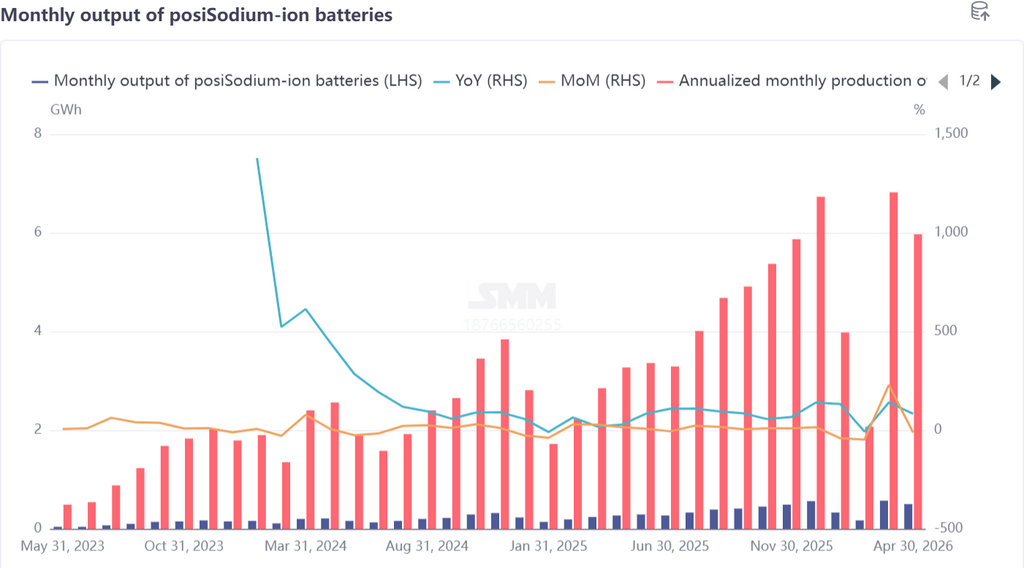
The current sodium-ion battery electrolyte market remains dominated by top-tier players, with core enterprises sustaining shipments and stabilizing supply, fully ensuring supply chain stability for downstream battery cell enterprises, serving as the core pillar of the industry's steady operation.

However, at the same time, downstream battery cell manufacturers, driven by cost control needs, continued to pressure electrolyte procurement prices, further squeezing the profit margins of electrolyte enterprises, with the industry presenting a trend of "stable volume under price pressure."

In stark contrast to the accelerating capacity release of cathode and anode materials, the current supply capability of sodium-ion battery electrolyte still has notable shortcomings. SMM analysis suggests that based on the current production scale of sodium-ion battery cells and medium and long-term expansion plans, a supply-demand gap already exists for sodium-ion battery electrolyte, and this gap is likely to widen further as battery cell capacity expands.The core reason is that current sodium-ion battery electrolyte capacity relies heavily on surplus capacity from existing lithium battery electrolyte production, with most electrolyte enterprises paying insufficient attention to the sodium-ion battery segment and failing to deploy dedicated capacity, resulting in supporting capacity unable to match future battery cell expansion demand. From an industry development perspective, electrolyte is gradually becoming another significant bottleneck constraining the scaled advancement of the sodium-ion battery industry, following hard carbon anode materials. Looking ahead to May, as downstream battery cell capacity is released and demand increases, sodium-ion battery electrolyte production is expected to grow in tandem.

According to SMM's forecast, sodium-ion battery electrolyte production in May is expected to increase 12% MoM and surge 120% YoY. However, the capacity gap issue is unlikely to be fundamentally resolved in the short term, and prices are expected to remain stable.

II. Battery Cells and End-Users: Consolidating for a Breakthrough, with Volume Ramp-up Expected in Q2

In April, the sodium-ion battery cell market exhibited a trend of "short-term adjustment with long-term positive outlook." According to SMM data, sodium-ion battery cell production in the month declined 12% MoM while rising 83% YoY.
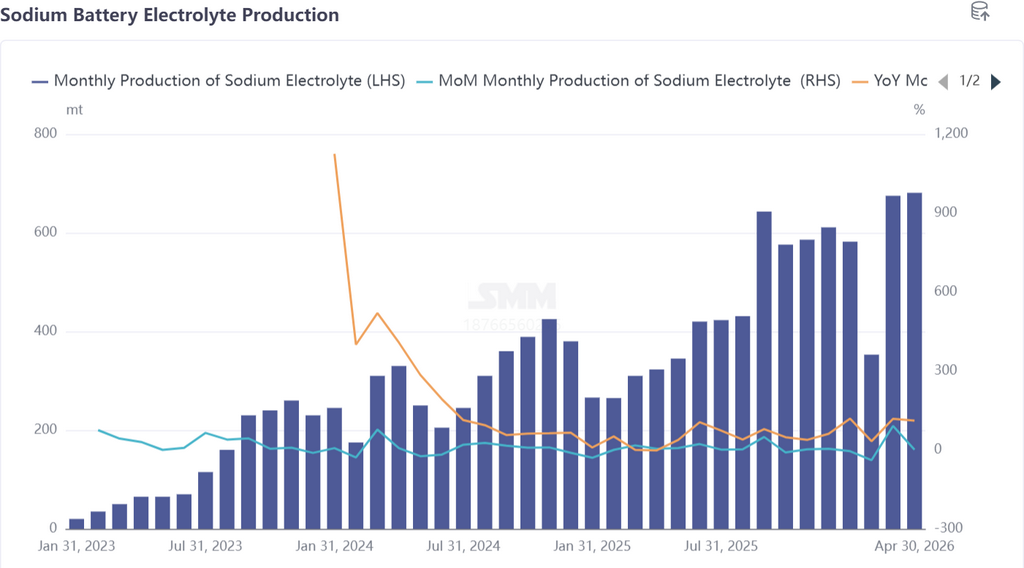
The slight MoM decline in production was not due to weak demand, but rather the result of enterprises reallocating and adjusting their existing capacity and orders — most enterprises, in preparation for new capacity commissioning in Q2 and subsequent energy storage project deliveries, used April as a consolidation period to optimize production processes, align material supply, and prepare for subsequent volume ramp-up.

April Sodium-Ion Battery Electrolyte & Battery Cell Market Review: Steady Momentum Building Ahead of Breakout, Bottlenecks and Opportunities Coexist

From the accelerating capacity of cathode and anode materials and recovering demand, to the steady momentum building in electrolyte and battery cells, the sodium-ion battery industry chain in April exhibited distinct characteristics of "upstream-downstream coordination with differentiated performance." According to SMM data, compared with the rapid growth of cathode and anode materials, the electrolyte and battery cell markets maintained high YoY growth but were affected in the short term by factors such as cost control,capacity alignment, and the pace of end-use demand release, presenting an operational landscape of "stability with adjustments." As the core supporting and end-user delivery segments of the sodium-ion battery industry chain, the development of both directly relates to the industry's commercialization progress. The following combines SMM data and market dynamics to provide a detailed review of April's electrolyte and battery cell market performance, compare with cathode and anode trends, summarize the current landscape, and look ahead at future trends.
Data Source Statement: Except for publicly available information, all other data are processed by SMM based on publicly available information, market communication, and relying on SMM's internal database model. They are for reference only and do not constitute decision-making recommendations.

For any inquiries or for more information, please contact: lemonzhao@smm.cn
For more information on how to access our research reports, please contact:service.en@smm.cn
Related News
GM move into sodium batteries spurs Korea to accelerate ESS push
Common.Time.hoursAgo
GM move into sodium batteries spurs Korea to accelerate ESS push
Read More
GM move into sodium batteries spurs Korea to accelerate ESS push
U.S. automotive giant General Motors (GM) has announced an investment in U.S. startup Peak Energy and plans to advance the commercialization of sodium-ion batteries, primarily for energy storage systems (ESS), with deployment targeted after 2029. This marks the first meaningful entry of a non-Chinese automaker into the field and is prompting Korea’s battery industry to incorporate sodium-ion technology into its strategic priorities, even as it accelerates efforts to catch up in LFP. Unlike ternary batteries (NCM/NCA) and LFP, which rely on lithium, sodium-ion batteries use more abundant and lower-cost sodium as a substitute, offering advantages such as greater supply chain stability, better low-temperature performance, and enhanced safety—making them particularly suitable for large-scale energy storage applications. At the same time, increased volatility in lithium prices has further strengthened the cost competitiveness of sodium-ion batteries. Korean players including LG Energy Solution, Samsung SDI, and SK On have already accelerated their efforts, aiming to advance sample production or commercialization around 2027. Overall, GM’s entry signals that a technology pathway previously dominated by Chinese companies is becoming globalized, and it is likely to push Korean battery manufacturers to accelerate adjustments to their technology and product portfolios.
Common.Time.hoursAgo
【Phosphorus Chemicals: Wengfu Raises Wet-Process 85% Phosphoric Acid Price by RMB 500 to RMB 12,100/ton】
Common.Time.hoursAgo
【Phosphorus Chemicals: Wengfu Raises Wet-Process 85% Phosphoric Acid Price by RMB 500 to RMB 12,100/ton】
Read More
【Phosphorus Chemicals: Wengfu Raises Wet-Process 85% Phosphoric Acid Price by RMB 500 to RMB 12,100/ton】
【Phosphorus Chemicals: Wengfu Raises Wet-Process 85% Phosphoric Acid Price by RMB 500 to RMB 12,100/ton】 On June 15, 2026, according to SMM, Wengfu increased its ex-factory price for wet-process 85% phosphoric acid by RMB 500 to RMB 12,100/ton. Driven by sharp fluctuations in sulfur prices, this hike is intended to ease tight supply pressures and curb downstream demand. A total of 800,000 tonnes of capacity at the Dazhou and Shanghang bases remain offline. Outlook: Significant geopolitical influences are expected to keep prices volatile in the short term. The rise in phosphoric acid prices further pushes up production costs for iron phosphate and lithium iron phosphate (LFP).
Common.Time.hoursAgo
GM Decides to Commercialize Sodium-Ion Batteries
Common.Time.hoursAgo
GM Decides to Commercialize Sodium-Ion Batteries
Read More
GM Decides to Commercialize Sodium-Ion Batteries
U.S. automaker General Motors (GM) has decided to commercialize sodium-ion batteries. According to battery industry sources on June 16, GM held its “GM Empower” event on June 9 local time and announced an equity investment in U.S. sodium-ion battery startup Peak Energy, as well as plans for joint development.
Common.Time.hoursAgo
[SMM Analysis] April Sodium-Ion Battery Market Review: Steady Momentum, Bottlenecks, and Opportunities Ahead - Shanghai Metals Market (SMM)