March Phosphate Ore Imports 182kt, Up 88.2% MoM; Jordan Halts Exports

Published: Apr 20, 2026 14:07
In March 2026, China’s phosphate ore imports reached 182,000 mt, up 88.2% MoM and 144.4% YoY, with an average price of $79.9/mt, down 7.2% MoM.Affected by Strait of Hormuz disruptions, Jordan halted supplies for the first time since September 2023. Imports mainly came from Egypt (170,000 mt) and Pakistan (12,000 mt), through Guangxi, Hubei and Fujian.

According to customs data, in March 2026, China's phosphate ore imports totaled 182,000 mt, up 88.2% from 97,000 mt in February and up 144.4% compared to the same period last year (75,000 mt). Total import value in March was $14.552 million, up 74.6% MoM from $8.336 million in February. The unit price was $79.9/mt, down 7.2% significantly from $86.1/mt in February.
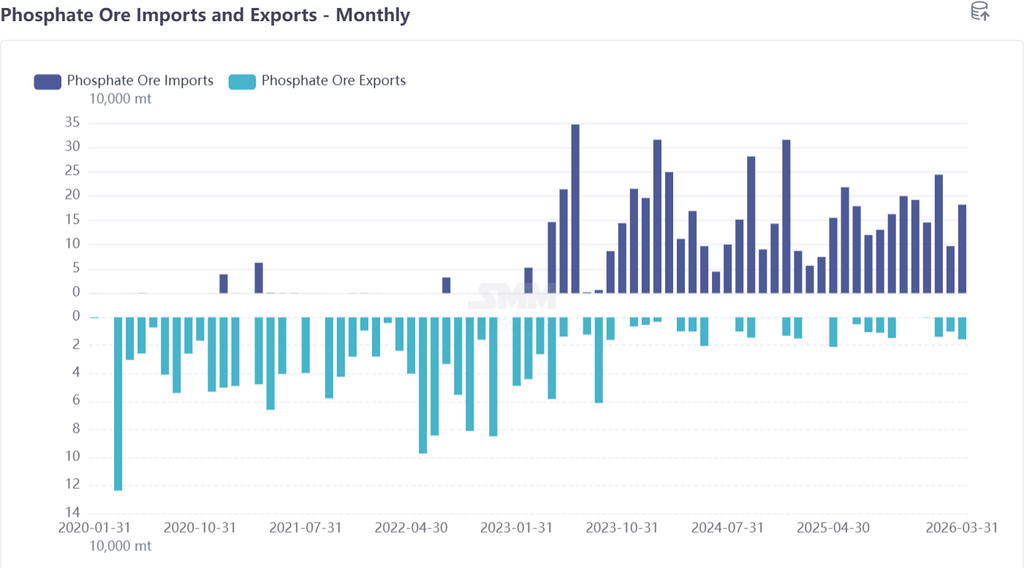
1. Phosphate ore imports: China's traditional major phosphate ore source countries were Egypt, Peru, and Jordan, with major importing provinces being Guangxi and Zhejiang, and major importing enterprises including Chuanjinnuo and other coastal phosphochemical enterprises. However, in March, due to logistics disruptions in the Strait of Hormuz, there were no phosphate ore imports from Jordan — the first time since September 2023 that no phosphate ore was imported from Jordan to China. The major source countries for phosphate ore imports in March were Egypt and Pakistan.
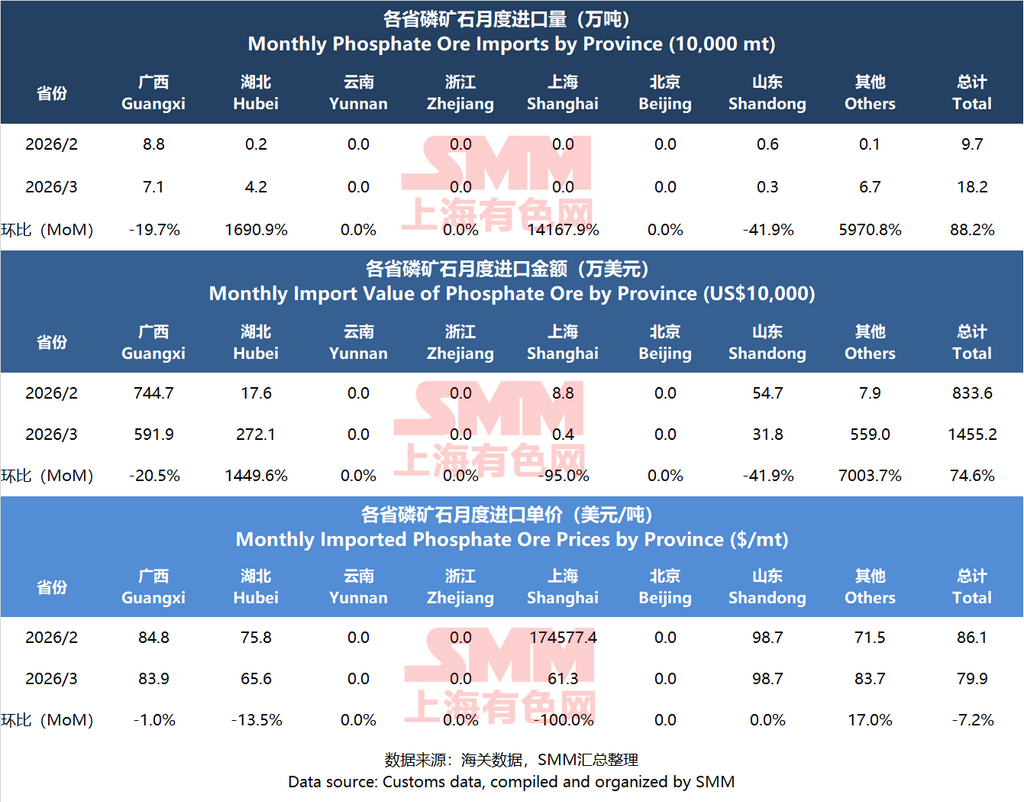
 

The top importing provinces in March were Guangxi (71,000 mt), Hubei (42,000 mt), and other regions such as Fujian (52,000 mt), while in February it was Guangxi (88,000 mt). Price side, the unit price was $79.9 in March versus $86.1 in February, showing a price decline in March.
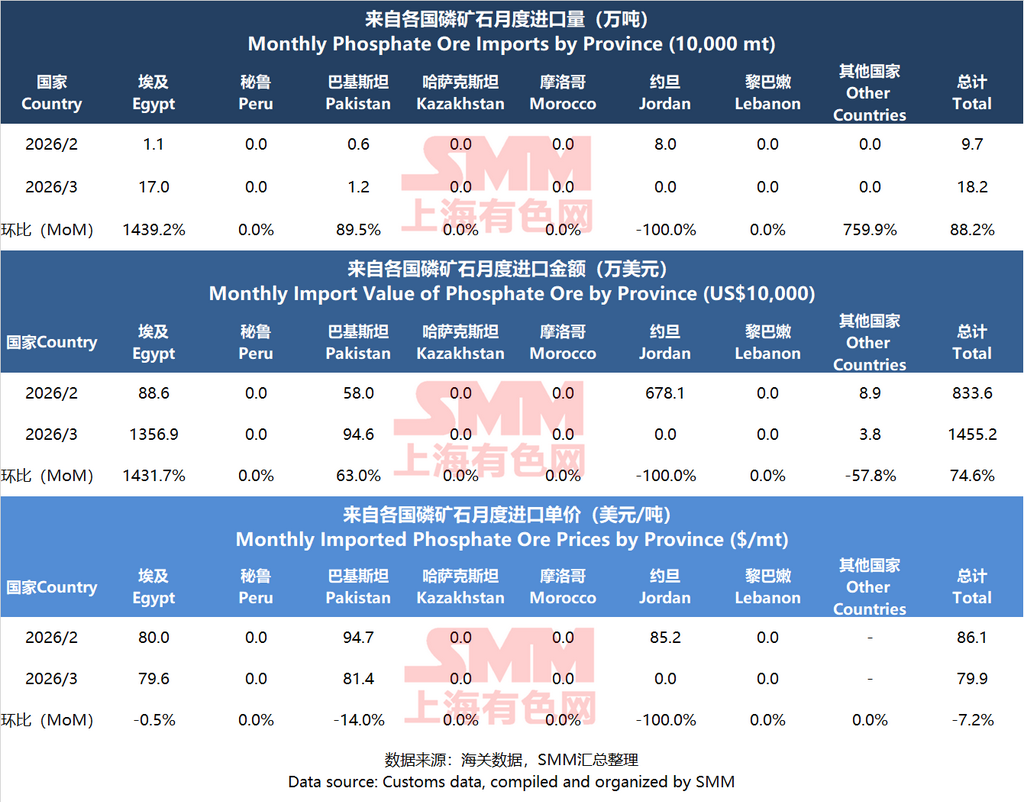
 

In March, China's phosphate ore imports mainly came from Egypt and Pakistan, with imports of 170,000 mt and 12,000 mt respectively. Affected by factors related to the Strait of Hormuz, phosphate ore from Jordan failed to be imported; however, imports from other regions had already filled the gap. As hindered transportation of high-priced Jordanian phosphate ore left no import volume to support prices, the import unit price of phosphate ore in March pulled back from February, falling below $80/mt.

2. Phosphate ore exports: Japan and South Korea became the main export destinations for phosphate ore in March, with shipments from Hubei to South Korea and Guizhou to Japan dominating.
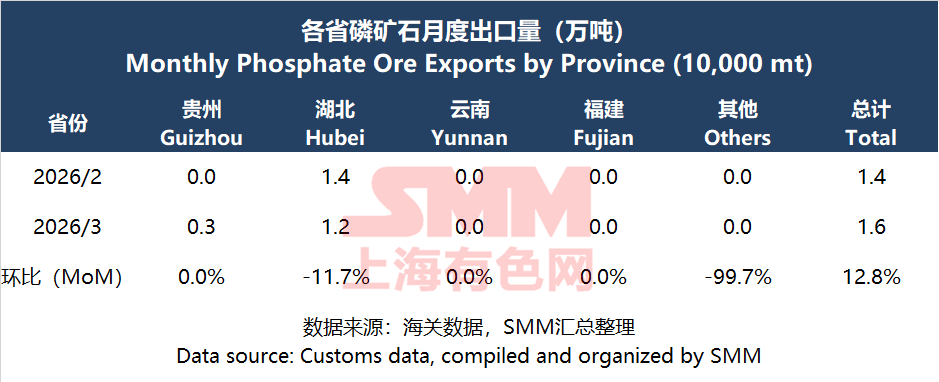
In March 2026, exports totaled 16,000 mt, up 55.7% from February, with the main export flow directed to Japan and South Korea. Hubei to South Korea and Guizhou to Japan accounted for 12,000 mt and 13,000 mt respectively, at unit prices of $185/mt and $328/mt.


Note: If you have any additions or corrections to the details mentioned in this article, please feel free to contact us at any time. Contact information is as follows:

Tel: 021-20707860 (or add WeChat 13585549799) Yang Chaoxing, thank you!

Data Source Statement: Except for publicly available information, all other data are processed by SMM based on publicly available information, market communication, and relying on SMM‘s internal database model. They are for reference only and do not constitute decision-making recommendations.

For any inquiries or to learn more information, please contact: lemonzhao@smm.cn
For more information on how to access our research reports, please contact:service.en@smm.cn
Related News
【SMM New Energy News】MIIT Issues 2026 Auto Standardization Guidelines to Advance EV and Battery Standards
Common.Time.hoursAgo
【SMM New Energy News】MIIT Issues 2026 Auto Standardization Guidelines to Advance EV and Battery Standards
Read More
【SMM New Energy News】MIIT Issues 2026 Auto Standardization Guidelines to Advance EV and Battery Standards
On May 26, the MIIT released its 2026 automotive standardization work priorities, focusing on expanding NEV standards. For power batteries, the ministry will accelerate safety standards for dismantling and crushing, and promote standards for battery dimensions and thermal management systems. Research will also deepen into battery cycle life, safety and performance evaluation, labeling, recycling, and BMS. Additionally, guidelines emphasize reviewing standards for chassis battery swapping, V2G, and automated charging.
Common.Time.hoursAgo
【Domestic Dynamics: Sunwoda 50,000-Ton Battery Recycling Phase I Begins Production】
Common.Time.hoursAgo
【Domestic Dynamics: Sunwoda 50,000-Ton Battery Recycling Phase I Begins Production】
Read More
【Domestic Dynamics: Sunwoda 50,000-Ton Battery Recycling Phase I Begins Production】
【Domestic Dynamics: Sunwoda 50,000-Ton Battery Recycling Phase I Begins Production】 Tengzhou Sunwoda's Phase I lithium-ion battery recycling project has commenced full production in 2026. Spanning 200 acres, the facility fills a critical downstream gap in the regional new energy supply chain. ​Operating on a closed-loop model, its 1.1-km automated line can process 50,000 tons of waste batteries annually—equivalent to recycling 60,000 EVs. ​The highly automated line integrates dismantling, pyrolysis, crushing, and restoration, achieving a 98.5% core element recovery rate to produce high-value black mass. ​By converting waste into lithium, nickel, and cobalt, the project resolves local material shortages and enhances regional supply chain security.
Common.Time.hoursAgo
【SMM New Energy News】Shenzhen 15th Five-Year Plan Aims for World-Class Advanced Energy Storage Center
Common.Time.hoursAgo
【SMM New Energy News】Shenzhen 15th Five-Year Plan Aims for World-Class Advanced Energy Storage Center
Read More
【SMM New Energy News】Shenzhen 15th Five-Year Plan Aims for World-Class Advanced Energy Storage Center
The Shenzhen 15th Five-Year Plan outline proposes accelerating the construction of a world-class new energy storage industry center, promoting the entire "generation-grid-load-storage" chain. Meanwhile, Shenzhen will expand its local NEV manufacturing scale, aiming for strategic emerging industry added value to top RMB 2.3 trillion by 2030.
Common.Time.hoursAgo