March Alumina Daily Output Falls M-o-M April New Capacity Combined with Import Shock Keeps Oversupply Pressure High

Published: Mar 31, 2026 15:53

SMM, March 31 –

In March 2026, China's metallurgical-grade alumina output rose 10.56% month-on-month but fell 3.33% year-on-year. From a capacity perspective, as of the end of March, the national installed capacity stood at approximately 113.22 million tonnes, with some growth driven by the gradual commissioning of new alumina projects in Guangxi. However, operating capacity declined 2.1% month-on-month and 8.7% year-on-year. Although new projects were brought online, they were still in trial production at the end of March and did not contribute effective output, leading to a decline in the overall operating rate.
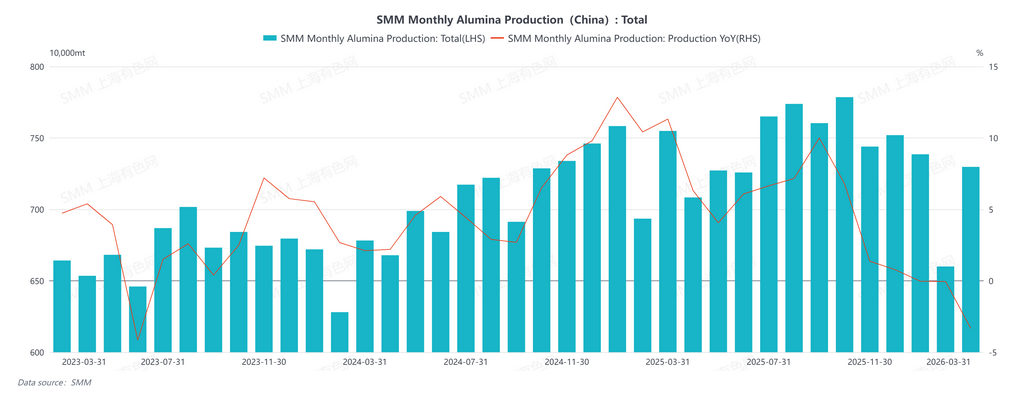
Looking at output structure, total production in March increased from February, but average daily output declined. The main reasons are: on one hand, several enterprises in Guizhou and Guangxi carried out various levels of maintenance; among them, one Guizhou-based company shut down part of its production lines due to operational pressure, significantly lowering the operating rate in southern China. On the other hand, northern regions such as Henan and Shandong saw relatively stable operations, mainly fulfilling long-term contract deliveries. In Shanxi, some enterprises continued upgrading their production lines, causing a slight decline in the operating rate. These factors combined led to a month-on-month drop in average daily output in March.

Looking ahead to April, the oversupply pattern in the alumina market is expected to persist. First, newly added capacity in Guangxi and Chongqing will be gradually released, driving overall output higher and intensifying competition within the industry. Second, attention should be paid to the indirect impact of geopolitical conflicts in the Middle East: some overseas alumina originally destined for the Middle East has been forced to be re-exported to China, resulting in an unexpected increase in China's imported alumina volume. This will likely impact the domestic market and may restrain the release of domestic production capacity. Based on a comprehensive assessment, China's operating alumina capacity in April 2026 is expected to be around 86.63 million tonnes.

Data Source Statement: Except for publicly available information, all other data are processed by SMM based on publicly available information, market communication, and relying on SMM‘s internal database model. They are for reference only and do not constitute decision-making recommendations.

For any inquiries or to learn more information, please contact: lemonzhao@smm.cn
For more information on how to access our research reports, please contact:service.en@smm.cn
Related News
Baotou Aluminum Reports 158.5% Net Profit Increase to 4.257 Billion Yuan in 2025
Common.Time.minsAgo
Baotou Aluminum Reports 158.5% Net Profit Increase to 4.257 Billion Yuan in 2025
Read More
Baotou Aluminum Reports 158.5% Net Profit Increase to 4.257 Billion Yuan in 2025
Baotou Aluminum Co., Ltd. 2025 annual important financial indicators, 2025 net profit of 4.257 billion yuan, an increase of 158.5%; Total assets were 24.224 billion yuan, compared with 23.714 billion yuan in the same period last year; Net assets were 18.711 billion yuan, compared with 15.084 billion yuan in the same period last year.
Common.Time.minsAgo
Lijian-2 Rocket Uses Innovative Optical Cylinder Tank Structure in China
Common.Time.minsAgo
Lijian-2 Rocket Uses Innovative Optical Cylinder Tank Structure in China
Read More
Lijian-2 Rocket Uses Innovative Optical Cylinder Tank Structure in China
On March 30, Zhang Yanrui, deputy chief engineer of Zhongke Yuhang Lijian No. 2, told reporters, The first and second tanks of the Lijian-2 carrier rocket both use the optical cylinder tank structure, which is the first engineering application of the large diameter optical cylinder tank structure in China. The second tank material is 2219 aluminum alloy, and the first tank material is 5A06 aluminum alloy.
Common.Time.minsAgo
CAS Space's Lijian-2: First Large-Diameter Unstiffened Cylindrical Tanks in China
Common.Time.minsAgo
CAS Space's Lijian-2: First Large-Diameter Unstiffened Cylindrical Tanks in China
Read More
CAS Space's Lijian-2: First Large-Diameter Unstiffened Cylindrical Tanks in China
On March 30, Zhang Yanrui, deputy chief designer of the Lijian-2 at CAS Space, told reporters that both the first- and second-stage propellant tanks of the Lijian-2 launch vehicle use an unstiffened cylindrical tank structure. This marks the first engineering application in China of a large-diameter unstiffened cylindrical tank structure. The second-stage tank is made of 2219 aluminum alloy, while the first-stage tank is made of 5A06 aluminum alloy.
Common.Time.minsAgo