Maintenance Ended, April Steel Mill Hot-Rolled Coil Production Schedule Rose MoM!

Published: Apr 7, 2026 10:20
According to SMM's latest tracking, the total planned volume of cold-rolled coil commercial material for this month at 31 mainstream steel mills amounted to 4.2118 million mt, down 164,600 mt from the actual cold-rolled coil commercial material production of the previous month, a decrease of 3.8%.
  • SMM Cold-Rolled Production Schedule: Steel Mills’ Daily Average Cold-Rolled Production Schedule in April Fell 0.6% MoM

According to SMM’s latest tracking, the total planned volume of cold-rolled commercial material for this month at 31 mainstream cold-rolled coil steel mills was 4.2118 million mt, down 164,600 mt from the actual cold-rolled commercial material production in the previous month, a decline of 3.8%.
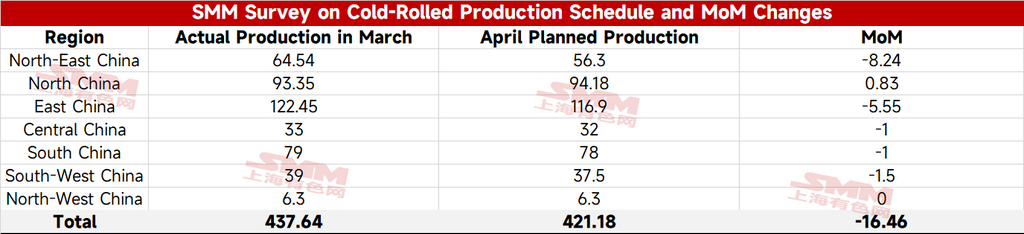

In daily average terms, as April had one fewer day than March, the daily average cold-rolled commercial material production schedule in April was 140,400 mt, down 0.6% MoM from the previous month’s daily average actual cold-rolled commercial material production.

  • SMM HRC Production Schedule: April HRC Production Schedule Up 5% MoM, Daily Average Up 9%

According to SMM's latest tracking, the total planned volume of HRC commercial material for this month at 39 mainstream HRC steel mills was 13.448 million mt, up 635,500 mt from the actual HRC commercial material production last month, an increase of 5.0%.
On a daily average basis, as April had one fewer day than March, the daily average scheduled production of HRC commercial material in April was 448,300 mt, up 8.5% MoM from the actual daily average production last month.

In March, blast furnaces or rolling lines at multiple steel mills in northeast China, north China, east China, and central and western China underwent maintenance. Coupled with the impact of environmental protection-driven production restrictions, some steel mills operated at reduced capacity. As maintenance concluded and production gradually resumed, hot-rolled coil production at steel mills rebounded markedly in April.


Summary: In April, the total production schedule for steel mills’ hot-rolled commercial flat products increased MoM, and as April has fewer days than March, the increase in daily average production scheduling was more pronounced.
Demand side, according to the latest SMM data, apparent demand for hot-rolled coil is currently below the level seen in the same period last year. As supply rebounds in April, demand absorption during the “Silver April” season will face significant challenges. Coupled with the backdrop of ongoing conflicts outside China, sheets & plates exports are under pressure, which will further exacerbate the supply-demand imbalance in China’s hot-rolled coil market.
Overall, market expectations are that the marginal impact of external factors on ferrous metals may weaken, while the cost side will face greater difficulty in breaking further to the upside. The trading center will gradually return to the fundamentals of the ferrous industrial chain. If downstream demand absorption is weak and inventory continues to decline only slowly, hot-rolled coil prices are expected to move sideways before trending weaker.

Data Source Statement: Except for publicly available information, all other data are processed by SMM based on publicly available information, market communication, and relying on SMM‘s internal database model. They are for reference only and do not constitute decision-making recommendations.

For any inquiries or to learn more information, please contact: lemonzhao@smm.cn
For more information on how to access our research reports, please contact:service.en@smm.cn
Related News
[SMM Iron & Steel] Thyssenkrupp Steel Invests €2.4 Million in High-Purity Ore Testing Facility
Common.Time.minsAgo
[SMM Iron & Steel] Thyssenkrupp Steel Invests €2.4 Million in High-Purity Ore Testing Facility
Read More
[SMM Iron & Steel] Thyssenkrupp Steel Invests €2.4 Million in High-Purity Ore Testing Facility
[SMM Iron & Steel] Thyssenkrupp Steel Invests €2.4 Million in High-Purity Ore Testing Facility
Thyssenkrupp Steel has announced an investment of €2.4 million into a new testing facility at its Duisburg site to evaluate the "iron ore of the future." This initiative focuses on the chemical and physical characterization of high-purity ores and pellets required for hydrogen-based direct reduction (DR) plants. As the industry moves away from traditional coal-based blast furnaces, ensuring a stable and efficient supply of DR-grade feedstock is critical for the success of Thyssenkrupp's decarbonization strategy, which targets its first climate-neutral steel production by the end of 2026.
Common.Time.minsAgo
[SMM Iron & Steel] Magnetite Mines Razorback Project Gains Major Project Status in Australia
Common.Time.minsAgo
[SMM Iron & Steel] Magnetite Mines Razorback Project Gains Major Project Status in Australia
Read More
[SMM Iron & Steel] Magnetite Mines Razorback Project Gains Major Project Status in Australia
[SMM Iron & Steel] Magnetite Mines Razorback Project Gains Major Project Status in Australia
The Australian federal government has granted "Major Project Status" to the Razorback Magnetite project in South Australia, recognizing its potential to provide high-grade iron ore feedstock for the green steel industry. This status streamlines regulatory approvals for the $2 billion project, which is designed to produce 68.5% Fe concentrate essential for hydrogen-based direct reduction ironmaking. The project is a key part of Australia's strategy to move toward higher-value mineral processing as global steelmakers seek to reduce their Scope 3 emissions through higher-purity inputs.
Common.Time.minsAgo
[SMM Iron & Steel] India NMDC Achieves Record Iron Ore Output in FY2026
Common.Time.minsAgo
[SMM Iron & Steel] India NMDC Achieves Record Iron Ore Output in FY2026
Read More
[SMM Iron & Steel] India NMDC Achieves Record Iron Ore Output in FY2026
[SMM Iron & Steel] India NMDC Achieves Record Iron Ore Output in FY2026
State-owned NMDC Limited reported a record-breaking performance for the fiscal year ending March 2026, achieving its highest-ever annual output of 53.15 million tonnes, a 21% increase year-on-year. This surge was supported by a massive 51% production spike in March alone as the company pushed to meet national infrastructure targets. Despite the record domestic volume, the mismatch between local low-grade output and the high-grade requirements of advanced steel mills continues to drive India's increasing reliance on seaborne procurement for its premium feedstock.
Common.Time.minsAgo