March 27, 2026:
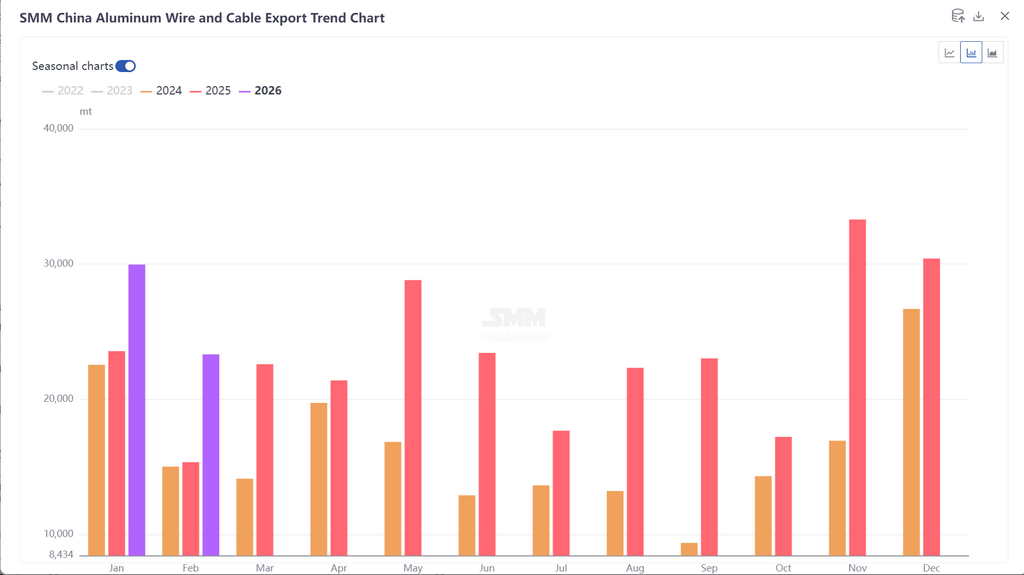
Customs data showed that China’s aluminum wire and cable exports totaled 53,280 mt in January-February 2026, with warehouse withdrawals up 37% YoY from January-February last year, while total export value reached $169 million. By export product mix, in January, exports of steel-core aluminum stranded wire were 18,000 mt, accounting for 60%, while exports of other non-insulated aluminum stranded wire were 12,000 mt, accounting for 40%; in February, exports of steel-core aluminum stranded wire were 15,800 mt, accounting for 68%, while exports of other non-insulated aluminum stranded wire were 7,400 mt, accounting for 32%. (HS codes: 76141000, 76149000)
By destination country, the steady release of China’s aluminum wire and cable exports in January-February 2026 was mainly driven by the concentrated advancement of global new energy projects and power grid infrastructure construction. Among key export destinations, demand support was prominent. Tanzania in Africa was the largest destination for aluminum wire and cable exports in January-February, with total exports reaching 7,445.8 mt, accounting for 14.0% of total exports. Its "National Energy Transition Plan" and "Rural Electricity Full Coverage Plan" entered a period of concentrated project construction in early 2026, and surging demand for rural power grid upgrades and supporting new energy line construction became the core force boosting exports; in addition, exports to Saudi Arabia in the Middle East were 6,983.3 mt, accounting for 13.1%, but as the war in the Middle East further escalates, subsequent shipping disruptions may affect the country’s future export performance; Australia ranked third in export volume, totaling 5,106.2 mt in January-February and accounting for 9.6%, as accelerated construction of supporting power transmission lines for local PV and wind power projects further expanded aluminum wire and cable imports.
By province, China’s aluminum wire and cable exports showed a regionally concentrated pattern. In January-February 2026, Jiangsu Province ranked first with exports of 22,822.8 mt, accounting for 42.8% of the national total and serving as the core hub for aluminum wire and cable exports; Henan Province recorded 7,975.7 mt, accounting for 15.0%, while the Xinjiang Uygur Autonomous Region recorded 6,483.9 mt, accounting for 12.2%. Combined exports from the three regions accounted for 70.0% of the national total, indicating a clear concentration effect. SMM Brief Comment:
Overall, China’s aluminum wire and cable exports got off to a steady start in January-February 2026, with an export volume of 53,000 mt laying a solid foundation for growth throughout the year. In markets outside China, demand from new energy and power grid construction in regions such as Africa, the Middle East, and Oceania continued to be released, becoming the core driver boosting exports. On the domestic supply side, the industrial clustering effect in leading provinces was significant, providing strong support for stable export volumes. Looking ahead to full-year 2026, aluminum wire and cable exports are expected to maintain positive growth momentum. Increased investment in power infrastructure in countries outside China will provide sustained demand support for China’s aluminum wire and cable exports. However, as geopolitical risks intensify, changes in global shipping routes, fluctuations in raw material prices, and adjustments to trade policies may bring potential risks. In the short term, more attention should be paid to dynamic changes in demand both outside China and in China.