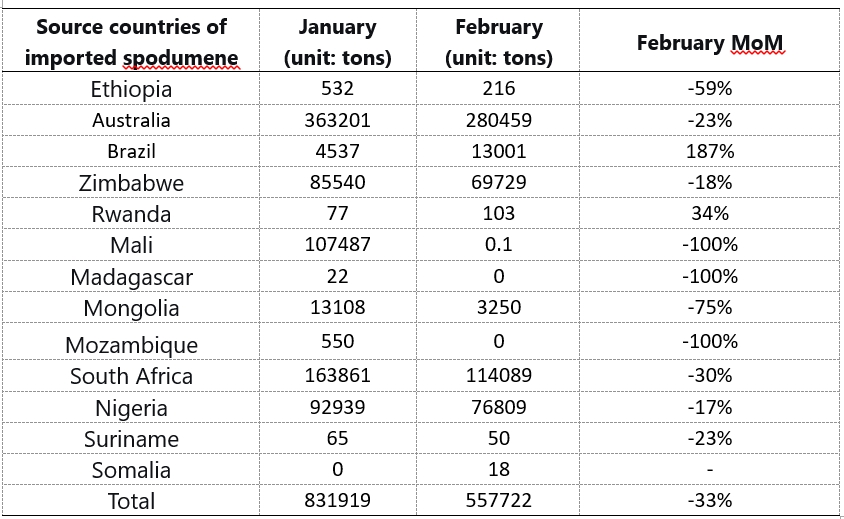
According to customs data, the total import volume of lithium spodumene in China from January to February 2026 was approximately 1.39 million physical tonnes: January imports reached 832,000 physical tonnes, up nearly 6% month-on-month and 41% year-on-year, equivalent to about 84,000 tonnes of lithium carbonate equivalent (LCE); February imports stood at 558,000 physical tonnes, down 33% month-on-month and approximately 2% year-on-year, equivalent to about 50,000 tonnes of LCE.
Overall, the arrival volume in January reached an exceptionally high level, mainly due to the tight supply of lithium salts in the fourth quarter of 2025, which drove strong production enthusiasm among domestic lithium spodumene smelters and consequently led to a high demand for lithium ore. In February, arrivals declined due to the Chinese New Year holiday and potential vessel delays.
By country of origin, Australia saw a 17% month-on-month recovery in January arrivals, significantly rebounding, supported by improved shipments from November to December 2025. However, after entering January, at the beginning of the quarter, Australian miners adopted a wait-and-see attitude toward lithium prices for the new year, leading to lower shipments. Combined with the Chinese New Year factor in February, arrivals in February decreased by 23% month-on-month. Zimbabwe entered the rainy season after October last year, resulting in a slight decline in concentrate output. Coupled with adjustments to export tax rates and the accounting period at the beginning of the year, arrivals fell by 35% and 18% month-on-month in January and February, respectively. Nigeria has seen a continuous rise in arrivals since June 2025, maintaining high levels. South Africa performed notably well, with arrivals remaining above 100,000 physical tonnes for three consecutive months from December 2025 to February 2026. In contrast, Brazil saw persistently low arrivals in January and February this year, as certain mines had not yet resumed production from October to December last year.
Additionally, according to screening and analysis using the SMM model, lithium spodumene imports in January corresponded to approximately 84,000 tonnes of LCE, with lithium concentrate amounting to 636,000 physical tonnes, accounting for 76%. In February, lithium spodumene imports corresponded to 50,000 tonnes of LCE, with lithium concentrate amounting to 438,000 physical tonnes, accounting for 79%.