China’s Brass Bar Imports Fell 9.94% YoY in January-February 2026

Published: Mar 25, 2026 14:14
According to the latest customs data, in January 2026, China’s imports of copper-zinc alloy (brass) bars and rods were 2,050.01 mt in physical content, down 8.37% MoM and up 24.53% YoY. In February, China’s imports of copper-zinc alloy (brass) bars and rods were 1,344.87 mt in physical content, down 34.4% MoM and down 36.67% YoY, showing an overall sharp decline. Cumulative imports in January-February 2026 were 3,394.87, down 9.94% YoY cumulatively. (HS codes 74072111, 74072119, 74072190).
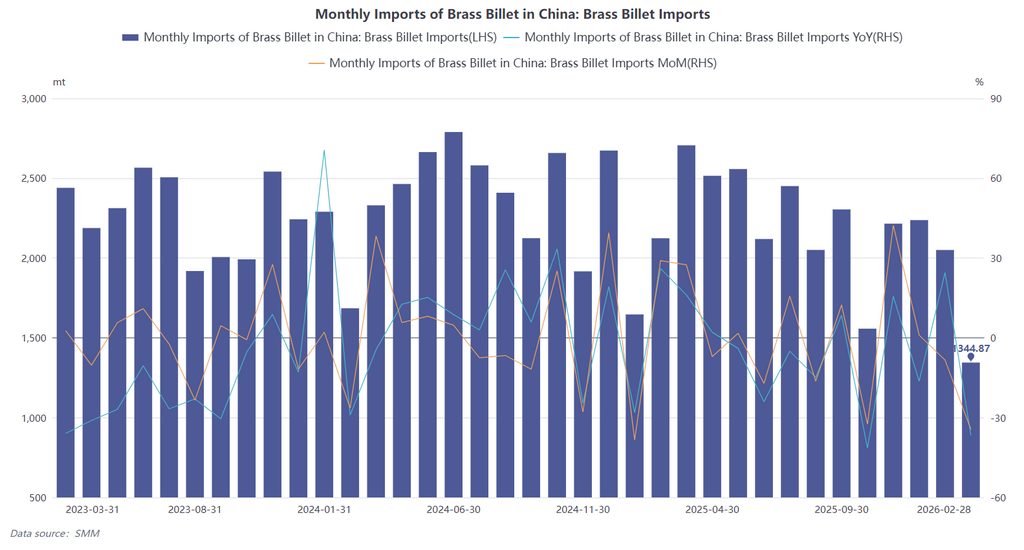
According to the latest customs data, in January 2026, China’s imports of copper-zinc alloy (brass) bars and rods were 2,050.01 mt in physical content, down 8.37% MoM and up 24.53% YoY. In February, China’s imports of copper-zinc alloy (brass) bars and rods were 1,344.87 mt in physical content, down 34.4% MoM and down 36.67% YoY, showing an overall sharp decline. Cumulative imports in January-February 2026 were 3,394.87, down 9.94% YoY cumulatively. (HS codes 74072111, 74072119, 74072190).

The Chinese New Year holiday in 2026 fell in February, significantly shortening effective production time, which was one of the reasons for the sharp drop in imports in February. In addition, persistently high raw material costs clearly suppressed import demand. Judging from operating conditions, the post-holiday resumption pace in the brass billet industry was also noticeably slower than in previous years.

It is worth noting that the continuously escalating geopolitical conflict in the Middle East since 2026 has already caused substantial disruption to the global non-ferrous metals supply chain. The rise in energy prices and increase in transportation costs caused by geopolitical conflict are putting pressure on brass processing enterprises from the cost side.

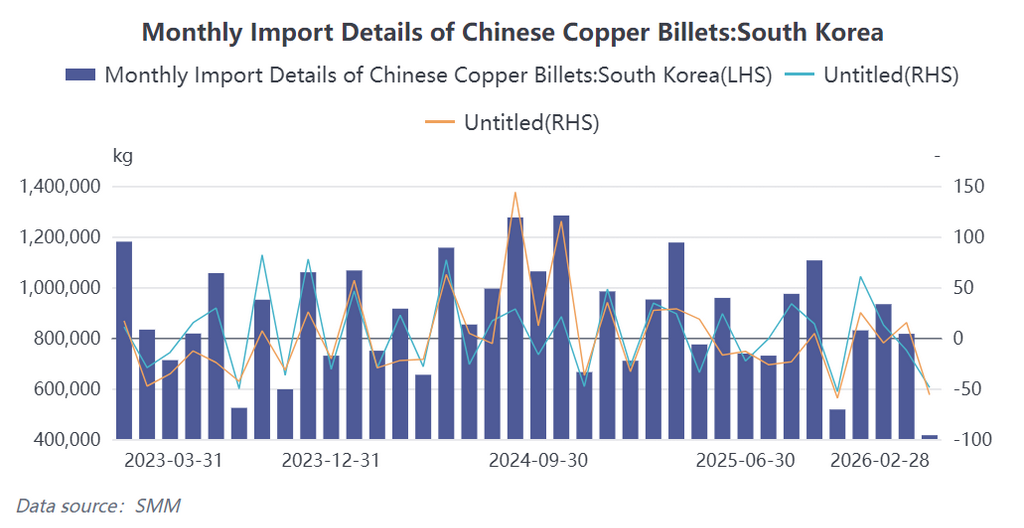
The import source landscape changed, with South Korea still ranking first but posting a significant decline: In terms of import origins, South Korea remained China’s largest source of brass billet imports, leading in the share of cumulative imports in January-February. Imports in January were 815.33 mt, down 12.55% MoM and up 15% YoY. Imports from South Korea in February were 414.98 mt, down 49.1% MoM and down 56.35% YoY, accounting for 30.86%. Japan ranked second, with February imports at 306.87 mt, down 34.23% MoM and down 19.36% YoY, accounting for 22.82%. Notably, Indonesia performed strongly, with February imports reaching 258.54 mt, up both MoM and YoY, with YoY growth of 42.8%, and its share rising to 19.22%, surpassing other traditional sources to become the third-largest source country. This change reflected the diversification of China’s brass billet import sources, with supply capability in Southeast Asia improving.
The decline in import value was smaller than that in imports, reflecting higher unit prices: In terms of import value, January import value was $17.64 million, down 5.43% MoM but up 43.58% YoY. February import value was $12.65 million, down 28.26% MoM and down 19.78% YoY, with the decline significantly smaller than the YoY decline in imports (36.67%), reflecting a YoY increase in the import unit price of brass billet. Cumulative import value in January-February 2026 was $30.29 million, up 7.96% YoY.

Looking ahead, the brass billet market will still face the phased predicament of “high costs, low demand, and weak expectations” in the short term, and the brass billet import market in Q1 2026 is expected to remain at a low level. 
Data Source Statement: Except for publicly available information, all other data are processed by SMM based on publicly available information, market communication, and relying on SMM‘s internal database model. They are for reference only and do not constitute decision-making recommendations.

For any inquiries or to learn more information, please contact: lemonzhao@smm.cn
For more information on how to access our research reports, please contact:service.en@smm.cn
Related News
Zijin Mining to Open Major Lithium Mine in Congo, Set to Be Top Battery Metal Supplier
Common.Time.minsAgo
Zijin Mining to Open Major Lithium Mine in Congo, Set to Be Top Battery Metal Supplier
Read More
Zijin Mining to Open Major Lithium Mine in Congo, Set to Be Top Battery Metal Supplier
The lithium mine Zijin Mining Group Co. plans to open this year in the Democratic Republic of Congo is set to be one of the world’s biggest suppliers of the battery metal.The Chinese company – which has grown at breakneck speed to become a top producer of copper and gold – has been developing the Manono lithium project in southeastern Congo since it secured the prized deposit in 2023.
Common.Time.minsAgo
Rio Tinto Targets 2030s Opening for Arizona Copper Mine, May Export Concentrate Due to US Smelting Costs
Common.Time.minsAgo
Rio Tinto Targets 2030s Opening for Arizona Copper Mine, May Export Concentrate Due to US Smelting Costs
Read More
Rio Tinto Targets 2030s Opening for Arizona Copper Mine, May Export Concentrate Due to US Smelting Costs
Rio Tinto aims to open Arizona’s Resolution Copper mine by the mid-2030s but may need to export some of its copper concentrate due to the challenging economics of smelting in the US, a senior executive told Reuters on Tuesday.The Anglo-Australian mining giant this month gained control of acreage needed to build one of the world’s largest copper mines after a years-long court fight in which rising US demand for the red metal clashed with the religious rights of the San Carlos Apache people.
Common.Time.minsAgo
Data: SHFE, DCE market movement (Mar 25)
1 hour ago
Data: SHFE, DCE market movement (Mar 25)
Read More
Data: SHFE, DCE market movement (Mar 25)
The following table shows the ferrous and nonferrous metals movement on the SHFE and DCE on 25 Mar , 2026
1 hour ago