3.20
The Strait of Hormuz is a critical chokepoint for global maritime trade, handling the vast majority of import and export shipping for countries along the Persian Gulf. On February 28, 2026 local time, after the US and Israel jointly launched military strikes against Iran, the Islamic Revolutionary Guard Corps announced the closure of the Strait of Hormuz on the same day, creating a de facto blockade through naval mines, drone harassment, GPS signal interference, and other measures. This blockade directly disrupted shipping routes passing through the strait, sent freight rates soaring, caused severe schedule delays, and broadly raised cross-border trade fulfillment costs and global supply chain risks.
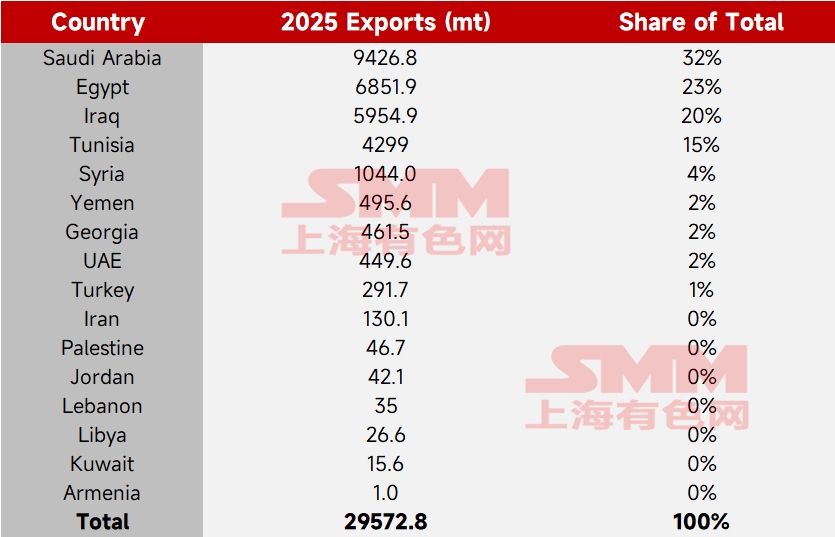
Based on China’s 2025 aluminum wire and cable export data to the Middle East, Saudi Arabia was the largest export destination in the region, with annual exports of 9,426.752 mt, accounting for 31.88 of the Middle East total; Iraq was the third-largest regional export destination, with exports of 5,954.909 mt, accounting for 20.14. Together, the two contributed more than half of the Middle East market share and were the most heavily affected markets after the blockade of the Strait of Hormuz. Dammam Port, Saudi Arabia’s core industrial port, is located deep in the Persian Gulf, and its traditional direct shipping route relied entirely on passage through the Strait of Hormuz. After the blockade, this main route was completely cut off, forcing shipping companies to shift to two alternative routes: one was to detour around the Cape of Good Hope in Africa to Jeddah Port on Saudi Arabia’s Red Sea coast, then connect to eastern consumer markets via inland transportation; the other was to transship through Salalah Port in Oman before entering by land, significantly extending shipping schedules. Iraq, by contrast, has no outlet to the Red Sea or the Mediterranean, and its only large-scale commercial port, Umm Qasr Port, depended entirely on navigation through the Strait of Hormuz.
After the blockade, it had no direct maritime shipping route and could only rely on overland transit via ports in neighboring Jordan and Turkey, resulting in even more severe impacts on delivery timeliness and logistics costs. The other Persian Gulf coastal countries accounted for less than 5 in total and all faced the same risk of route disruptions, while Red Sea coastal countries such as Egypt and Tunisia were affected only by cost increases stemming from geopolitical spillover, without any direct shipping suspension impact.

![Inventory fluctuated downward as increased warehouse withdrawals accelerated destocking, and recovering consumption drove processing fees back above parity [SMM Aluminum Billet Weekly Review]](https://imgqn.smm.cn/usercenter/LfGaw20251217171654.jpg)