In mid-April 2026, CAAM and the China Automotive Battery Innovation Alliance successively released data on the auto and power battery markets for March 2026. CAAM noted that in March, auto production and sales rebounded significantly MoM with a slight YoY decline, showing improvement compared to the first two months. Auto exports maintained rapid growth and demonstrated strong resilience despite external uncertainties, while Chinese brands continued to enhance their competitiveness... SMM has compiled the relevant data on the auto market and power battery market for March 2026 for readers' reference.
Auto Sector
CAAM: Auto Production and Sales Up 74.4% and 60.6% MoM in March
In March, auto production and sales reached 2.917 million units and 2.899 million units respectively, up 74.4% and 60.6% MoM, while down 3% and 0.6% YoY respectively.
From January to March, auto production and sales reached 7.039 million units and 7.048 million units respectively, down 6.9% and 5.6% YoY.
CAAM: NEV Sales Reached 1.252 Million Units in March, Up 1.2% YoY
In March, NEV production and sales reached 1.231 million units and 1.252 million units respectively, with production down 3.6% YoY and sales up 1.2% YoY. NEV sales accounted for 43.2% of total new auto sales.
From January to March, NEV production and sales reached 2.965 million units and 2.96 million units respectively, down 6.8% and 3.7% YoY. NEV sales accounted for 42% of total new auto sales.
CAAM: Rapid Growth in Auto Exports in March; NEV Exports Up 1.2x YoY, January-March
In March, auto exports reached 875,000 units, up 30.2% MoM and 72.7% YoY. From January to March, auto exports reached 2.226 million units, up 56.7% YoY.
In March, NEV exports reached 371,000 units, up 31.6% MoM and 1.3x YoY; traditional fuel vehicle exports reached 505,000 units, up 29.2% MoM and 44.6% YoY. From January to March, NEV exports reached 954,000 units, up 1.2x YoY; traditional fuel vehicle exports reached 1.271 million units, up 29.9% YoY.
Regarding the auto market in March, CAAM stated that auto production and sales rebounded significantly MoM with a slight YoY decline, showing improvement compared to the first two months. Among them, the Chinese market showed relatively sluggish performance, with double-digit YoY declines, affected by factors such as policy transition adjustments, demand being front-loaded and released, and a high base in the same period last year; auto exports maintained rapid growth and demonstrated strong resilience despite external uncertainties, with Chinese brands' competitiveness continuing to improve.
The CPCA also released data on the passenger vehicle market for March 2026. From March 1 to 31, national passenger vehicle market retail sales reached 1.648 million units, down 15.0% YoY and up 59.4% MoM. Cumulative retail sales year-to-date reached 4.226 million units, down 17.4% YoY. Overall passenger vehicle performance in China and non-China markets in Q1 2026 was slightly better than expectations. Due to the complex impact of market factors and fiscal and tax policy adjustments, the "low first half, high second half" pattern in annual sales has been quite pronounced in recent years. Affected by factors such as the late Chinese New Year, the decline in domestic retail sales in Q1 2026 was a result of the overlapping effects of the fiscal and tax policy adaptation period and the market recovery period around Chinese New Year.
NEV side, passenger NEV market retail sales in March reached 848,000 units, down 14.4% YoY and up 82.6% MoM; from January to March, passenger NEV market retail sales reached 1.908 million units, down 21.1% YoY. Conventional fuel passenger vehicle retail sales in March reached 800,000 units, down 16% YoY and up 40% MoM.
NEV export side, as the scale advantages of Chinese NEVs became apparent and market expansion demand grew, an increasing number of Chinese-manufactured new energy brand products went overseas, with recognition outside China continuing to rise. Among them, PHEVs accounted for 44% of new energy exports (35% in the same period last year). Although recently affected by some interference from foreign countries, independent PHEV exports to developing countries grew rapidly with bright prospects. Passenger NEV exports in March reached 349,000 units, up 139.9% YoY and up 29.6% MoM, accounting for 50.2% of passenger vehicle exports, up 13.7 percentage points YoY; among them, BEVs accounted for 52.3% of new energy exports (62.8% in the same period last year), and A00+A0 class BEVs, as the core focus, accounted for 52% of BEV exports (52% in the same period last year).
The CPCA stated that after the NEV purchase tax exemption policy, which had been in effect since September 2014, officially expired at the end of December 2025, the NEV market in 2026 is in a tax subsidy adjustment period. Countries in Europe and the US with substantial new energy subsidies have also experienced market correction periods due to subsidy adjustments. The auto market this year shows: 1) Few new models: only 18 new models were launched in Q1 this year, significantly fewer than 33 in Q1 2024 and 28 in Q1 2025. The incremental contribution of all-new models declined, gradually transitioning to annual facelift and refresh updates amid a fully competitive market. 2) Structural shift: As the trend of consumption upgrading became increasingly evident, the launch of economy cars dropped sharply to only 1 model. Recently, some new products sought breakthroughs through extended-range EVs and hybrid car models, which are expected to have considerable growth potential in China and non-China markets, providing a certain boost to the auto market. 3) Rising costs: The price surge in memory, chips, non-ferrous metals, and other materials driven by the US AI revolution, combined with the ongoing stalemate of the recent Middle East crisis pushing international oil prices higher, led to increased automotive-grade parts manufacturing costs and end-user vehicle usage costs, suppressing the release of consumption potential. 4) Channel difficulties: As Q1 auto market sales posted negative growth, dealers faced mounting survival pressure. In March, internal combustion engine vehicles sales promotions declined 0.8 percentage points MoM, while NEV sales promotions growth remained flat compared to the same period last year. Coupled with the absence of a price-cutting wave, wait-and-see sentiment among consumers was evident. Anti-involution in the automotive industry will serve as the main theme for quality improvement, efficiency enhancement, and industrial upgrading. Exports and China auto market growth are expected to diverge this year, with NEV performance not being strong, and domestic consumption still requiring long-term policies such as car purchase tax deductions against personal income tax for support.
Characteristics of the passenger vehicle market in March 2026: First, in March, passenger vehicle producers' exports of both internal combustion engine vehicles and NEVs hit all-time monthly highs, fully demonstrating the continuously improving competitiveness of China's automotive industry in the global market and robust demand outside China. Second, after the expiration of the vehicle purchase tax exemption, the pullback in retail was notable, with the share of high-end NEVs rising significantly, reflecting a structural shift driven by a declining share of entry-level consumption, which is conducive to promoting the industry's transformation toward high-quality development. Third, new car launches in 2026 remained steady. Combined with the advancement of "anti-involution" efforts to curb disorderly price cuts, NEV sales promotions in March stayed at 10.6%, remaining around 10% for seven consecutive months, with no vicious volume discount competition, helping to maintain market order. Fourth, the historical pattern of weaker post-Chinese New Year internal combustion engine vehicle retail performance compared to NEVs continued once again. In March, internal combustion engine vehicle domestic retail was down 16% YoY, pure EV market retail was down 12% YoY, extended-range was down 6% YoY, and plug-in hybrid was down 24% YoY. As consumers gradually adapt to the normalization of NEV taxation, the new energy market is expected to gradually return to a positive growth trajectory. Fifth, March this year marked the post-Chinese New Year return to the NEV-dominated consumption phase, with NEV domestic retail penetration rate at 51.5% and export penetration rate at 50.2%, both showing solid performance. Sixth, in March 2026, independent brand internal combustion engine passenger vehicle exports reached 307,000, up 42% YoY, while independent brand new energy exports reached 300,000, up 133% YoY, with new energy accounting for 49.4% of independent brand exports. In particular, the high growth of new energy exports in Europe, Southeast Asia, and other regions signifies the continuously expanding influence of Chinese NEV brands in international markets, laying a solid foundation for future export growth.
Power Battery
Power and ESS Battery Sales Up 51.6% YoY in March; Cumulative Sales Up 52.9% YoY, January-March
In March, China's power and ESS battery sales reached 175.1 GWh, up 54.7% MoM and up 51.6% YoY. Of this, power battery sales were 114.7 GWh, accounting for 65.5% of total sales, up 53.9% MoM and up 31.1% YoY; ESS battery sales were 60.4 GWh, accounting for 34.5% of total sales, up 56.2% MoM and up 115.9% YoY.
From January to March, China's cumulative power and ESS battery sales reached 437.1 GWh, up 52.9% YoY on a cumulative basis. Of this, cumulative power battery sales were 291.9 GWh, accounting for 66.8% of total sales, up 34.3% YoY on a cumulative basis; cumulative ESS battery sales were 145.1 GWh, accounting for 33.2% of total sales, up 111.8% YoY on a cumulative basis.
China's Power Battery Installations Up 114.9% MoM in March; Cumulative LFP Battery Installations Accounted for 79.3% of Total, January-March
In March, China's power battery installations reached 56.5 GWh, up 114.9% MoM and down 0.1% YoY. Of this, ternary battery installations were 10.7 GWh, accounting for 19.0% of total installations, up 88.1% MoM and up 7.3% YoY; LFP battery installations were 45.8 GWh, accounting for 81.0% of total installations, up 122.3% MoM and down 1.7% YoY.
From January to March, China's cumulative power battery installations reached 124.9 GWh, down 4.1% YoY on a cumulative basis. Of this, cumulative ternary battery installations were 25.8 GWh, accounting for 20.7% of total installations, up 3.3% YoY on a cumulative basis; cumulative LFP battery installations were 99 GWh, accounting for 79.3% of total installations, down 5.9% YoY on a cumulative basis.
BYD Sold Over 300,000 Units in March; Leap Motor Deliveries Surpassed 50,000, Reclaiming the Top Spot Among New Forces
Previously, Battery Network compiled the March delivery data of multiple new force automakers, as follows:
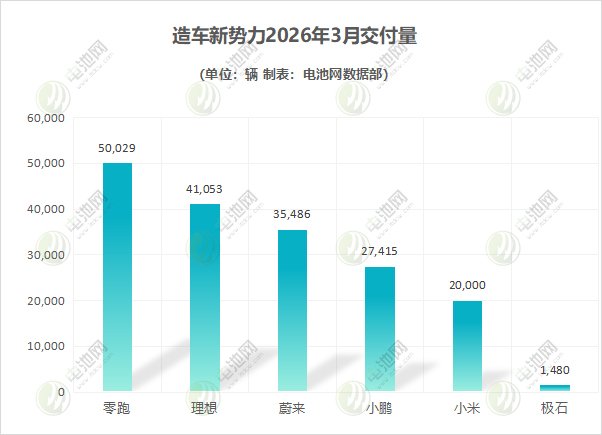
Among them, Leap Motor continued to lead in March this year, with deliveries steadily surpassing the 50,000 mark, delivering 50,029 units across all models, up 35% YoY. On April 9, Leap Motor announced that its Leap C10 model had achieved cumulative global sales of over 260,000 units in the three years since its launch.
Li Auto followed closely behind in deliveries. In March 2026, Li Auto delivered 41,053 new vehicles, up 11.94% YoY. As of March 31, 2026, Li Auto delivered 95,142 units in Q1, with cumulative deliveries reaching 1,635,357 units. As of March 31, 2026, Li Auto had 517 retail centers nationwide, covering 160 cities, and 552 after-sales repair centers and authorized service centers, covering 223 cities. Li Auto had put into use 4,057 Li Auto supercharging stations nationwide, with 22,439 charging piles.
NIO delivered 35,486 new vehicles in March, up 136.0% YoY and up 70.6% MoM. In Q1 2026, NIO delivered a total of 83,465 new vehicles, up 98.3% YoY. As of now, NIO has cumulatively delivered 1,081,057 new vehicles. On March 10, NIO released its Q4 and full-year 2025 financial results, announcing that it achieved an operating profit of 1.25 billion yuan in Q4, marking the company's first quarterly profitability. Cash reserves in Q4 stood at 45.9 billion yuan, up significantly by nearly 10 billion MoM. The Q1 delivery figure announced today exceeded the Q1 2026 delivery guidance (80,000–83,000 units).
In March 2026, XPeng Motors delivered a total of 27,415 new vehicles, up 80% MoM. During the month, XPeng X9 delivered 3,075 units, surging 134% YoY, with cumulative global deliveries exceeding 55,000 units. As XPeng's global flagship car model, the XPeng X9 has become the top choice for high-end family seven-seaters, thanks to its ultra-long driving range, the world's first three-row electric tri-fold design, and rear-wheel steering as standard across all trims.
Xiaomi Auto delivered over 20,000 units in March. The new-generation SU7, which began deliveries on March 23, had accumulated over 7,000 units delivered. Previously, Xiaomi Auto announced that it delivered a total of 411,082 units in 2025, up 200.4% YoY. In Q4 2025, it delivered 145,115 units, up 108.2% YoY. In 2025, the Xiaomi SU 7-series ranked first in sales among sedans with a selling price of 200,000 yuan and above in mainland China. As of February 2026, the Xiaomi YU 7-series achieved the top spot in mid-to-large SUV sales in mainland China for seven consecutive months. In 2026, Xiaomi Auto will go all out to achieve the delivery target of 550,000 units.
As for BYD, the leading EV automaker in China, it sold 300,222 units in March, claiming the sales champion title among Chinese automakers. From January to March 2026, BYD Group sold a cumulative 700,463 units, with cumulative ex-China sales of passenger vehicles and pickups reaching 319,751 units, and cumulative new energy vehicle sales exceeding 15.8 million units. Meanwhile, on March 31, BYD's 5,000th flash charging station was officially put into operation at the Jiejia Zui service area on the Qinglan Expressway in Lanzhou, Gansu, marking a milestone in BYD's "Flash Charge China" strategy.
Regarding the auto market in Q1, CAAM stated that auto production and sales declined slightly in Q1, with the decline narrowing compared to January-February, releasing a positive signal. Specifically, the decline in the passenger vehicle market narrowed, commercial vehicle sales maintained growth, NEV popularity remained strong, and auto exports grew rapidly.
Looking ahead to the auto market in April, the CPCA stated that there are 21 working days in April this year, one day fewer than the 22 working days in April 2025, and auto production and sales are expected to continue the slow rebound seen in the previous period. The year 2026 marks the beginning of a gradual phase-out of NEV support policies, and growth pressure was already evident in Q1. However, driven jointly by national consumption promotion policies and corresponding consumption promotion policies across multiple provinces and cities, auto show offline events are expected to fully enliven market sentiment and accelerate the gathering of consumer interest. In Q1, most automakers adopted pre-sale campaigns as a warm-up for new product launches at the Beijing Auto Show. This year's Beijing Auto Show is both a period for the concentrated showcase of new industry technologies and new enterprise products, and a grand event for the auto industry to present new brand images, which is bound to attract widespread public attention. With the surge in private car travel driven by free highway tolls during the Labour Day holiday, rising attention to the auto market from the Beijing Auto Show, and the early release of new models, the car purchase upgrade trend in the April auto market is still expected to perform well. As NEVs continue to achieve high growth, competition in the mid-to-high-end segments is intensifying, while the economy EV market is shrinking sharply. The mid-to-high-end segment is becoming increasingly crowded, and structural growth in the auto market is unable to offset the pressure on overall volume growth.
Looking ahead to Q2, CAAM stated that the policy effects of the program of large-scale equipment upgrades and consumer goods trade-ins and other initiatives are expected to continue to be released, and the Beijing Auto Show is expected to kick off an intensive new product launch cycle, helping to boost market enthusiasm and stimulate auto consumption. However, it should also be noted that the current external environment is complex and volatile, geopolitical conflict risks are rising, raw material and key component prices are fluctuating at highs, enterprise operational pressure is further increasing, domestic demand momentum remains weak, and the industry still faces considerable operational pressure. It is necessary to closely monitor changes in the external environment, effectively respond to various risks and challenges, continue to expand domestic demand, thoroughly address "involution-style" competition, foster a sound market environment, and support the stable operation of the industry.
Cui Dongshu, Secretary General of the CPCA, stated that consumers' purchasing power and consumption enthusiasm have experienced certain fluctuations, and the auto consumer market is facing significant pressure, urgently requiring the introduction of long-term support measures to stabilize market growth, with a particular focus on the area of car popularization to effectively release latent consumer potential. Cui Dongshu expects that the auto market will enter a phase of gradual and slow improvement in Q2, though the recovery process will be relatively slow. The market is expected to gradually enter a stabilization phase in Q3, and the overall auto market in H2 is expected to achieve general stabilization and deliver positive growth.
At the recent hosted by SMM, Shi Jianhua, Vice Chairman of China EV100 and Dean of China EV100 Think Tank Research Institute, mentioned that China's automobile market has entered a cycle of high sales volume but low growth. In 2025, China's auto sales reached 27.302 million units, up 6.7% YoY. It is expected that China's auto market will achieve slight growth in 2026 (around 28 million units), and by 2030, China's auto market will enter a mature development phase with a market size of approximately 30 million units. In terms of NEVs, in 2025, NEV sales (including exports) reached 16.49 million units with a penetration rate of 47.9%. NEV sales (including exports) in 2026 are expected to reach 20 million units with a penetration rate exceeding 55%. By 2030, the NEV penetration rate is expected to reach approximately 70%. For the China market specifically, NEV sales (domestic) in 2025 were 13.875 million units with a domestic penetration rate of 50.8%. In 2026, domestic NEV sales are expected to reach approximately 16-16.5 million units with a domestic penetration rate approaching 60%. By 2030, the domestic NEV penetration rate is expected to approach 75%. He projected that the share of NEV ownership will rise rapidly. NEV ownership is expected to exceed 60 million units in 2026, accounting for approximately 15%, and exceed 120 million units by 2030, accounting for over 30%.