[SMM Analysis] Ternary Cathode Material Exports Remain High in Early 2026

Published: Mar 20, 2026 17:01
It is worth noting that the overall overseas ternary cathode demand outlook for 2026 remains subdued. The U.S. market has been sluggish since the fourth quarter of last year, prompting many overseas manufacturers to place their hopes on the European market.

In February 2026, China's ternary cathode material exports (NCM and NCA combined) totaled 10,800 metric tons, representing a 14% MoM decline but a 76% YoY increase. Among these, NCM exports accounted for 10,600 metric tons, comprising 98% of the total.
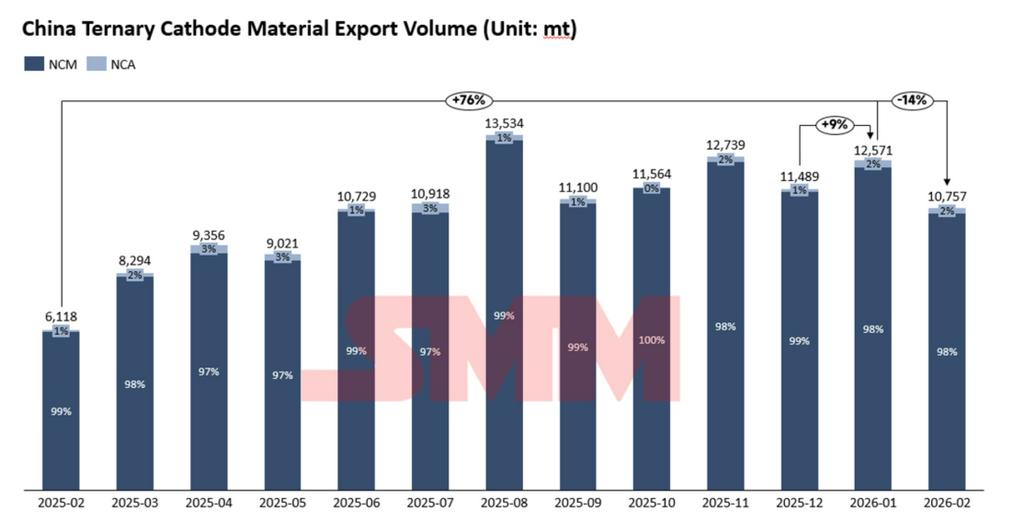
By destination, South Korea remained the largest importer of NCM, with imports reaching 5,147 metric tons in February. Poland and Japan ranked second and third, with imports of 1,490 metric tons and 1,457 metric tons respectively. Additionally, Germany, Malaysia, and Hungary recorded significant YoY increases in import volumes.

In terms of overall export volumes, exports from January to February 2026 remained at historically high levels, similar to the volumes seen in the second half of 2025. The traditional seasonal pattern for overseas ternary cathode demand is typically weaker in the early part of the year and stronger toward year-end. The ability to maintain high export levels in the first quarter of this year is primarily attributed to the impending cancellation of China's 13% VAT rebate on ternary cathode material exports, effective April 1. In anticipation of this policy change, most overseas customers placed orders in advance, bringing forward some demand. Export volumes in the second quarter are expected to decline notably.

It is worth noting that the overall overseas ternary cathode demand outlook for 2026 remains subdued. The U.S. market has been sluggish since the fourth quarter of last year, prompting many overseas manufacturers to place their hopes on the European market. On one hand, several European countries remain committed to the long-term trend of electrification, with many having resumed or extended new energy vehicle subsidy programs. On the other hand, certain policy adjustments may impact EV sales of some automakers in the near term.

For instance, Norway has begun imposing VAT on certain high-priced EVs, marking the end of the universal subsidy era. The UK and France have implemented strict distinctions among automakers eligible for subsidies, favoring domestically produced brands, which has negatively impacted short-term sales of non-European brands exported to these markets. Additionally, the recently proposed IAA presents significant challenges for non-EU suppliers targeting the European market.

While these policy fluctuations may temporarily affect the European sales of some Chinese, Japanese, and Korean automakers, they also encourage these manufacturers to accelerate the development of their production footprints in Europe, thereby facilitating long-term market positioning.
Data Source Statement: Except for publicly available information, all other data are processed by SMM based on publicly available information, market communication, and relying on SMM‘s internal database model. They are for reference only and do not constitute decision-making recommendations.

For any inquiries or to learn more information, please contact: lemonzhao@smm.cn
For more information on how to access our research reports, please contact:service.en@smm.cn
Related News
Capchem's Q1 2026 Net Profit Grows Over 100%
6 hours ago
Capchem's Q1 2026 Net Profit Grows Over 100%
Read More
Capchem's Q1 2026 Net Profit Grows Over 100%
On April 10, Shenzhen Capchem Technology Co., Ltd. released its performance forecast for the first quarter of 2026. The announcement shows that for the period from January 1 to March 31, 2026, the company expects a net profit attributable to shareholders of the listed company of 460 million yuan to 500 million yuan, representing a year-on-year increase of 100.11% to 117.51% compared to 229.8775 million yuan in the same period last year; the net profit after deducting non-recurring gains and losses is expected to be 449.28 million yuan to 489.28 million yuan, a year-on-year increase of 102.48% to 120.51%.
6 hours ago
MGL Plans To Invest 3 Billion Yuan In Lithium Iron Phosphate Integrated Project
6 hours ago
MGL Plans To Invest 3 Billion Yuan In Lithium Iron Phosphate Integrated Project
Read More
MGL Plans To Invest 3 Billion Yuan In Lithium Iron Phosphate Integrated Project
MGL announced that the company plans to sign an investment agreement with the Management Committee of Dazhou High-tech Industrial Park and invest 500 million yuan to establish a wholly-owned subsidiary, Sichuan MGL New Material Technology Co., Ltd., to implement the fourth-generation and beyond lithium iron phosphate integrated project. This project includes two sub-projects: lithium iron phosphate and iron phosphate, both to be constructed in two phases. The lithium iron phosphate sub-project involves a total investment of approximately 1.8 billion yuan, while the iron phosphate sub-project involves a total investment of approximately 1.2 billion yuan, bringing the combined total investment to approximately 3 billion yuan.
6 hours ago
[SMM PV News] QCIL Signs 30 MW Solar PPA to Decarbonize Healthcare Facilities Across India
7 hours ago
[SMM PV News] QCIL Signs 30 MW Solar PPA to Decarbonize Healthcare Facilities Across India
Read More
[SMM PV News] QCIL Signs 30 MW Solar PPA to Decarbonize Healthcare Facilities Across India
[SMM PV News] QCIL Signs 30 MW Solar PPA to Decarbonize Healthcare Facilities Across India
Quality Care India Ltd (QCIL), a top Indian healthcare platform, has partnered with AMPIN Energy and Radiance Renewables to procure solar power for five facilities across Odisha, Chhattisgarh, and Maharashtra. Under a Group Captive model, this initiative marks the first phase of a broader plan to transition 19 hospitals—including CARE Hospitals and KIMS Health—to renewable energy. QCIL is targeting a total renewable capacity of 30 MW, with the initial 6 MWp phase expected to reduce carbon emissions by 8,000 tonnes annually and cut electricity costs by approximately 20%. In the long term, the group aims to meet 80% of its energy needs through a hybrid model combining solar, wind, and battery storage (BESS).
7 hours ago