

News
Exclusive analysis articles with the latest market updates, and real-time news feeds.
DRC Establishes US-DRC Special Working Group to Accelerate Strategic Minerals Partnership
According to foreign media reports, Kinshasa, September 11 — The DRC Cabinet approved the establishment of a DRC-US working group to accelerate the implementation of the bilateral strategic minerals partnership agreement and attract Western investment into the country's copper and cobalt industries. The DRC is the world's largest cobalt producer and the second-largest copper producer and exporter. The two countries signed a minerals cooperation agreement last December, marking the latest move by the country to broaden financing channels and strengthen cooperation with the US. Under the current cooperation framework, Virtus Minerals has already secured US-backed mining investment and is facilitating expanded copper mine cooperation between Gecamines, Mercuria, and Glencore, helping mineral products reach Western markets. The working group was originally scheduled to launch in February this year but was delayed by administrative obstacles, and its members and key projects have not yet been disclosed. The Cabinet meeting also approved a $24.8 billion fiscal budget for 2027, a 12% increase over this year's revised spending, with infrastructure, security, and economic diversification as priority areas.
Sep 21, 2026 10:00 (GMT+8)
[SMM Analysis] China-US Talks Fuel Bullish Sentiment in Pr-Nd Market, But Fundamentals Prevail
On the evening of September 23 (Beijing time) President Xi Jinping arrived in Washington by special plane for a state visit to the United States at the invitation of President Donald Trump, with the trip scheduled through September 25. Earlier, Chinese economic and trade teams had gone to New York to participate in related talks. Within the China‑US economic agenda, rare earths and critical minerals remain one of the most closely watched themes for global supply chains.
Sep 24, 2026 12:34 (GMT+8)
Why Is SHFE Copper’s “Three Highs” Market Intensifying?
Why Is SHFE Copper Entering a High-Premium, High-Backwardation, High-Price Market?
Sep 22, 2026 18:53 (GMT+8)
Latest News
Bauxite Inventory at Ten Domestic Ports Falls by 70,000 mt Wo
7 hours ago

Bauxite Departures from Guinea, Australia Drop
7 hours ago
![[Hunan Yuneng: Spain Project Investment Raised to RMB1.65B]](https://imgqn.smm.cn/usercenter/mzgdV20251217171729.png)
[Hunan Yuneng: Spain Project Investment Raised to RMB1.65B]
7 hours ago
[Enjie: Subsidiary to Acquire 45% of Hubei Enjie for RMB1.15B]
On September 27, Enjie announced that its controlling subsidiary Shanghai Enjie signed an equity transfer agreement with EVE Energy for Hubei Enjie New Material Technology Co., Ltd., and plans to use its own and self-raised funds of RMB1.15 billion to acquire the 45% equity interest held by EVE Energy in Hubei Enjie. After the transaction is completed, Shanghai Enjie will hold 100% equity in Hubei Enjie.
7 hours ago
[Jinyinhé: Plans Private Placement of Up to RMB1.5B]
On September 27, Jinyinhé announced that it plans to issue shares to specific targets to raise no more than RMB1.5 billion. After deducting issuance expenses, the proceeds will be used for high-end intelligent equipment industrialization projects for sodium-ion batteries, consumer lithium batteries, solid-liquid batteries, and new-type energy storage batteries; the R&D and construction project for high-end intelligent equipment for dry electrode and solid-state batteries; the silicon-based materials and polymer materials construction project (Phase I); the R&D and construction project for high-end intelligent equipment for silicone supercritical physical foaming and vacuum thermal reduction of rubidium and cesium metals; and to replenish working capital.
7 hours ago
[Kangpu Chemical: Pilot Plant Produces Lithium Carbonate]
On September 24, Kangpu Chemical released an investor relations activity record. The 100-tonne-level green comprehensive utilization facility for new energy metals, built and put into operation in 2024, adopts the company’s self-developed new hydrometallurgical technology route to achieve efficient extraction and green recovery of new energy metals. The facility can fully validate the recycling process and obtain relevant operational data, accumulating experience for the company in resource recycling. At present, the facility has verified multiple batches of various feedstocks, produced several tonnes of lithium carbonate in the first half of 2026, and achieved external sales.
7 hours ago
[Derui Lithium Battery: Shexi Plant Phase 1 Plans 8 Production Lines]
On September 24, Derui Lithium Battery released an investor relations activity record. The first phase of the Company’s Shexi plant has been planned and built with 8 production lines, including 4 cylindrical and 4 pouch lithium primary battery production lines. After officially commencing trial production and operation in March 2026, and following initial capacity ramp-up, as of the end of June 2026, the monthly production capacity of cylindrical lithium primary batteries at the Shexi plant had exceeded 5 million cells, effectively alleviating the previous capacity constraints for some products. The pouch production line has also completed small-batch trial production and is currently undergoing product testing and verification. The release of new capacity at the Shexi plant will need to proceed gradually in line with market development and order conditions. Investors are advised to be aware of investment risks.
7 hours ago
[Jiayou International: Signs Burundi Spodumene Mine Cooperation Agreement]
On September 24, Jiayou International announced that it had signed a “Burundi Spodumene Mine Cooperation Agreement” with SONALEK MINING COMPANY LTD and SUNTIAL HK LIMITED. As the exclusive logistics service provider, the Company enjoys exclusive sales agency rights for spodumene ore products, with a cooperation term of seven years. This cooperation is an important step for the Company to implement its Africa strategy and deepen its overseas mineral supply chain layout.
7 hours ago
[SMM Analysis] A New Variable in Zimbabwe’s Lithium Mining
7 hours ago
[SMM Analysis] Zimbabwe's Lithium Mine Welcomes a New Investor: India's LOHUM Enters the Fray
7 hours ago
![Gold, silver, and oil fell on the weekly chart, overseas metals broadly declined, LME tin rose over 1%, LME zinc fell nearly 2%, US stocks rose [Holiday Market Review]](https://imgqn.smm.cn/usercenter/gePcx20251217171735.jpg)
Gold, silver, and oil fell on the weekly chart, overseas metals broadly declined, LME tin rose over 1%, LME zinc fell nearly 2%, US stocks rose [Holiday Market Review]
8 hours ago
![[SMM Flash News] Indonesia Names PT CNI Corporate Suspect in Rp401.65 Billion Nickel Governance Case](https://imgqn.smm.cn/usercenter/qLeLR20251217171733.jpg)
[SMM Flash News] Indonesia Names PT CNI Corporate Suspect in Rp401.65 Billion Nickel Governance Case
21 hours ago
![[SMM Coal Flash] India Orders 112 Captive Coal Plants to Maximise Power Output Through Year-End](https://imgqn.smm.cn/usercenter/FGavQ20251217171717.jpg)
[SMM Coal Flash] India Orders 112 Captive Coal Plants to Maximise Power Output Through Year-End
23 hours ago
[SMM Coal Flash] Bayan Resources Lifts Force Majeure as Three Subsidiaries Secure Revised 2026 RKAB
Indonesia’s PT Bayan Resources Tbk (BYAN) has lifted the force majeure previously declared over coal supply obligations after three subsidiaries — PT Tiwa Abadi (TA), PT Tanur Jaya (TJ) and PT Fajar Sakti Prima (FSP) — received full approval for their revised 2026 RKAB from the Ministry of Energy and Mineral Resources (ESDM) on September 23. The approvals allow the three companies to resume preparations for coal mining operations, while Bayan can restart coal transportation and sales. The force majeure had been declared on September 11 after delays in the revised RKAB approvals prevented the subsidiaries from legally continuing production and affected deliveries under their Coal Supply Agreements.
23 hours ago
[JFE Steel expects 600,000-tonne output cut after typhoon damage]
Japan's JFE Steel expects its output to fall by about 600,000 tonnes after heavy rain and Typhoon No. 25 damaged facilities at its East Japan Works in the Chiba area. The company said the impact is likely to be prolonged because the typhoon caused additional damage after August downpours in Chiba. Several facilities were flooded in August; restoration has proceeded with safety first and operations resumed gradually, but blast furnaces have yet to return to normal. Typhoon No. 25 brought further flooding at some facilities there, with repairs under way. JFE said the estimated cut may change with restoration progress and it is still assessing impacts on output and earnings. Some deliveries have been delayed and the company is coordinating with customers to limit supply disruption.
Sep 26, 2026 20:36 (GMT+8)
[India's crude steel output up 4.6% in August as global production declines]
India's crude steel output rose 4.6% y-o-y to 14.8 million tonnes in August, retaining its No.2 global rank, while world output slipped 1.2%, per worldsteel. China stayed first at 74.6 mt, down 3.7%; the US was third at an estimated 7.3 mt, up 3%; Japan made 6.7 mt, Russia 5.5 mt and South Korea 5.4 mt. The 70 reporting countries produced 144.2 mt, about 98% of 2025 world output. In January-August, India's output climbed 6% to 115.9 mt, China's fell 3.1% to 651.9 mt and global output eased 0.7% to 1.225 billion tonnes. Asia and Oceania made 106.7 mt in August, down 1.4%, dragged by China. Vietnam jumped 36.4% to 2.7 mt and Brazil fell 6.2% to 2.7 mt. North America gained 3.9%, Africa 8.8%; West Asia, South America and Russia plus other CIS excluding Ukraine fell 4.6%, 4.9% and 5.6%.
Sep 26, 2026 20:36 (GMT+8)
[Ukraine's steel industry nears collapse as top producers halt output]
Ukraine's top steelmaker, ArcelorMittal Kryvyi Rih, said on Sept 25 it cannot restart production amid surging Russian strikes. The sector has absorbed at least nine ballistic missile attacks since August, costing nearly 100 million USD, per industry body Ukrmetallurgprom. Steel was 7% of Ukraine's GDP. Strikes have damaged blast furnaces and halted pig iron output, forcing Ukraine's three largest producers to suspend operations, the worst year since 2022, when Azovstal and Illich were destroyed and 40% of national output lost. Closed Black Sea ports block trade, rail and Polish/Romanian routes lift coal freight costs 50-60%, and June EU tariffs plus CBAM curb European sales. Even with 51 nations backing Black Sea trade at the UN Sept 23, restarting output needs months and tens of millions of dollars.
Sep 26, 2026 20:36 (GMT+8)
[EU Draft Waste Shipment List Excludes India, Malaysia, Thailand from Metal Scrap Imports]
The European Commission on 18 September published a draft list of non-OECD states eligible to receive certain non-hazardous waste under the EU Waste Shipment Regulation, excluding India, Malaysia and Thailand from ferrous and non-ferrous scrap imports. The Bureau of International Recycling and Recycling Europe objected, warning of severe market disruption. India's MRAI told the Ministry of Commerce and Industry that EU-to-India scrap flows could halt from 21 May 2027, calling the plan a trade barrier and resource protectionism, with CBAM pushing European steel and aluminium producers to retain scrap. India last year imported about 2.03 million tonnes of aluminium scrap, 0.47 million tonnes of copper and copper alloy, 0.21 million tonnes of lead and 0.11 million tonnes of zinc; the EU supplied 20%, 22%, 20% and 40%. Ferrous and stainless scrap imports hit 8.45 million tonnes, of which 0.79 million tonnes came from the EU.
Sep 26, 2026 20:36 (GMT+8)
[OECD: global steel excess capacity to reach 721 million tonnes by 2027]
Global steel excess capacity will grow from 601 million tonnes in 2024 to 721 million tonnes by 2027, the OECD warns, curbing low-emission investment. While 25.8 million tonnes of BF-BOF capacity is to close in 2025-2027, including 15.6 million tonnes in China, new BF-BOF capacity of 62.1 million tonnes, mainly in China and India, far outweighs it; only 6.9 million tonnes (27%) of closures come with on-site EAF, as market weakness, not decarbonisation, drives closures. Planned additions of 30.7 million tonnes of DRI-EAF and 61.7 million tonnes of scrap EAF capacity reflect feedstock and energy advantages, with only 19 million tonnes tied to low-emission goals. By Q2 2025, 15.5 million tonnes of low-emission projects were suspended or postponed; Europe's green premium widened from 17% to 25%.
Sep 26, 2026 20:35 (GMT+8)
Nigeria woos German OEMs to revive its steel industry
Nigeria's Ministry of Steel Development hosted a delegation of German original equipment manufacturers (OEMs) led by Chux Onaa, head of the VDMA German OEMs group, in Abuja, focusing on mineral processing, equipment manufacturing, technology transfer and local industrial value chains. Minister of Steel Development Shuaibu Audu said the engagement aims to turn earlier Nigeria-Germany talks at the 9th German-African Economic Forum in Dortmund into concrete investment and industrial partnerships. Priority areas listed include deploying modern technology, equipment manufacturing and supply, mineral processing, steel production, engineering services, capacity building and technology transfer; German OEMs are invited to join ongoing and emerging steel and metallurgical projects, cutting reliance on imported equipment and technology. Permanent Secretary Nura Abba Rimi said the move aligns with the government's Renewed Hope Agenda, under which President Bola Tinubu created the ministry to speed up the sector's revitalisation. Nigeria seeks to expand manufacturing, create jobs, deepen local mineral processing and diversify away from crude oil.
Sep 26, 2026 20:35 (GMT+8)
Huawei Pursues Africa Green‑Mining Partnerships and Holds Business Talks with ZESCO at SMM ACM 2026
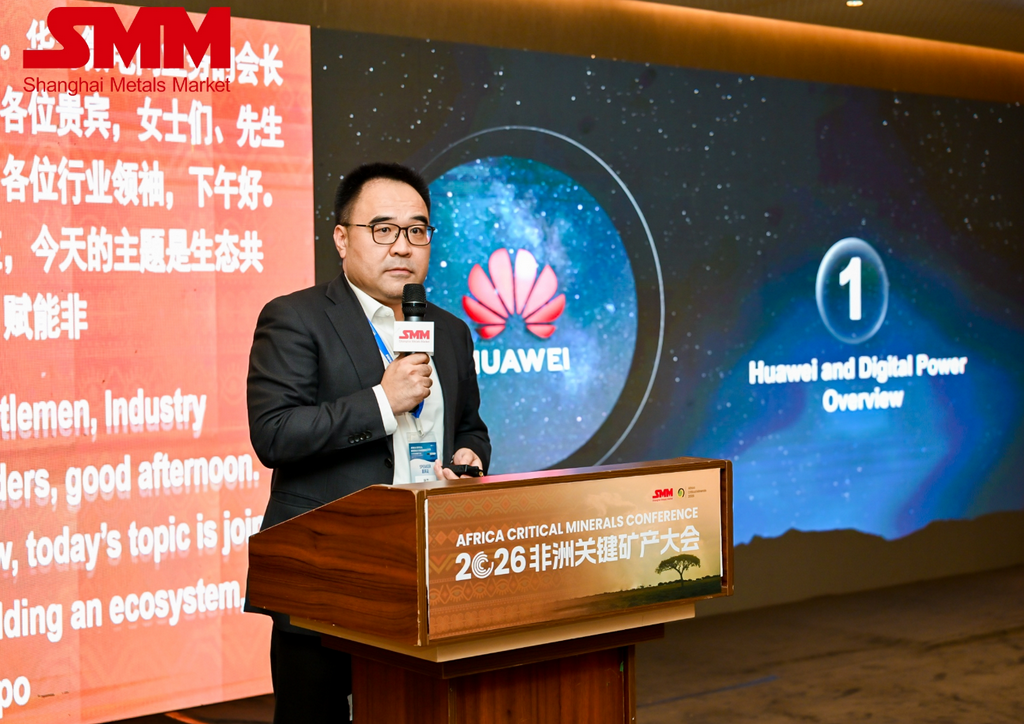
The SMM Africa Critical Minerals Conference 2026 (ACM2026) , hosted by Shanghai Metals Market (SMM), wrapped up with great success in Lusaka, Zambia on September 15‑16. Focusing on the development of strategic minerals such as copper, cobalt, lithium, and tin in Africa, local deep-processing transformation, green mine construction and energy infrastructure upgrading, this premium event has brought together 400+ industry representatives from Chinese and African government agencies, top miners, commodity traders, investors, and technical service providers to jointly explore high-quality development paths for Africa's critical minerals industry chain. Huawei presented its mine microgrid solution at this conference. Joseph Yao, President of Mining Micro-Grid Business at Huawei Digital Power , delivered a keynote speech titled "Eco‑Partnerships for Green African Mines: Huawei's Mine Microgrid Practices under the IPP‑PPA Model". Huawei's delegation also held business talks with ZESCO, Zambia's national power utility, covering mine energy supply, new‑energy deployment and collaborative power‑infrastructure build‑out. As the global energy transition continues to advance, the new energy industry is steadily boosting demand for critical minerals such as copper and cobalt. Africa is rich in strategic mineral resources and is accelerating its upgrade from exporting mineral raw materials to a high-value-added industry chain encompassing local smelting and deep processing. Mines, as power-intensive sites, require stable and low-cost green power supply, which has become a core factor constraining the implementation of mining projects and the release of capacity in Africa. Leveraging the IPP-PPA (independent power producer investment + long-term power purchase agreement) cooperation model, distributed new energy microgrids can provide reliable power nearby for open-pit mines and smelter sites, helping mines reduce electricity costs and carbon emissions, and supporting the implementation of Zambia's strategy for local copper ore processing. (Joseph Yao, President of Mining Micro-Grid Business at Huawei Digital Power) Joseph Yao shared an overview of Huawei and its Digital Energy business, introducing Huawei as a leading provider of ICT infrastructure and smart terminals, a technology-driven enterprise with operations across many countries worldwide, focusing on core business segments such as smart PV and grid-forming ESS. He noted that Africa's mining sector is generally plagued by power shortages. High diesel costs erode mine profit margins, unstable power supplies risk production disruptions, while ESG requirements also impose constraints on mineral exports. He proposed a three-step path for the sustainable development of African mining: Firstly, supply green electricity to mines through digital energy infrastructure to reduce carbon emissions; Secondly, electrification transition of mining equipment; Thirdly, reshape production processes through AI platforms and intelligent management systems, optimize equipment scheduling, and improve mine capacity and production efficiency. He also highlighted Huawei's mine microgrid system. Rather than a standalone piece of equipment, it is a complete energy solution integrating photovoltaic‑storage systems, intelligent dispatching, diesel backup power supplies, control systems and management software. It breaks the conventional single‑power‑source model to enable energy self‑sufficiency and efficient energy management at mining sites. Citing the large‑scale microgrid project for Saudi Arabia's Red Sea Global as a case study, he explained that this city‑level microgrid achieved major technical breakthroughs underpinned by Huawei's robust in‑house R&D capabilities and power‑simulation laboratories. Huawei possesses independent R&D capacity for core power‑electronic components such as IGBTs, and delivers one‑stop services covering design, simulation and project delivery. Together with ecosystem partners, it also provides full‑lifecycle engineering consultation and on‑site implementation support. The successful delivery of this project has laid a solid foundation for microgrid deployment in mining scenarios. He specifically addressed the widespread funding pain points confronting African mining projects. Under the IPP‑PPA ecosystem model, domestic and international investors can be brought in to finance mine‑energy projects. Mining companies, as power purchasers, sign long‑term power‑purchase agreements to secure stable mine operations, while investors obtain steady returns, forming a sustainable commercial closed‑loop. In his speech, Joseph cited several African mine microgrid implementation cases. Among them, after the completion of the Kamoa-Kakula mining microgrid project in the DRC, green electricity will replace a large amount of diesel power generation, significantly reducing mine electricity costs and carbon emissions, and delivering a good return on investment. For this Chinese-funded miner's copper mine project in the DRC, microgrid upgrades sharply reduced electricity costs and significantly improved the mine's capacity utilization rate, verifying the practical value of green electricity microgrids in African mine scenarios. He summarized Huawei's three core capabilities: a globalized business platform, end-to-end one-stop microgrid solutions, and a diverse ecosystem partner system that includes investors, EPCs, and design consulting agencies. He added that Huawei is looking forward to establishing partnership with more investors to develop energy projects across Zambia and wider Africa, secure power supplies for critical‑mineral industries including copper and lithium, jointly foster green mines in Africa, and build a low‑carbon and sustainable industrial future. During the conference, the Huawei delegation held a business meeting with representatives from Zambia's national power utility ZESCO. Against the backdrop of accelerating green transformation in African mining and continuously growing power demand in mining areas, the two sides exchanged views on topics of common concern such as power infrastructure construction and new energy support, and expressed their intention to jointly explore potential areas for cooperation. Africa's mineral industry is at a critical window for industry chain upgrading. Huawei, drawing on its technological strengths in new energy and smart power, will partner with IPP investors, local power authorities and mining operators to build an open‑cooperation ecosystem. Leveraging its proven mine microgrid solutions, Huawei aims to deliver green, reliable power supplies for African mining and smelting projects, advance the low‑carbon transition of Africa’s critical minerals industry, and deepen practical China‑Africa cooperation across the mining and energy sectors.
Sep 23, 2026 16:41 (GMT+8)
![[SMM Analysis] China’s Shifting Tungsten Trade Landscape: A Strategic View](https://imgqn.smm.cn/usercenter/eThpo20251217171723.jpeg)
[SMM Analysis] China’s Shifting Tungsten Trade Landscape: A Strategic View
Sep 23, 2026 09:13 (GMT+8)
![[SMM Analysis] A Snapshot of Zambia’s Gold Market: From Mine Output to Formal Trade](https://imgqn.smm.cn/usercenter/nQsOk20251217171736.jpg)
[SMM Analysis] A Snapshot of Zambia’s Gold Market: From Mine Output to Formal Trade
Sep 23, 2026 16:23 (GMT+8)
![Canada Lifts Solar Trade Duties: Can Chinese Modules Win a Bigger Share? [SMM Analysis]](https://imgqn.smm.cn/usercenter/VqcvE20251217171739.jpg)
Canada Lifts Solar Trade Duties: Can Chinese Modules Win a Bigger Share? [SMM Analysis]
Sep 21, 2026 18:03 (GMT+8)
DRC Establishes US-DRC Special Working Group to Accelerate Strategic Minerals Partnership
Sep 21, 2026 10:00 (GMT+8)
![[SMM Analysis] China-US Talks Fuel Bullish Sentiment in Pr-Nd Market, But Fundamentals Prevail](https://imgqn.smm.cn/usercenter/PVQnj20251217171744.jpg)
[SMM Analysis] China-US Talks Fuel Bullish Sentiment in Pr-Nd Market, But Fundamentals Prevail
Sep 24, 2026 12:34 (GMT+8)
Why Is SHFE Copper’s “Three Highs” Market Intensifying?
Sep 22, 2026 18:53 (GMT+8)
Latest News
Bauxite Inventory at Ten Domestic Ports Falls by 70,000 mt Wo
7 hours ago
Bauxite Departures from Guinea, Australia Drop
7 hours ago
[Hunan Yuneng: Spain Project Investment Raised to RMB1.65B]
7 hours ago
[Enjie: Subsidiary to Acquire 45% of Hubei Enjie for RMB1.15B]
7 hours ago
[Jinyinhé: Plans Private Placement of Up to RMB1.5B]
7 hours ago
[Kangpu Chemical: Pilot Plant Produces Lithium Carbonate]
7 hours ago
[Derui Lithium Battery: Shexi Plant Phase 1 Plans 8 Production Lines]
7 hours ago
[Jiayou International: Signs Burundi Spodumene Mine Cooperation Agreement]
7 hours ago
[SMM Analysis] A New Variable in Zimbabwe’s Lithium Mining
7 hours ago
[SMM Analysis] Zimbabwe's Lithium Mine Welcomes a New Investor: India's LOHUM Enters the Fray
7 hours ago
Gold, silver, and oil fell on the weekly chart, overseas metals broadly declined, LME tin rose over 1%, LME zinc fell nearly 2%, US stocks rose [Holiday Market Review]
8 hours ago
[SMM Flash News] Indonesia Names PT CNI Corporate Suspect in Rp401.65 Billion Nickel Governance Case
21 hours ago
[SMM Coal Flash] India Orders 112 Captive Coal Plants to Maximise Power Output Through Year-End
23 hours ago
[SMM Coal Flash] Bayan Resources Lifts Force Majeure as Three Subsidiaries Secure Revised 2026 RKAB
23 hours ago
[JFE Steel expects 600,000-tonne output cut after typhoon damage]
Sep 26, 2026 20:36 (GMT+8)
[India's crude steel output up 4.6% in August as global production declines]
Sep 26, 2026 20:36 (GMT+8)
[Ukraine's steel industry nears collapse as top producers halt output]
Sep 26, 2026 20:36 (GMT+8)
[EU Draft Waste Shipment List Excludes India, Malaysia, Thailand from Metal Scrap Imports]
Sep 26, 2026 20:36 (GMT+8)
[OECD: global steel excess capacity to reach 721 million tonnes by 2027]
Sep 26, 2026 20:35 (GMT+8)
Nigeria woos German OEMs to revive its steel industry
Sep 26, 2026 20:35 (GMT+8)